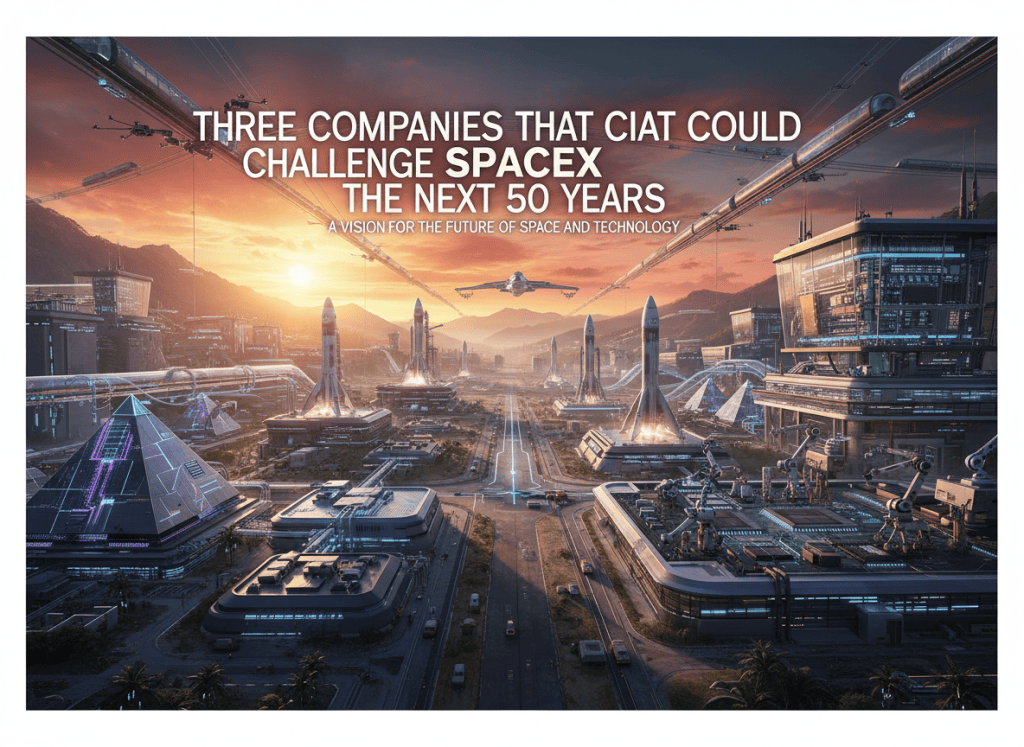
SpaceX has built an unusually broad position across reusable launch vehicles, spacecraft, satellite communications and human spaceflight. A 50-year horizon, however, is long enough for today’s competitive landscape to change dramatically. Three companies stand out as plausible long-term challengers for different reasons: Blue Origin, Rocket Lab and Amazon. The selection is an analytical scenario rather than a prediction, based on demonstrated space hardware, vertical integration, capital access and infrastructure that could compound over decades.
1. Blue Origin: The Direct Heavy-Lift Challenger
Blue Origin is the most direct candidate because it is already developing many of the same fundamental capabilities that define a large space transportation company. New Glenn reached orbit on its first mission in January 2025. Blue Origin says the vehicle supports commercial, civil and national-security missions, while its broader roadmap includes Blue Moon lunar landers, Blue Ring orbital systems and sustained lunar operations.
The company is also expanding physical infrastructure. Blue Origin announced construction of a second New Glenn pad, LC-36B, for its larger 9×4 configuration and additional payload-processing infrastructure. In September 2026, Blue Origin also expanded a research partnership with the Air Force Research Laboratory covering advanced rocket propulsion technology. Those investments matter because sustained competition with SpaceX would require more than a single successful rocket. It would require engines, manufacturing, launch cadence, reusable vehicles, government customers and infrastructure operating together as a system.
2. Rocket Lab: The Vertical Integration Path
Rocket Lab represents a different competitive model. Electron established the company in small launch, but Rocket Lab has increasingly expanded into spacecraft, satellite components and larger launch systems. The company reported record second-quarter 2026 revenue of $234 million and a record backlog of $2.36 billion. It also reported more than 90 launches in its launch backlog while continuing development of the reusable medium-lift Neutron rocket.
Rocket Lab’s long-term significance may come from vertical integration rather than rocket size alone. The company has been assembling launch vehicles, spacecraft manufacturing, components, optical communications and satellite operations under one corporate structure. Its announced agreement to acquire Iridium would push that model further toward a company capable of building spacecraft, launching them and operating communications infrastructure. If that strategy succeeds over decades, Rocket Lab could compete across more of the space-industry value chain rather than functioning only as a launch provider.
3. Amazon: The Capital and Constellation Wild Card
Amazon is the unconventional selection. Amazon is not primarily a rocket manufacturer, but Amazon Leo has already made the company a substantial satellite operator. Amazon reported in 2026 that its low-Earth-orbit network had deployed nearly 400 satellites and secured more than 100 launches. The company also committed more than $200 million to launch-support infrastructure at Cape Canaveral.
Amazon’s strategic advantage is the combination of satellite communications with a much larger technology ecosystem. Over several decades, cloud computing, ground infrastructure, networking, logistics, satellite manufacturing and communications could become increasingly interconnected. Amazon does not currently have an orbital launch vehicle of its own, so any scenario in which it becomes a comprehensive SpaceX competitor would require major additional investment, acquisitions or partnerships. The existing constellation nevertheless gives Amazon a real operational foothold in space rather than a purely hypothetical one.
Why 50 Years Changes the Question
Space competition in 2076 is unlikely to be determined only by which company builds the best rocket in 2026. Launch cost, manufacturing rate, reusable propulsion, satellite networks, orbital computing, lunar infrastructure, autonomous robotics, energy systems and access to capital could all become important. Blue Origin currently offers the clearest direct heavy-lift comparison, Rocket Lab is building a vertically integrated space stack, and Amazon possesses a large technology and capital base attached to an operating satellite constellation.
None of those paths guarantees that a company will surpass SpaceX. Fifty-year corporate forecasts contain enormous uncertainty, and companies that do not yet exist could eventually become larger competitors than any company operating today. The more defensible conclusion is that the industry has several credible foundations from which a second or third large-scale space platform could emerge.
Sources
- Blue Origin: New Glenn Reaches Orbit
- Blue Origin: Launch Complex 36 Expansion
- Blue Origin: AFRL Propulsion Partnership
- Rocket Lab: Q2 2026 Results
- Amazon: Amazon Leo Launch Expansion
BitcoinVersus.Tech Editor’s Note:
We volunteer daily to ensure the credibility of the information on this platform is Verifiably True. If you would like to support to help further secure the integrity of our research initiatives, please donate here: 3C9o19EH5HSiwEPyCTmEKzxhNCbo2X6TTb


Leave a Reply