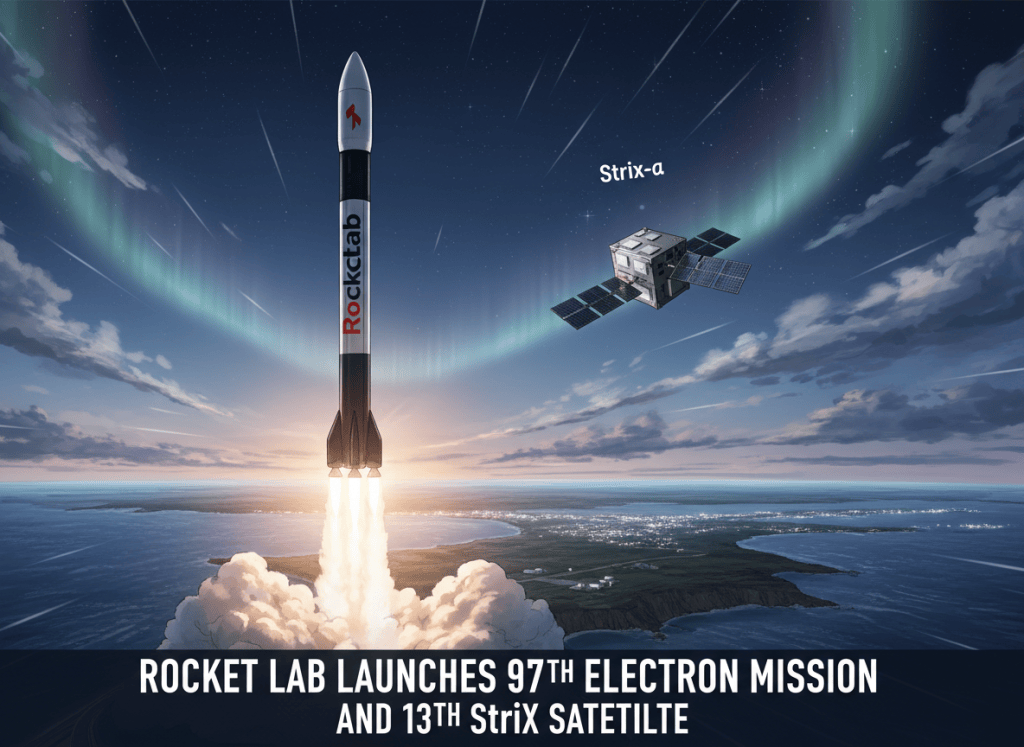
Rocket Lab has completed its 97th Electron mission, delivering Synspective’s 13th StriX synthetic aperture radar satellite into a 559-kilometer low Earth orbit.
The mission, called “Owlright Owlright Owlright,” lifted off from Rocket Lab Launch Complex 1 in New Zealand on September 26. Rocket Lab said it was the company’s 18th launch of 2026 and its 13th dedicated Electron launch for Japanese Earth-observation company Synspective.
StriX expands an all-weather radar network
StriX satellites use synthetic aperture radar, or SAR, rather than conventional optical cameras. Radar allows the spacecraft to collect Earth-imaging data during the day or night and through cloud cover. Synspective uses the constellation for applications including infrastructure monitoring, urban planning and disaster response.
Electron approaches 100 launches
The flight brings Electron within three missions of its 100th launch. Rocket Lab says all 13 StriX satellites it has launched for Synspective have been successfully deployed. Another 14 dedicated missions are scheduled to continue building the constellation through the end of the decade.
The mission also highlights the hardware behind modern Earth observation. Electron is a small orbital launch vehicle, while StriX combines radar electronics with a deployable antenna system to produce high-resolution observations from orbit. The latest spacecraft was deployed at a 37-degree inclination.
A high launch cadence in 2026
Rocket Lab’s 18 launches this year include Electron orbital missions and HASTE suborbital missions. The company continues to expand its launch and space-systems businesses while developing its larger reusable Neutron rocket.
Sources
BitcoinVersus.Tech Editor’s Note
BitcoinVersus.Tech reports on Bitcoin, mining hardware, artificial intelligence, data centers, semiconductors, energy, robotics and emerging technology.
Related BitcoinVersus.tech coverage: Astra Space comeback · Google AI chips in space · SpaceXAI Colossus expansion · Three SpaceX challengers


Leave a Reply