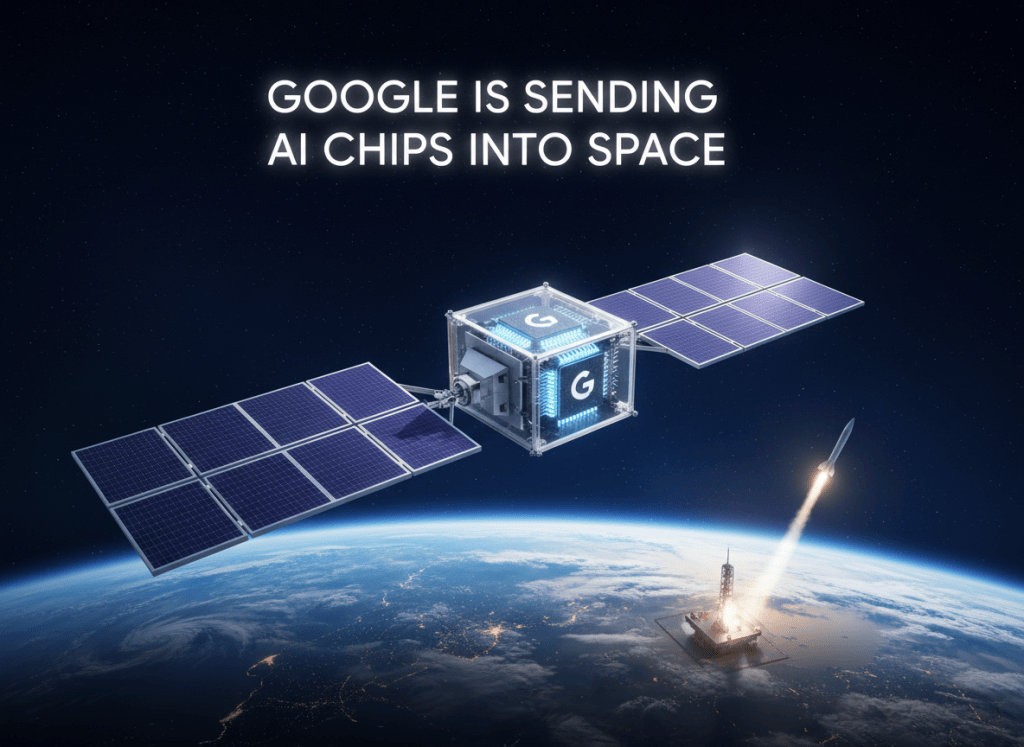
Google is preparing to take technology normally found inside data centers and put it into orbit.
On October 1, Google’s Project Suncatcher is scheduled to send a prototype satellite into low Earth orbit carrying four of the company’s Tensor Processing Units, or TPUs. The mission will test whether Google’s AI hardware can survive launch, radiation and the thermal conditions of space.
Why This Matters
The idea is simple: AI needs enormous amounts of electricity, while satellites can receive near-constant sunlight. Google says satellites in the right low Earth orbit could generate up to eight times more solar power than comparable panels on Earth.
If engineers can eventually connect many AI-equipped satellites, some computing infrastructure now built in enormous terrestrial data centers could theoretically move into orbit. This first mission is much smaller. It is an engineering experiment designed to answer a basic question: can Google’s AI chips reliably operate in space?
Google Has Already Stress-Tested the Chips
A rocket launch creates conditions that conventional server hardware never experiences. Google says individual components can experience forces of 50 to 100 times gravity, so engineers subjected the satellite hardware to intense vibration testing.
Radiation is another problem. Google tested its Trillium TPUs with a proton beam at UC Davis’s Crocker Nuclear Laboratory. The company says its initial testing showed the processors could tolerate a radiation dose greater than what they would be expected to receive during a five-year space mission.
AI’s Power Problem Is Getting Bigger
The experiment arrives as technology companies spend heavily on AI data centers, electrical infrastructure and specialized processors. Those facilities require electricity, land, cooling systems, substations and grid connections.
Project Suncatcher explores a different architecture. Instead of bringing more electricity to AI computers on Earth, engineers could eventually bring some computers closer to a powerful energy source: the Sun.
Space Creates New Problems Too
Orbit does not eliminate the engineering challenges. Launching hardware is expensive, repairing equipment is difficult and processors still generate heat. Because space is a vacuum, engineers cannot cool chips by simply moving air across them. Google is testing heat pipes and radiators to move heat away from its TPUs.
The upcoming satellite is not a full orbital data center. It carries four TPUs and is meant to gather real-world engineering data. Google says future work will include testing high-bandwidth laser links between satellites in 2027.
The first launch is therefore a small satellite testing a much bigger idea. If the hardware works, Google will have evidence that AI processors can operate beyond Earth. The much harder question will be whether thousands of processors can someday operate together in orbit economically and reliably.
Related BitcoinVersus.tech coverage: Rocket Lab Electron mission · Astra Space comeback · SpaceX challengers · SpaceXAI Colossus
BitcoinVersus.Tech Editor’s Note: We volunteer daily to help ensure the credibility of information on this platform is verifiably true. BitcoinVersus.tech is not a financial advisor. This article is independent reporting and educational content for informational purposes only.


Leave a Reply