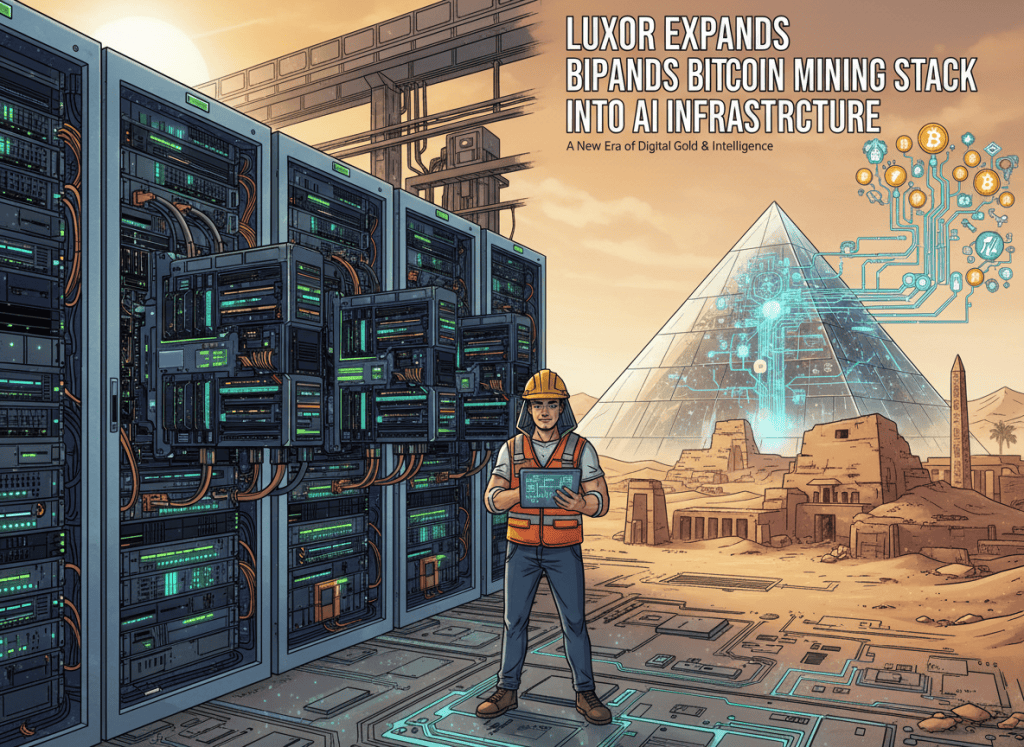
Luxor Technology is taking the infrastructure stack it built for Bitcoin mining and expanding it into artificial intelligence data centers. The company launched Luxor AI on September 24, bringing energy services, GPU sourcing, physical compute contracts, compute derivatives, cloud infrastructure and market data under one business.
The move is notable because Luxor is not abandoning Bitcoin mining. Its existing mining business still includes a mining pool, LuxOS firmware, ASIC hardware trading, Commander fleet management, energy services and hashrate derivatives. Instead, Luxor is attempting to reuse the operational and financial systems developed for ASIC data centers in the GPU market.
$1 billion of ASIC trading becomes a GPU supply business
Luxor says its hardware brokerage desk has traded about $1 billion of Bitcoin mining ASIC hardware. Under Luxor AI, that operation is expanding into GPUs and AI servers through OEM and distribution relationships. The company also operates as a licensed freight forwarder and Non-Vessel Operating Common Carrier, giving the hardware business a logistics component in addition to brokerage.
That is a different path into AI than the one being taken by many publicly traded miners. Rather than converting one large mining campus into a hyperscale GPU facility, Luxor is selling infrastructure services to operators across both compute markets.
Luxor Energy already services more than 75 MW
Power is another bridge between the two industries. Luxor says Luxor Energy currently services more than 75 MW of load and operates in ERCOT and SPP. The business supplies electricity and helps data centers participate in demand response, economic curtailment and other grid programs.
Those capabilities grew out of Bitcoin mining, where operators routinely adjust ASIC load as electricity prices and grid conditions change. Luxor and Bentaus demonstrated in August that a liquid-cooled GPU workload could also respond to an ERCOT 4CP signal, cutting power draw to roughly 25% in under half a second without interrupting the inference workload.
Mining software meets AI compute markets
Luxor AI also includes physical compute offtake contracts and an internal compute trading fund. The company is offering over-the-counter cash-settled derivatives tied to compute-rental indexes, including forwards and options. The idea resembles financial products Luxor already operates around Bitcoin hashrate, but the underlying commodity is GPU compute capacity.
Tenki Cloud adds the software layer. Luxor says the platform has handled 1.8 million workloads year to date and provides GitHub Actions runners, isolated sandboxes for AI agents and automated code review. Luxor says the services run on bare-metal infrastructure it owns.
Bitcoin mining remains part of the stack
The launch is another example of Bitcoin mining infrastructure moving into the wider compute economy, but it is not simply a mining shutdown. Luxor continues to sell and manage ASIC hardware and operate Bitcoin-focused software and financial products while building a parallel AI business.
For miners, the important question is whether expertise in power markets, fleet management, hardware logistics and compute trading transfers effectively from specialized SHA-256 machines to GPU clusters. Luxor is now putting that thesis into production.
Sources
BitcoinVersus.Tech Editor’s Note
BitcoinVersus.Tech reports on Bitcoin, Bitcoin mining hardware, data centers, semiconductors, energy and emerging technology. Support independent reporting with Bitcoin: 3C9o19EH5HSiwEPyCTmEKzxhNCbo2X6TTb.
Follow BitcoinVersus.Tech on X: BitcoinVersus.Tech on X.
Financial disclaimer: This article is for informational and educational purposes only and is not financial, investment, legal or tax advice. Bitcoin and publicly traded securities can be volatile. Readers should conduct their own research before making financial decisions.
Related BitcoinVersus.tech coverage: Luxor mining into AI · Cango mining site AI GPUs · Soluna Bitcoin-to-AI campus · Bitdeer AI expansion


Leave a Reply