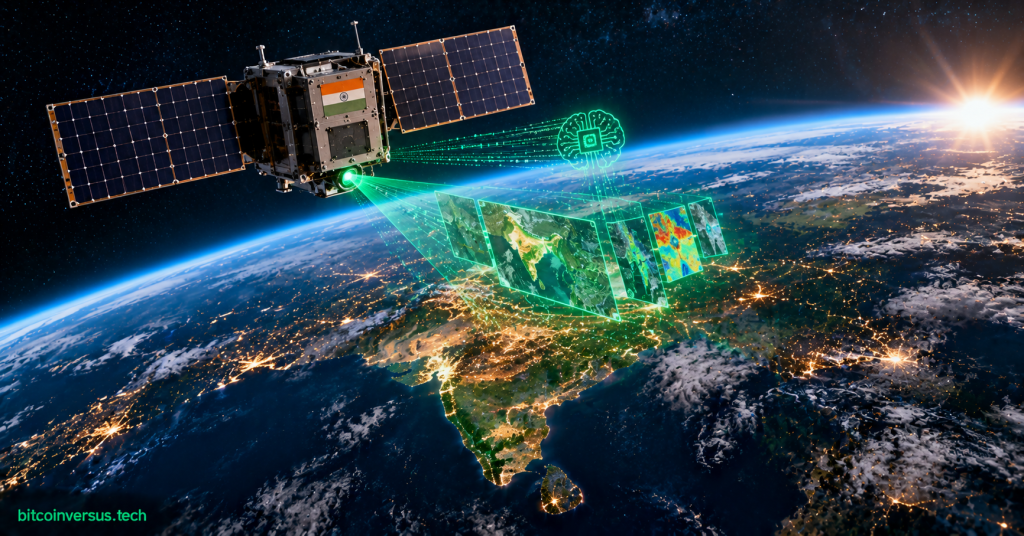
India now has an AI computer riding above Earth instead of waiting for satellite imagery to reach a terrestrial data center.
TakeMe2Space’s MOI-1A reached orbit aboard SpaceX’s Transporter-18 mission, carrying an NVIDIA Jetson Orin NX, 16 GB of memory, 2 TB of onboard storage and a nine-band multispectral imager. The point is not simply to take pictures from space. It is to run customer AI models against those images while the data is still in orbit and send back the useful result instead of the entire raw dataset.
A Transporter-18 status on X highlighted MOI-1A among the mission’s unusually compute-heavy payloads alongside Google’s Project Suncatcher and other orbital infrastructure experiments.
117 TOPS in a 14-kilogram spacecraft
TakeMe2Space lists MOI-1A at roughly 14 kilograms with 117 TOPS of onboard compute, 2 TB of storage and about 120 watts of peak power. Its official technical description identifies the compute module as an NVIDIA Jetson Orin NX protected for the low-Earth-orbit radiation environment.
That makes MOI-1A closer to an edge-computing node with a camera than a conventional communications satellite. A customer can upload a containerized AI workload, have the satellite inspect imagery during a pass, and receive the resulting inference rather than paying to downlink every pixel first.
The bandwidth problem is the business model
Earth-observation satellites can generate far more raw data than is practical to continuously transmit. If an agriculture customer only needs to know where crop stress appears, or a mining customer only needs specific changes identified, transmitting the answer can be dramatically cheaper than transmitting every underlying image.
Reuters reported that TakeMe2Space signed 23 customers for the mission across agriculture, mining, supply chains, insurance, geospatial analysis and education. The company’s thesis is straightforward: avoided raw-data downlink costs can offset the premium customers pay for compute in orbit.
This is not an orbital hyperscale data center
The distinction matters. MOI-1A operates at roughly a hundred watts, not megawatts. It is an edge computer positioned next to the sensor producing the data. Calling it a full terrestrial-style data center would obscure what makes the design practical.
That separates it from the larger orbital-compute concepts BitcoinVersus has been tracking. Google is testing AI chips in space as part of its own orbital-compute research, while the industry explores whether larger clusters can eventually move above the atmosphere.
Transporter-18 is turning into an orbital infrastructure laboratory
MOI-1A did not fly alone. The same rideshare mission carried multiple experiments aimed at changing what satellites do after launch. BitcoinVersus recently covered Cowboy Space’s Reason-1 laser power-beaming mission, which is testing optical and thermal technologies for a much larger vision of orbital computing.
Another branch of the idea is even more Bitcoin-native. Starcloud has discussed putting Bitcoin-mining ASICs in space, where continuous solar exposure and unconventional thermal engineering could eventually create a radically different mining environment.
MOI-1A still has to prove the compute
Reaching orbit is not the same as completing the commercial mission. The spacecraft still has to commission successfully, operate its imaging and compute pipeline, accept customer workloads and demonstrate that its inference-before-downlink model works reliably enough to save money.
That evidence bar matters because TakeMe2Space’s earlier orbital demonstrator proved important subsystems but did not complete every intended AI-imaging objective. MOI-1A is the next attempt with substantially more capable hardware.
If it works, the important breakthrough will not be that “AI went to space.” It will be that data stopped making a round trip to Earth just to find out which few bytes actually mattered.
BitcoinVersus.Tech
Advertisement
Editor’s Note
The featured artwork is a conceptual illustration, not an on-orbit photograph of MOI-1A. Published hardware specifications are identified as company specifications; successful launch is distinguished from successful commissioning and commercial AI inference.
Support independent BitcoinVersus.Tech reporting with Bitcoin donations at: 3C9o19EH5HSiwEPyCTmEKzxhNCbo2X6TTb
BitcoinVersus.tech is not a financial advisor. This media platform reports on financial subjects purely for informational purposes.


Leave a Reply