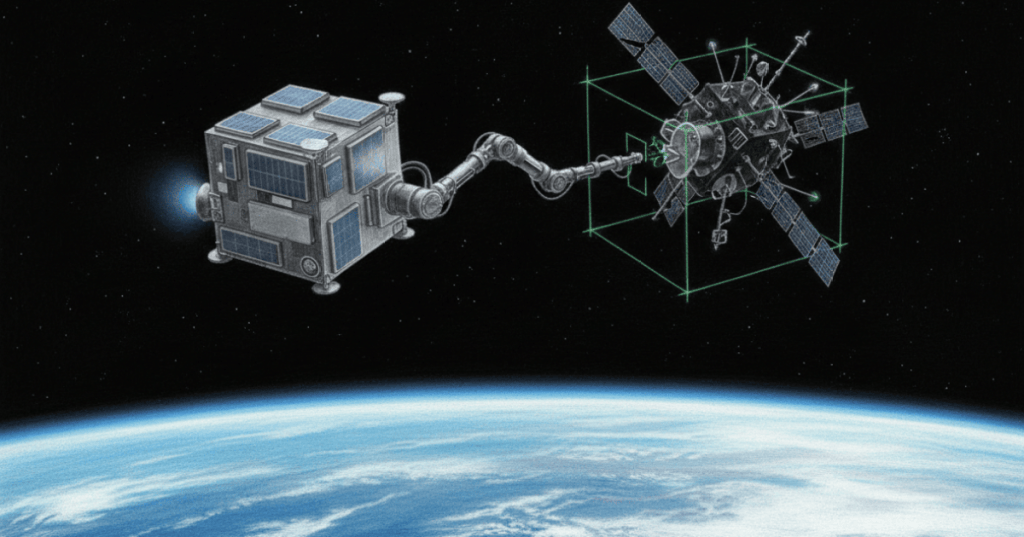
A robot spacecraft is now in orbit with a strange job: fly up to dead satellites, inspect them from close range, and help figure out what should happen to them next.
The spacecraft is Starfish Space’s Otter 24C, flying NASA’s Small Spacecraft Propulsion and Inspection Capability mission—better known as SSPICY. Otter launched October 1 aboard SpaceX’s Transporter-18 rideshare mission from Vandenberg Space Force Base in California.
Otter is built to inspect up to four dead spacecraft
NASA’s October 1 mission update says Otter will inspect as many as four inoperable U.S.-origin objects in low Earth orbit. Rather than immediately touching them, the spacecraft will first approach from a safe distance and collect information about surface condition, geometry and orbital behavior.
The mission is expected to operate for about two years, with close-range inspections beginning in 2027. That gives Starfish time to commission the spacecraft, validate its navigation systems and then begin moving between targets.
Starfish Space marked the milestone in its launch announcement on X, saying the company is moving from years of developing servicing technology to putting full Otter vehicles to work for customers in orbit.
The robot has computer vision, autonomous guidance and a movable thruster boom
The most interesting part of SSPICY is not simply that Otter can move through orbit. It is the stack of technologies it uses to decide how to approach another object without hitting it.
Its CETACEAN navigation system combines computer vision with sensors and stereoscopic imaging to estimate the target’s position and motion. CEPHALOPOD then uses that information to make approach and abort decisions. A multi-joint robotic boom called Manta can redirect thrust, giving the spacecraft more control over how it maneuvers near another object.
Otter also carries Nautilus, a mechanical gripper designed to attach to surfaces and protrusions even when the target satellite was never designed for docking. NASA says docking is not part of the SSPICY inspection objectives, but that hardware points directly toward later servicing, life-extension and disposal missions.
Why dead satellites need a robot inspector
A dead satellite is not necessarily a stable object waiting politely in space. It can tumble, degrade, lose pieces or eventually collide with something else. Before a future vehicle can repair, move or deorbit it, operators need to know exactly what condition it is in.
Ars Technica’s prelaunch look at Otter describes the mission as the first full-scale deployment of the spacecraft after years of smaller rendezvous experiments. Those earlier tests let Starfish develop the autonomous guidance and close-approach software now being pushed into an operational NASA mission.
Transporter-18 is turning into a snapshot of the next space economy
Otter was not alone on the October 1 rideshare. BitcoinVersus.Tech has been following several payloads from the same launch because together they show how quickly low Earth orbit is becoming a working technology layer rather than just a destination.
Cowboy Space launched Reason-1 to test laser power beaming from orbit toward Earth, another example of infrastructure that could eventually support power and compute systems above the atmosphere.
Google’s Project Suncatcher is putting TPU hardware into orbit to study whether AI accelerators can survive radiation and reject heat efficiently in space.
And India’s MOI-1A is testing 117 TOPS of NVIDIA-powered edge compute in orbit, pushing more processing closer to where satellite data is collected.
Spacecraft that fix spacecraft could become basic infrastructure
As orbital networks grow, the economics of throwing away every failed satellite become harder to defend. A future space economy will need inspection, refueling, relocation, life extension and controlled disposal just as terrestrial infrastructure needs maintenance crews.
SSPICY is still an inspection mission, not a cleanup mission. But inspection is the prerequisite for everything that comes after it. A robot has to find the object, understand its motion and approach it safely before anyone can seriously talk about repairing or removing it.
That is what makes Otter interesting. The spacecraft is not just another satellite. It is one of the early attempts to make satellites serviceable by other machines already in space.
BitcoinVersus.Tech
Advertisement
Editor’s Note
We volunteer daily to ensure the credibility of the information on this platform is Verifiably True. If you would like to support to help further secure the integrity of our research initiatives, please donate here: 3C9o19EH5HSiwEPyCTmEKzxhNCbo2X6TTb
BitcoinVersus.tech is not a financial advisor. This media platform reports on financial subjects purely for informational purposes.


Leave a Reply