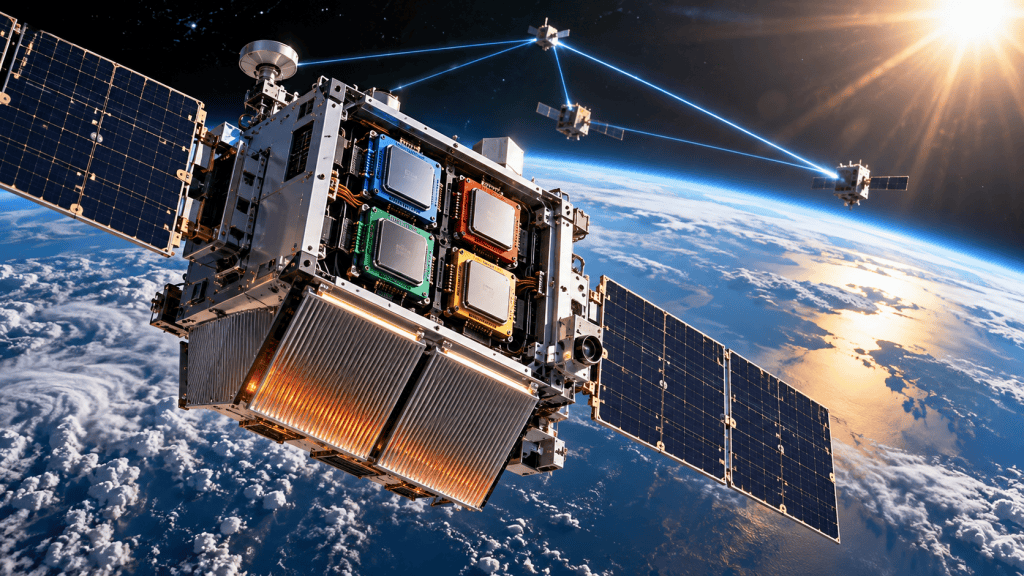
Google is moving Project Suncatcher from a paper exercise toward hardware in orbit. In a new engineering update, Google says a prototype satellite will test Tensor Processing Units under launch vibration, radiation and the unusual thermal constraints of low Earth orbit.
The project is not yet an orbital AI data center. It is a hardware-validation mission designed to answer a narrower question first: can dense AI accelerator hardware survive and operate reliably outside Earth’s atmosphere? Independent reporting describes the same experimental step and the longer-term plan to test high-bandwidth links between satellites.
Google’s public update puts the mission’s immediate objective plainly: send TPUs to orbit and measure how the hardware behaves there.
The first problem is simply keeping the chips alive
Google says the launch environment can subject the spacecraft to sustained acceleration approaching 10 g, while individual components can experience substantially higher forces. Engineers have already vibration-tested the satellite across three axes. Radiation is another constraint: the team exposed Trillium TPUs to a proton beam at UC Davis while running AI workloads, looking for faults such as bit flips.
Those tests matter because orbital compute cannot be serviced like a terrestrial rack. BitcoinVersus.tech recently examined the same maintenance problem in Starcloud’s planned orbital Bitcoin-mining experiment: once hardware is in orbit, board swaps, cable repairs and routine technician interventions become radically harder.
Cooling in a vacuum changes the data-center equation
Space may be cold, but vacuum removes the airflow terrestrial data centers normally use to carry heat away. Project Suncatcher is testing heat pipes and radiators to move energy from the TPU package and reject it as radiation. That makes thermal design a first-class compute constraint rather than an accessory around the server.
That is a useful contrast with Earth-based AI infrastructure. Our GB200 NVL72 rack breakdown shows how cold plates, coolant distribution and facility heat rejection surround modern accelerators, while the recent MaxLINC thermal-interface report shows how engineers are attacking resistance even at the chip-to-cooling boundary.
Y Combinator’s English-language interview with Starcloud CEO Philip Johnston provides useful engineering context on orbital data centers, including heat rejection, radiation and the economics of putting compute hardware in space.
Solar power is the attraction; networking is the harder scale problem
Google estimates that solar panels in favorable orbit can receive up to eight times more solar energy per year than panels at Earth’s mid-latitudes. Instead of transmitting that energy back to Earth, Project Suncatcher’s long-term concept is to put the computation near the energy source.
But useful AI clusters need more than power. Future Suncatcher satellites are envisioned with dozens of TPUs and optical inter-satellite links. Google says the links must deliver very high bandwidth while spacecraft fly in tight formation, demanding precise relative positioning. The company plans a later orbital test involving two satellites to explore that networking problem.
A real experiment, not proof of an orbital hyperscaler
The significance of Project Suncatcher is that several previously theoretical constraints are becoming measurable hardware questions. Radiation errors, thermal performance, launch survivability, solar generation and optical networking can all be instrumented and compared against engineering targets.
Commercial economics remain unresolved. Launch cost, radiator mass, repairability, hardware obsolescence, communications bandwidth and collision management all have to compete with terrestrial data centers whose infrastructure can be serviced and upgraded continuously. BitcoinVersus.tech’s AI data-center infrastructure explainer illustrates how many systems beyond the accelerator itself must operate together to deliver production compute.
The next useful evidence will therefore be telemetry rather than projections: whether the TPUs remain stable after launch, how the thermal system performs in vacuum, what radiation-induced faults appear, and how much sustained compute the spacecraft can actually deliver. Project Suncatcher is best understood as an engineering test that could either strengthen or narrow the case for orbital AI infrastructure.
BitcoinVersus.Tech Editor’s Note: We volunteer daily to help ensure information on this platform is verifiably true. BitcoinVersus.tech reports on technology and financial subjects for informational purposes.
Follow BitcoinVersus.Tech on X for Bitcoin mining, AI hardware, semiconductor and data-center reporting.
Financial-information disclaimer: BitcoinVersus.tech is not a financial advisor. Nothing published here is investment, legal, tax or financial advice. This media platform reports on financial subjects purely for informational purposes.


Leave a Reply