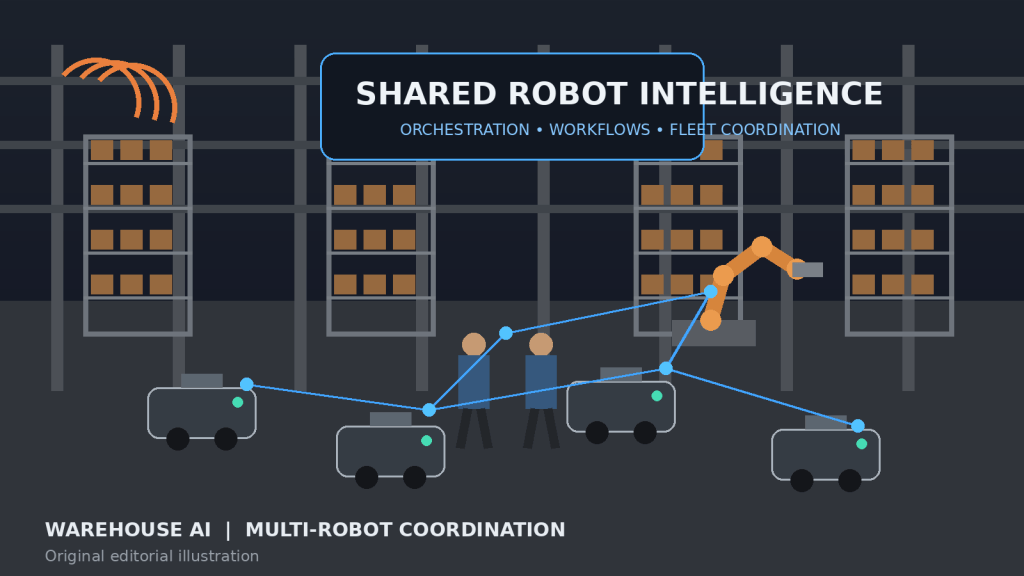
Destro AI has raised $8 million in seed funding to scale a software layer designed to coordinate different warehouse robots, people and workflows as one operating system.
The company announcement says the round was co-led by Base10 Partners and Bonfire Ventures, while independent funding coverage confirms participation from CoFound Partners and says Destro plans to use the capital to expand enterprise deployments plus engineering and research.
The Bet Is on Coordination, Not Another Robot Body
Warehouse automation already includes autonomous mobile robots, robotic arms, forklifts, conveyors, vision systems and human-directed workflows. Destro’s pitch is that the harder problem is increasingly coordination: deciding what should move, who or what should move it, in what order, and how the system should react when real operations diverge from the plan.
That positioning lines up with a broader shift BitcoinVersus.tech has been following across physical-AI robot learning stacks, AMD’s physical-AI push from cloud to robot, Agility’s Digit 5 warehouse humanoid, and Amazon Vulcan bringing touch sensing into warehouse automation.
MothershipOS Coordinates the Floor
Destro describes MothershipOS as an agentic coordination layer that continuously observes robots, workers, inventory, orders and warehouse conditions, then reallocates work as priorities change. The system is designed to sit above individual robot controllers rather than requiring one hardware vendor across the building.
The company calls that approach robot-agnostic. In practical terms, it means a warehouse can potentially mix different robotic platforms without rebuilding its entire orchestration logic every time hardware changes.
VisionOS Handles Intelligence Closer to the Robot
Destro pairs MothershipOS with VisionOS, which the company describes as an operating system for robot intelligence trained on human demonstration data. The goal is to combine floor-level coordination with local perception and action.
That distinction matters because a warehouse cannot rely on a central scheduler for every millisecond-level decision. A robot still needs local awareness for navigation, manipulation and safety while the orchestration layer handles the larger workflow.
An Earlier Investor Post Explains the Core Thesis
One of Destro’s earlier backers summarized the problem in this investor post: warehouse robotics has plenty of local intelligence for tasks such as obstacle avoidance and perception, but orchestration across many robots remains a separate problem.
The New Capital Is for Deployment
Destro says it plans to use the seed round to accelerate deployment across enterprise warehouses and expand its engineering and research teams. That focus matters because warehouse robotics software has to prove itself in live facilities where inventory changes, workers improvise and exceptions happen continuously.
The company also publishes performance claims including productivity gains, shorter payback periods and lower handling cost, but those figures are company-reported and should be treated as deployment claims rather than universal benchmarks. Performance will depend heavily on facility layout, labor mix, robot hardware and workload.
The Larger Robotics Race Is Moving Up the Stack
Much of the robotics industry has focused on better motors, arms, actuators, sensors and foundation models. Destro is betting that the next competitive layer is above the machine itself: the software that decides how fleets of different machines cooperate.
If that model works, warehouse automation could become less dependent on single-vendor robot fleets. Operators could add new hardware generations while keeping a shared orchestration layer across the building. The harder test will be whether that promise holds as deployments become larger, more heterogeneous and more safety-critical.
BitcoinVersus.Tech Editor’s Note:
We volunteer daily to ensure the credibility of the information on this platform is Verifiably True. If you would like to support to help further secure the integrity of our research initiatives, please donate here: 3C9o19EH5HSiwEPyCTmEKzxhNCbo2X6TTb
BitcoinVersus.tech is not a financial advisor. This media platform reports on financial subjects purely for informational purposes.


Leave a Reply