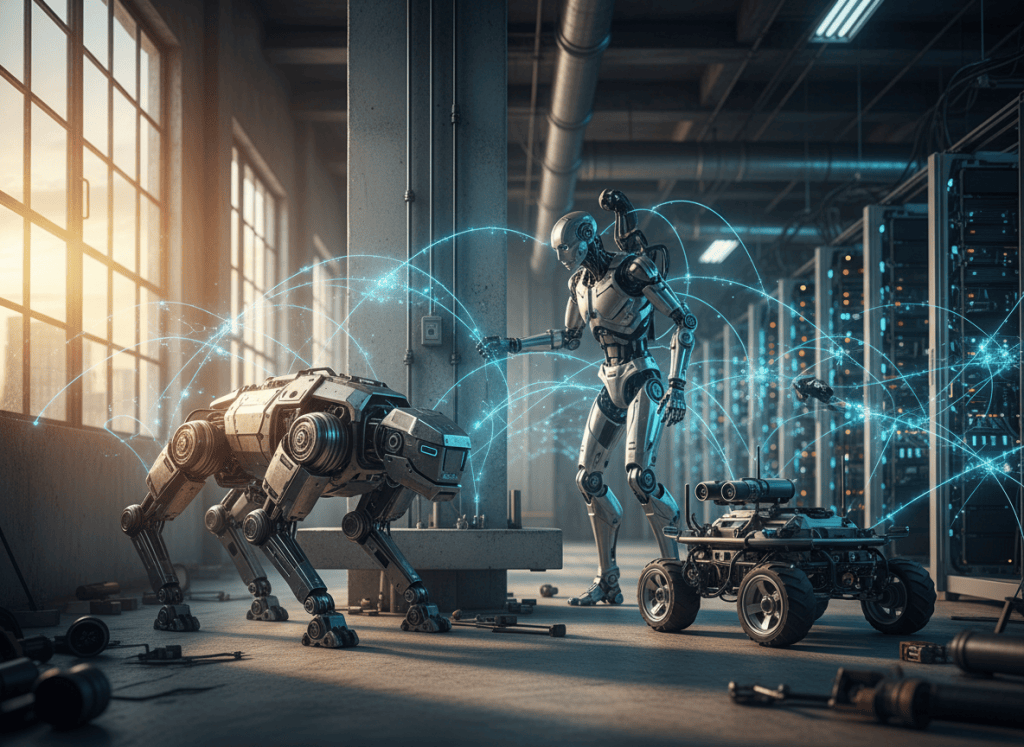
FieldAI has closed a new robotics funding round worth about ₿8,092 ($700 million), lifting the company’s reported valuation to roughly ₿115,596 ($10 billion) as investors keep pushing capital toward physical AI.
The new round was reported by Business Insider, which said FieldAI has also moved past approximately ₿1,561 ($135 million) in revenue and customer contracts across more than 30 clients. Approximate Bitcoin conversions use a publication-time BTC/USD quote near ₿1 ($86,508); Bitcoin trades continuously, so the BTC equivalents will move.
The headline number is huge, but the more interesting part is what investors appear to be betting on: not one robot body, but one software brain that can run across many different machines.
FieldAI Is Selling the Brain, Not the Body
FieldAI describes its platform as a general-purpose robotics intelligence layer built around risk-aware Field Foundation Models. The company says the same core autonomy stack can operate quadrupeds, humanoids, wheeled machines and other robotic platforms without relying on one fixed hardware design.
That is a different strategy from many humanoid companies. Instead of trying to win by manufacturing the best single robot, FieldAI is trying to become the intelligence layer underneath an entire fleet of robot types.
The practical idea is simple: the physical world is messy. A robot that works in a factory aisle may fail when the floor changes, the lighting shifts, equipment moves, GPS disappears or humans unexpectedly enter the work zone. FieldAI is designing its models around uncertainty, physical constraints and real-time decision-making rather than assuming the environment will remain perfectly structured.
This Round Builds on a Much Bigger Capital Ramp
FieldAI was already heavily funded before this round. In its earlier funding announcement on X, the company said it had raised more than roughly ₿4,624 ($400 million) while emphasizing real-world deployment rather than lab-only demonstrations.
The new financing means the company is now playing in a very different weight class. A valuation around ₿115,596 ($10 billion) puts enormous pressure on FieldAI to turn its software advantage into repeatable commercial deployments, not just impressive robotics demos.
Caterpillar Is the Kind of Customer That Makes the Thesis Real
The best evidence for FieldAI is not the valuation. It is the growing list of industrial environments where the company says its autonomy stack is already being tested or deployed.
One of the clearest recent examples is Caterpillar. FieldAI announced a strategic collaboration in September after real-world validation on complex Caterpillar jobsites, positioning its robot-agnostic models as an intelligence layer for heavy industry, inspection and autonomous operations.
That industrial focus matters because a robot that can reliably handle construction, mining, energy or factory work has a very different commercial profile from a robot built mainly for controlled demonstrations.
BitcoinVersus.Tech recently covered Agility Robotics and FORT extending Digit 5 safety beyond the robot itself. FieldAI is attacking a neighboring problem from the software side: how the robot reasons when the environment stops behaving like the training set.
Construction Is Already a Useful Stress Test
Construction sites are almost designed to break conventional automation. Maps become stale. Materials move. People improvise. Temporary walls appear. Dust, vibration, uneven terrain and changing routes can all destroy assumptions that work inside a clean factory.
That is exactly why construction is a useful proving ground. If a shared robot brain can work across changing jobsites without engineers rebuilding the autonomy stack for every new floor plan, the same architecture becomes more credible for data centers, utilities, warehouses, mines and manufacturing plants.
The Robotics Stack Is Starting to Look Like the Data-Center Stack
The industry is beginning to separate into layers. One company builds the robot body. Another supplies sensors. Another provides accelerators. Another builds orchestration software. FieldAI wants to own the intelligence layer that ties those pieces together.
That mirrors what has already happened in cloud computing and AI infrastructure, where the most valuable platforms often sit above commodity hardware and make different machines behave like one programmable system.
The same systems-level trend is visible in NVIDIA Isaac ROS 5.0 bringing AI agents deeper into robot development. The battle is shifting from “can this robot move?” toward “can a software layer make many robots useful, deployable and continuously improvable?”
The Hard Part Is Scaling Reliability
A ₿115,596 ($10 billion) valuation does not prove that general robot intelligence has been solved. It proves that investors are willing to pay heavily for the possibility that a reusable autonomy layer can scale faster than building one vertically integrated robot at a time.
The difficult questions now become operational: how often robots need human intervention, how quickly models transfer between hardware platforms, how failures are contained, how safety is validated, and whether customers keep expanding deployments after the first pilot.
Those questions also show up in warehouse robotics. BitcoinVersus.Tech recently examined Destro AI’s effort to coordinate mixed robot fleets, another sign that orchestration and autonomy software may become as important as the machines themselves.
Physical AI Is Becoming a Platform Race
FieldAI’s new round is a signal that physical AI is moving beyond a contest over who can build the most human-looking robot.
The bigger race may be over which software platform can make many different robots useful across many different industries.
If FieldAI can make one intelligence stack portable across quadrupeds, humanoids, rovers and future machines while maintaining reliability in unpredictable environments, the company could end up looking less like a robot manufacturer and more like an operating layer for the physical world.
That is the real story behind the ₿8,092 ($700 million) round: investors are not only funding more robots. They are funding the possibility of a common brain for all of them.
BitcoinVersus.Tech
Advertisement
Editor’s Note:
We volunteer daily to ensure the credibility of the information on this platform is Verifiably True. If you would like to support our research initiatives, please donate here: 3C9o19EH5HSiwEPyCTmEKzxhNCbo2X6TTb
BitcoinVersus.tech is not a financial advisor. This media platform reports on financial subjects purely for informational purposes.


Leave a Reply