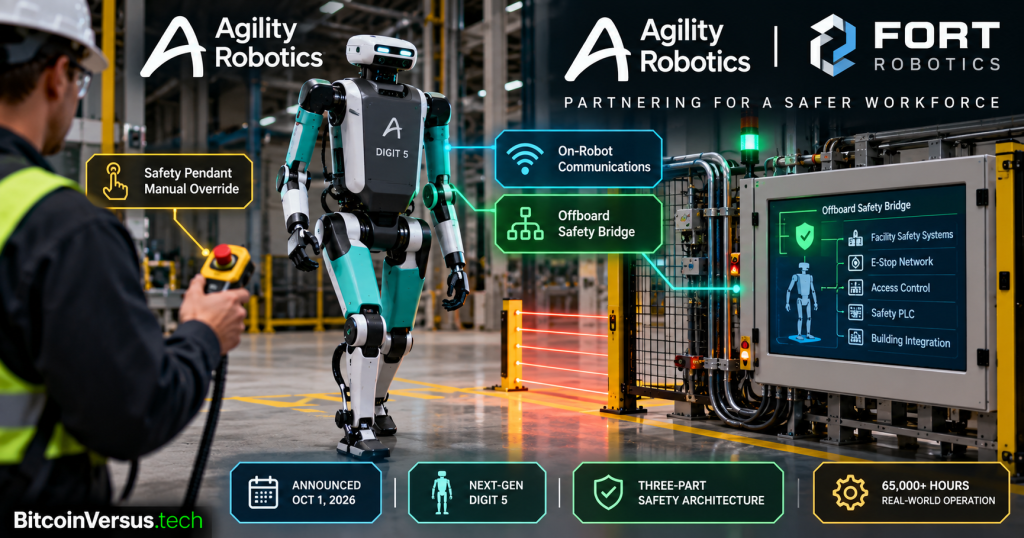
Agility Robotics and FORT Robotics are extending humanoid safety beyond the robot itself, adding an external bridge that can connect Digit 5 with the safety systems already operating across a factory, warehouse or logistics facility.
The companies announced the expanded partnership on October 1. Their new three-part architecture combines a safety pendant, on-robot communications and an Offboard Safety Bridge linking Digit with external facility safety systems.
The important change is architectural: Digit 5’s safety envelope is being designed to receive protective inputs from both the humanoid and the industrial environment around it.
Digit 5 gets a safety layer outside its own body
Agility describes Digit 5 as its first humanoid engineered for cooperatively safe work at scale. Planned onboard functions include safe human detection, safety cues and safe motion control. FORT’s external communications layer is intended to complement those systems rather than replace them.
The Offboard Safety Bridge matters because an industrial robot does not operate in isolation. Facilities already use emergency-stop circuits, access controls, safety PLCs and other protective equipment. Connecting the humanoid to that surrounding infrastructure creates another path for a safety event to reach the machine.
BitcoinVersus.tech previously covered the Digit 5 launch, where Agility positioned the new generation around safer large-scale commercial work rather than demonstrations alone.
The bridge is designed to make facility-level safety signals part of the robot’s operating environment instead of leaving every protective decision onboard.
The partnership grew from one component into three layers
FORT technology has appeared in earlier Digit generations. The relationship expanded this year when FORT developed a pendant sled that holds Digit’s tablet while integrating emergency-stop and enabling-device functions.
The pendant gives an operator an independent manual override during setup, maintenance or an unexpected condition. Digit can still operate autonomously during normal work, but the pendant preserves a direct human control path when needed.
Agility’s public announcement describes the new bridge as the connection between Digit and safety systems already running inside a facility.
The result is a layered design: manual override at the pendant, safety communications on the robot and an interface to the surrounding facility.
65,000 operating hours are feeding the next safety architecture
Agility says previous Digit generations have accumulated more than 65,000 hours of operation and have been deployed at customer sites including Schaeffler, GXO and Toyota Motor Manufacturing Canada. That operating history gives the companies a larger real-world base from which to design the next generation of safeguards.
The safety problem is becoming more important as humanoids move from pilot programs into industrial work. BitcoinVersus.tech recently reported on Eni moving humanoids toward industrial field testing, another example of physical AI entering environments where machinery, workers and existing safety systems have to coexist.
Independent coverage notes that the agreement moves FORT beyond component supply into joint hardware development, solutions engineering, regulatory compliance and deployment support as Digit 5 rolls into more complex commercial environments.
Safety is becoming an integration problem as much as a robot problem: the machine, operator controls and building systems increasingly have to understand one another.
Physical AI is starting to look like industrial infrastructure
The partnership also illustrates a broader transition in robotics. A commercially deployed humanoid needs more than perception and motion models. It needs redundant control paths, predictable behavior around people, service procedures, regulatory documentation and interfaces that work with equipment already installed at customer sites.
That is why the safety stack may become as strategically important as the AI stack. BitcoinVersus.tech recently examined AMD’s push to move physical AI from cloud infrastructure into robots. Agility and FORT are addressing the other side of that deployment equation: how autonomous machines can be integrated into workplaces without treating safety as a single onboard feature.
The companies say their memorandum of understanding will support joint hardware development, solutions engineering, regulatory compliance and deployment support. They also expect the architecture to inform future Digit generations as the platform takes on more tasks.
Digit 5 is therefore becoming more than a humanoid platform. Its safety architecture is being designed as part of the factory around it.
BitcoinVersus.Tech
Advertisement
BitcoinVersus.Tech Editor’s Note:
We volunteer daily to ensure the credibility of the information on this platform is Verifiably True. If you would like to support to help further secure the integrity of our research initiatives, please donate here: 3C9o19EH5HSiwEPyCTmEKzxhNCbo2X6TTb
BitcoinVersus.tech is not a financial advisor. This media platform reports on financial subjects purely for informational purposes.


Leave a Reply