Warehouse robotics may be approaching a point where the hardest problem is no longer building the robot — it is deciding what every robot and every person should do next.
Destro AI emerged from stealth on September 29 with a ₿92.769 ($8 million) seed round and a deliberately different pitch: instead of manufacturing another warehouse robot, the startup is building a shared intelligence layer that coordinates robots, human workers and enterprise systems across the same operation.
Destro wants one operating layer across different robot bodies
In its September 29 funding announcement, Destro said Base10 Partners and Bonfire Ventures co-led the seed round, with CoFound Partners participating. The company describes its core thesis as robot-agnostic automation: customers should be able to change hardware without rebuilding the intelligence layer that coordinates the warehouse.
The architecture is split into two systems. MothershipOS operates outside the robot body and decides which robot should perform which task, where and when. VisionOS runs on the robot and handles perception and manipulation using AI models trained from human demonstrations.
Yusen’s pilot started with three robots in the Pacific Northwest
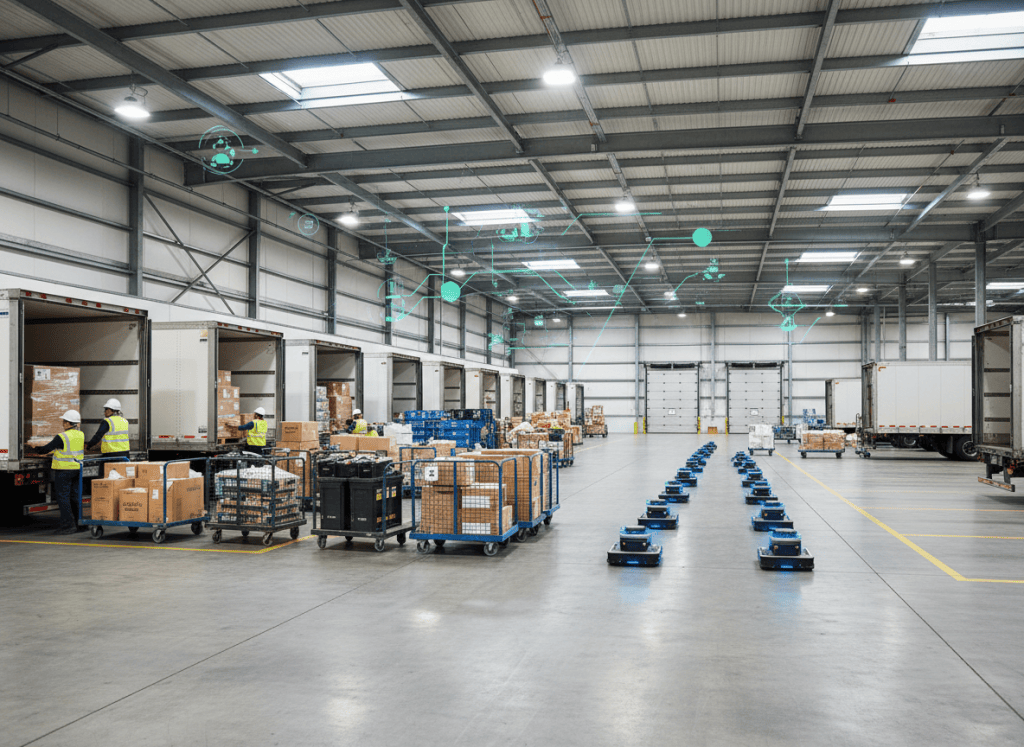
TechCrunch reported that Destro began with three cart-moving robots from Miva Robotics at a Yusen Logistics facility in the Pacific Northwest. Human workers unload goods into carts; the robots identify completed loads and move them to the correct destinations while Destro’s software coordinates the broader workflow.
The important distinction is that Destro is not only dispatching robots. Its Mothership layer also directs the surrounding human workflow, so carts, workers, robots and outbound trucks are treated as parts of one system rather than independent automation islands.
A September 30 X post summarizing the rollout highlighted the same contrast: the startup is not building robot bodies; it is coordinating people, machines and trucks around the cross-dock process.
The next step is 26 robots — plus a second 17-robot pilot
Yusen plans to expand the original Pacific Northwest pilot into a 26-robot deployment and launch a separate 17-robot pilot at a Southern California facility. Those figures are planned expansions, not robots already operating today, which makes the next phase an important test of whether the coordination layer scales beyond a small pilot.
That matters because cross-docking is not just point-to-point robot movement. Goods arrive on one truck, are separated into different outbound loads and then leave on other trucks. A robot may be capable of moving a cart perfectly while the overall operation still fails if loading, unloading, staging and human decisions are not synchronized.
The bet is that orchestration becomes the valuable layer
Robotics companies have spent enormous effort improving bodies, dexterous hands, perception systems and foundation models. Destro is betting that those components increasingly become platforms that can be swapped underneath a persistent operating layer.
That is almost the inverse of the humanoid strategy. Instead of owning the entire hardware-and-model stack, Destro wants to benefit as other companies improve it. The risk is equally clear: generic hardware and open models still struggle with dexterous manipulation, and companies building stronger foundation models or robot bodies may decide to own the orchestration layer themselves.
Physical AI is moving from demos toward system integration
The Destro story fits a broader shift in robotics. BitcoinVersus.Tech recently covered Agility and FORT extending Digit 5 safety beyond the robot itself, AMD pushing physical AI from cloud infrastructure down to the robot, and FieldAI raising capital around the idea of a general-purpose robot brain.
All three point toward the same systems problem: useful physical AI requires more than a capable model or impressive robot. It needs safety, compute, perception, workflow integration and reliable coordination with the people already doing the job.
The real test is whether the warehouse gets better, not whether the robot looks smarter
Destro’s next deployments should make that thesis easier to judge. A 26-robot operation and a separate 17-robot pilot create much more opportunity for congestion, exceptions, shifting priorities and human-machine coordination failures than a three-robot test.
If the system can manage those conditions while remaining hardware-independent, the valuable product may not be the robot that moves the cart. It may be the software deciding how the entire warehouse moves around it.
BitcoinVersus.Tech
Advertisement
Editor’s Note
We volunteer daily to ensure the credibility of the information on this platform is Verifiably True. If you would like to support to help further secure the integrity of our research initiatives, please donate here: 3C9o19EH5HSiwEPyCTmEKzxhNCbo2X6TTb
BitcoinVersus.tech is not a financial advisor. This media platform reports on financial subjects purely for informational purposes.


Leave a Reply