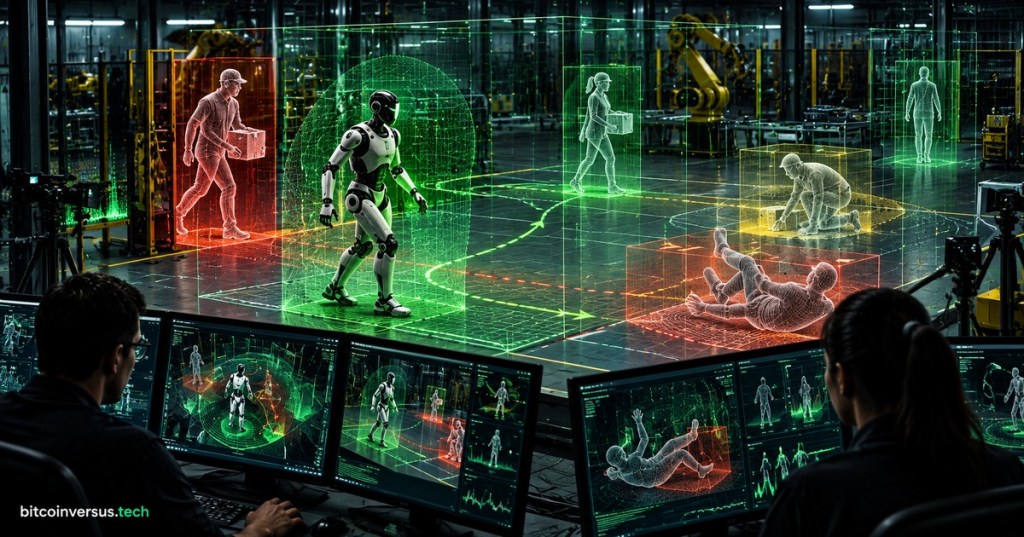
Robotics has spent years proving that AI-powered machines can walk, grasp, navigate and work. The next bottleneck is proving they can do those things around people without turning a rare software edge case into a physical accident.
SafeWorld has emerged from stealth with $12.2 million in seed funding to build a safety-testing layer for physical AI. The company is betting that as robot control systems become more probabilistic and more capable, enterprises will need a repeatable way to stress-test dangerous situations before a machine ever encounters them on a real factory floor.
SafeWorld Wants to Turn Robot Edge Cases Into Repeatable Tests
SafeWorld describes its platform as a testing and evaluation system for robots working around people. The core problem is straightforward: the most dangerous human-robot interactions are exactly the scenarios engineers least want to reproduce physically.
A person can step out from a blind corner, crouch behind an object, fall unexpectedly, run into a robot’s path or carry something that partially blocks the robot’s view. SafeWorld’s approach is to model those interactions in simulation, generate many possible paths, estimate interaction risk and preserve the evidence so safety, engineering and operations teams can review what happened.
The important shift is from a one-time certification mindset toward continuous testing. Every software update, perception-model change or new facility layout can alter the risk profile of a physical AI system, meaning safety validation may need to behave more like regression testing in software.
Why Generative AI Makes Robot Safety Harder
Traditional industrial robots are often built around constrained, deterministic behavior. Generative and learned control systems are different: their strength is adaptability, but that also means engineers cannot assume every future action follows a small set of hard-coded branches.
TechCrunch reported that SafeWorld was founded by Carnegie Mellon Safe AI Lab director Dr. Ding Zhao, veteran startup executive Kyle Wong and machine-learning engineer Simo Rachidi. The $12.2 million round was led by Shine Capital and a16z Speedrun, with participation from Box Group, Carnegie Mellon University Endowment, Innovation Endeavors and SV Angel.
The company’s method puts a robot’s real control software into simulated environments and runs thousands of human-interaction scenarios. In one factory example, that means asking whether a robot detects a person emerging from a blind corner while carrying boxes, whether its stopping distance is sufficient, and how it behaves if the person suddenly falls.
The Industry Is Moving From Robot Demos to Deployment Engineering
The timing matters because physical AI companies are already moving beyond isolated demonstrations. BitcoinVersus.Tech recently covered Destro AI’s attempt to coordinate humans and warehouse robots through a shared intelligence layer. Once robots operate inside live workflows, safety becomes a systems problem rather than a feature attached to one machine.
That same transition is visible in humanoids. Agility Robotics and FORT are extending Digit 5’s safety architecture beyond the robot itself, connecting onboard controls to external facility safety systems. The common theme is that the surrounding environment increasingly has to participate in keeping an autonomous machine safe.
Safety Could Become Its Own Physical-AI Infrastructure Market
Frontier robotics investment has mostly focused on better perception, foundation models, manipulation and hardware. BitcoinVersus.Tech also covered FieldAI’s $700 million raise around a general-purpose robot brain. SafeWorld is effectively making the opposite bet: smarter robot brains create demand for a parallel layer that can continuously test whether those brains remain safe in the physical world.
If that model works, robot-safety simulation could become recurring infrastructure rather than a pre-launch checklist. A factory could rerun scenarios after a software update, before moving a robot to a new work cell, after changing a facility layout or whenever an incident exposes a new failure mode.
That is a less flashy business than building a humanoid. It may also be one of the businesses that makes humanoids commercially deployable at scale. The robot industry does not only need machines that can do more. It needs a credible way to prove what happens when humans do something the machine did not expect.
BitcoinVersus.Tech
Advertisement
Editor’s Note
We volunteer daily to ensure the credibility of the information on this platform is Verifiably True. If you would like to support to help further secure the integrity of our research initiatives, please donate here: 3C9o19EH5HSiwEPyCTmEKzxhNCbo2X6TTb
BitcoinVersus.tech is not a financial advisor. This media platform reports on financial subjects purely for informational purposes.


Leave a Reply