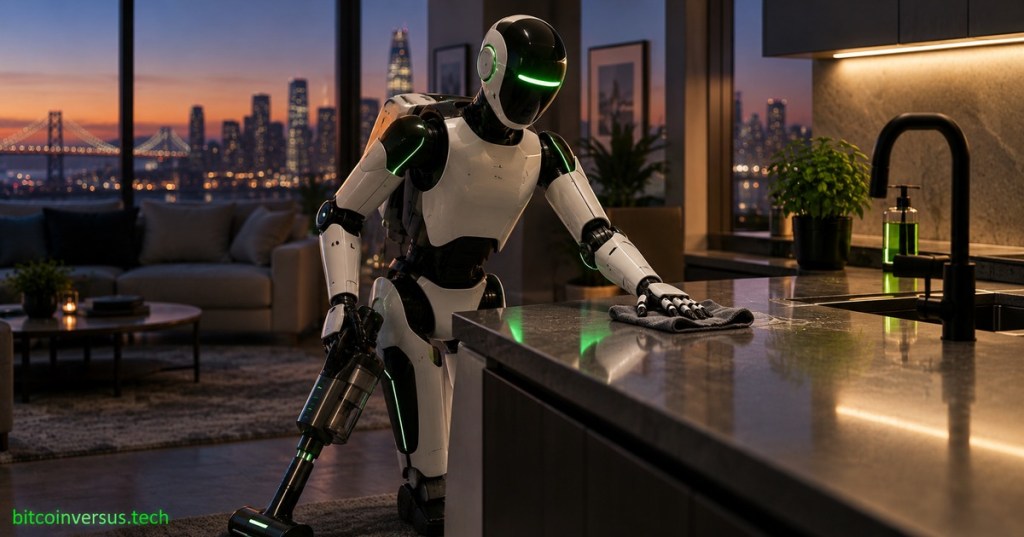
Tau Robotics says its humanoid cleaning service has now worked in more than 50 San Francisco properties over a four-week period, moving one of the most futuristic consumer-robotics ideas from demonstration videos into repeated paid home visits.
The milestone matters because Tau is not presenting the robots as a laboratory prototype. Tau’s current service terms describe a one-hour cleaning visit in which a humanoid is brought into a customer’s home and operated in real time by a trained human operator. The service remains invite-only, and the company explicitly says the robot is not yet autonomous.
The same terms list the service at approximately ₿0.00035 ($30) per humanoid for one hour. Tau says it sends two humanoids to each visit, making a standard one-hour cleaning approximately ₿0.00070 ($60).
Tau said on X that its robots had cleaned more than 50 properties during the preceding four weeks and pointed viewers to Associated Press footage from a recent San Francisco cleaning.
A robot that cleans real apartments, with a human still in the loop
The robots can vacuum floors, wipe surfaces, mop, clear clutter and perform other household cleaning tasks. What makes the deployment technically interesting is the control model: AI assists the system, but a remote human operator remains responsible for real-time operation. That makes Tau’s service a practical example of supervised physical AI rather than a claim of fully autonomous household labor.
Reuters filmed Tau’s robots working in San Francisco in September, including vacuuming, wiping counters and cleaning a bathroom. Co-founder Cornelia Weinzierl told Reuters that cleaning is the company’s first application and acknowledged that some tasks still use teleoperation.
Why the 50-property milestone is more important than a demo
Humanoid robotics has no shortage of impressive demonstrations. Repeated customer visits are a different test because homes vary in floor plans, clutter, furniture, lighting, network conditions and human expectations. Each additional visit exposes the system to more edge cases that a controlled lab cannot reproduce.
BitcoinVersus first covered Tau’s San Francisco cleaning-service launch in August. This follow-up is about what happened after launch: the company now says the robots have accumulated more than 50 real-property cleaning visits in a four-week window. That operating milestone makes the story materially different from the original service announcement.
The deployment also fits the broader shift BitcoinVersus has been tracking in robotics. SafeWorld is building stress-testing systems for GenAI robots before they interact with people. Real homes create exactly the kind of messy, unpredictable environments where safety, recovery and human oversight matter.
The commercial side is moving at the same time. RobCo is pushing its Alfie platform toward factory deployment, while Tau is testing whether a humanoid service can become useful inside private homes. Industrial robots and domestic robots face different constraints, but both depend on reliable perception, manipulation, recovery from mistakes and a business model that justifies the hardware.
The real product today is supervised autonomy
Tau’s current setup is important precisely because it does not hide the human operator. A remote person can intervene when the robot encounters a difficult object, unfamiliar room layout or manipulation problem. That human-in-the-loop architecture can keep the service usable while generating the operational experience needed to automate more of the workflow later.
For the robotics industry, the key question is no longer whether a humanoid can wipe a counter in a video. It is whether a company can repeat the task safely, affordably and predictably across dozens, hundreds and eventually thousands of real customer environments. Tau’s 50-plus-property run is still small, but it is the kind of field evidence that starts answering that question.
BitcoinVersus.Tech
Advertisement
Editor’s Note:
We volunteer daily to ensure the credibility of the information on this platform is Verifiably True. If you would like to support our research initiatives, please donate here: 3C9o19EH5HSiwEPyCTmEKzxhNCbo2X6TTb
BitcoinVersus.tech is not a financial advisor. This media platform reports on financial subjects purely for informational purposes.


Leave a Reply