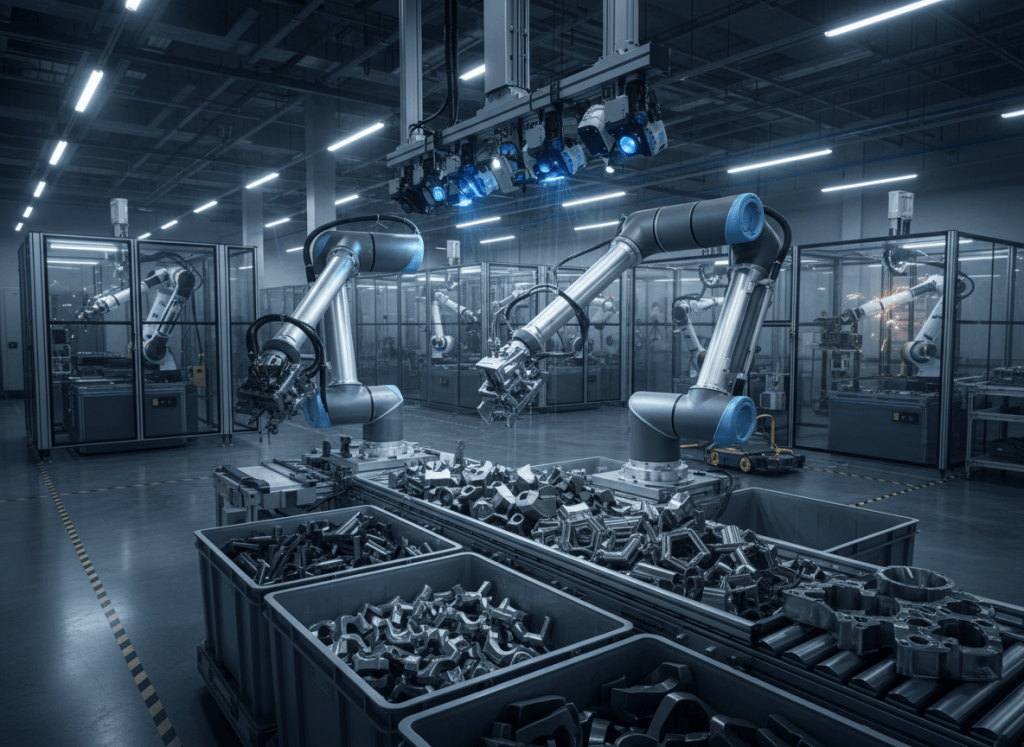
Industrial robotics startup RobCo has crossed a ₿11,668.3 ($1 billion) valuation as it prepares to move its two-armed Alfie robot from customer prototypes toward commercial launch.
The Munich-founded company said on October 5 that its valuation has more than doubled in nine months. The new transaction combines fresh investment with an employee secondary share sale, giving long-standing workers a chance to realize part of the value they helped create.
The valuation is confirmed; the transaction size is separately reported
In its official October 5 announcement, RobCo confirmed that it has surpassed a ₿11,668.3 ($1 billion) valuation. Existing investors including Sequoia, Lightspeed, Greenfield, Kindred, Lingotto and Promus Ventures participated alongside new investors including Cherry Ventures and European Tech Collective.
RobCo did not disclose the total size of the transaction or the split between new capital and secondary employee shares.
Reuters reported that the Wall Street Journal put the share-sale figure at about ₿466.73 ($40 million). Reuters also reported that RobCo has now raised close to ₿2,333.66 ($200 million) in total after a ₿1,166.83 ($100 million) capital raise in January.
Alfie is the bigger product bet
The valuation milestone matters, but RobCo’s next product is more important operationally. Alfie is a two-armed autonomous industrial robot designed for tasks that traditional fixed automation struggles to handle: high-mix production, variable objects, unstructured workspaces and jobs where the sequence can change from one cycle to the next.
RobCo says Alfie combines perception, reasoning and execution rather than relying only on a rigid pre-programmed motion sequence. Commercial launch is scheduled for March 4, 2027 at RobCoN in Munich, and Reuters says several customers already have prototypes installed.
RobCo is trying to automate the work traditional robots skip
Traditional industrial robots are excellent when a factory can control the environment: the same part arrives at the same position, the fixture is known, and the robot repeats the same motion thousands of times.
The difficult market is everything outside that ideal. Small and mid-sized manufacturers often run many product variants, shorter production runs and processes that still depend on human judgment because conventional automation is too expensive or too brittle to reconfigure constantly.
RobCo’s thesis is that physical AI can expand the addressable automation market by allowing a robot to adapt to more variation rather than requiring engineers to eliminate that variation first.
Robotics-as-a-Service changes the buying decision
RobCo also sells many systems through a Robotics-as-a-Service model instead of requiring factories to make a large upfront capital purchase.
That can matter as much as the robot itself. A subscription model lowers the initial barrier for manufacturers that need automation but cannot justify a large one-off integration project. It also gives the robotics provider an incentive to keep the machine productive over time because recurring revenue depends on continued deployment.
The tradeoff is that RobCo takes on more operating responsibility. A robot that fails during a night shift is not simply a hardware problem; it becomes a service-quality problem tied directly to the customer’s production line.
The United States is becoming the expansion market
RobCo says the United States is now its fastest-growing market. Customer operations span more than a dozen states, with manufacturing and assembly in Austin, Texas, and a lab in San Francisco.
CEO Roman Hölzl has relocated to the United States to lead that expansion personally. Reuters says roughly 70% of RobCo’s business is still in Europe, so the company is not abandoning its German manufacturing base; it is trying to build a second growth engine in the U.S.
Physical AI is moving from demos toward factory economics
The larger robotics race is increasingly splitting into two questions: who can build the most capable machine, and who can deploy enough machines to produce reliable economics.
BitcoinVersus.Tech recently covered FieldAI raising ₿8,092 ($700 million) around a general-purpose robot brain, NEURA and SECO building European physical-AI hardware, and Phantom MK-1 pushing humanoid robotics into defense environments.
RobCo sits on a different part of that curve. Its near-term market is industrial production, where customers already understand the value of automation and can measure payback in labor availability, throughput and uptime.
The March 2027 launch is the next real test
A unicorn valuation proves investor demand. It does not prove that a new robot can operate profitably across thousands of messy factory tasks.
That makes Alfie’s transition from customer prototypes to a commercial product the more important milestone. RobCo has to show that perception and self-learning autonomy can reduce engineering work without introducing unacceptable reliability or safety problems.
If that works, RobCo will be selling more than robot arms. It will be selling a way to automate factory jobs that previously remained manual because they changed too often to justify traditional automation.
BitcoinVersus.Tech
Advertisement
Editor’s Note
We volunteer daily to ensure the credibility of the information on this platform is Verifiably True. If you would like to support to help further secure the integrity of our research initiatives, please donate here: 3C9o19EH5HSiwEPyCTmEKzxhNCbo2X6TTb
BitcoinVersus.tech is not a financial advisor. This media platform reports on financial subjects purely for informational purposes.


Leave a Reply