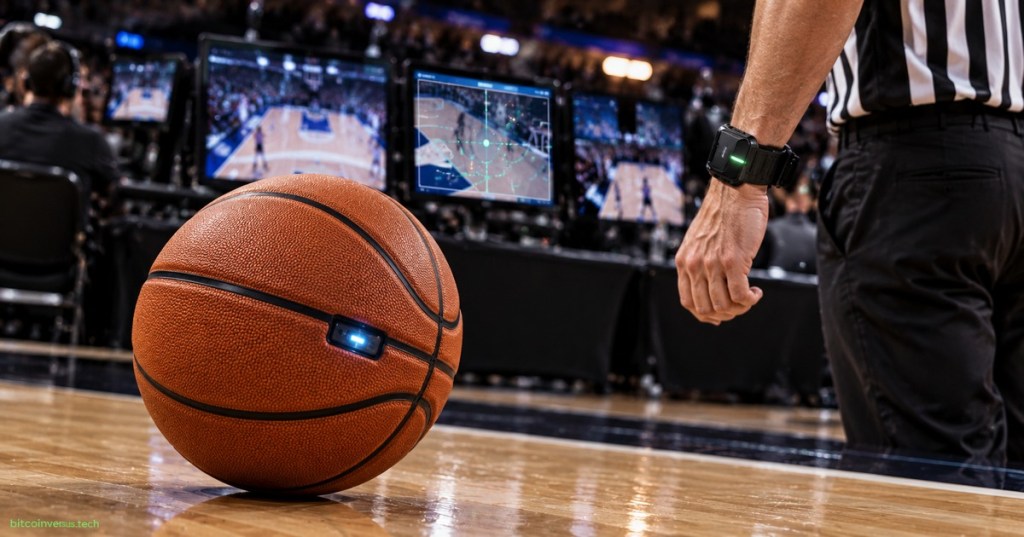
The NBA is testing two pieces of officiating technology during selected preseason games: a Bluetooth-enabled smart basketball and wrist wearables for referees. The Associated Press reported on October 5 that the connected ball can collect data for possible future real-time officiating applications, but its data will be used only for research during the current exhibitions and will not change calls on the floor.
The second experiment puts a communication device on an official’s wrist. The wearable can be used in designated situations involving replay reviews, scoring changes and clock malfunctions, giving referees another direct link to the league’s Replay Center without turning the test into an automated decision system.
The Smart Ball Is Collecting Data, Not Making Calls
The Wilson-developed basketball contains a Bluetooth sensor designed to capture information while remaining usable as a game ball. For now, the NBA is keeping a clear separation between measurement and adjudication: the sensor can generate research data, but officials will still make the actual in-game decisions.
That distinction matters because instrumented sports equipment can produce much richer datasets than video alone. A connected ball could eventually help measure possession, release timing, trajectory or boundary events more directly, but any move from research data to officiating would require validation against the league’s existing review standards.
The Wrist Wearable Extends the Replay Center
The referee wearable follows an earlier NBA push to tighten communication between crews and centralized replay staff. NBA Official documented the league’s 2025 headset rollout, which was designed to improve communication with the Replay Center and among officials during review situations. The new wrist test explores a different form factor for similar operational problems.
The experiment fits a larger trend BitcoinVersus.Tech has been following across sports. The NFL is using AI to identify run schemes and blocking assignments, turning tracking data into structured football analysis.
In tennis, IBM’s US Open system converts serve mechanics into a biomechanics score, showing how sensor and vision systems can turn movement into machine-readable performance data.
And in track and field, TDK’s smart javelin puts sensors directly into sporting equipment, a concept much closer to what the NBA is now trying with its connected basketball.
The NBA says neither experiment is headed straight into the regular season. That is the right framing for now: preseason gives the league a controlled environment to learn whether the data is accurate, whether the hardware changes game operations, and whether officials actually gain useful information without adding friction.
BitcoinVersus.Tech
Advertisement
Editor’s Note
We volunteer daily to ensure the credibility of the information on this platform is Verifiably True. If you would like to support to help further secure the integrity of our research initiatives, please donate here: 3C9o19EH5HSiwEPyCTmEKzxhNCbo2X6TTb
BitcoinVersus.tech is not a financial advisor. This media platform reports on financial subjects purely for informational purposes.


Leave a Reply