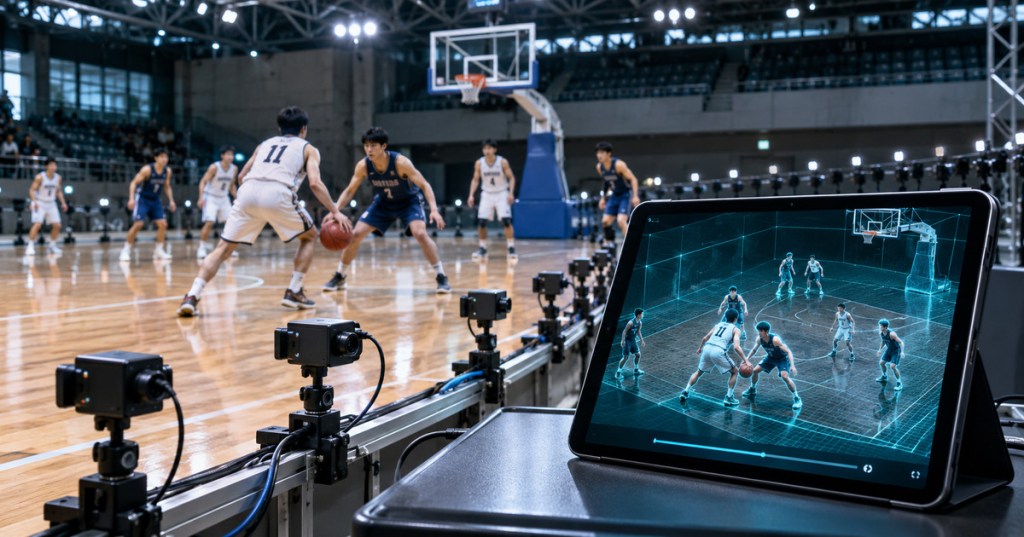
Canon said on October 15, 2026, that it had streamed a live, freely navigable 3D reconstruction of a basketball game in Japan to approximately 750 devices. The late-September demonstration used volumetric video so viewers could choose their own camera angle on a phone, tablet or computer. Canon measured about 16 seconds between capture and display.
How Canon moved a basketball game into 3D
The system begins with roughly 100 synchronized cameras recording the court from different positions. Video traveled over an NTT-led IOWN All-Photonics Network link to Canon’s Kawasaki office, where computers reconstructed the players and court as three-dimensional spatial data. That data was compressed and distributed to viewers through a cloud platform, according to Canon’s October technical announcement.
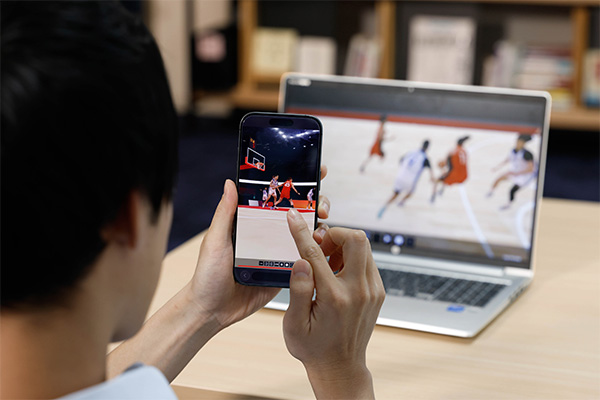
Unlike a conventional broadcast, the viewer can select a high perspective over the floor or move closer to an athlete. A previous Brooklyn Nets 360-degree replay deployment similarly reconstructs basketball action, but produces arena highlights rather than streaming freely controlled live 3D scenes to many individual devices.
A bigger audience, with a measurable delay
This follows Canon’s September 18 mixed-reality demonstration, in which approximately 60 participants at a separate venue viewed a tabletop 3D basketball scene. The October report describes a broader personal-device distribution experiment, not a verified commercial service or evidence that every viewer received the same image quality.
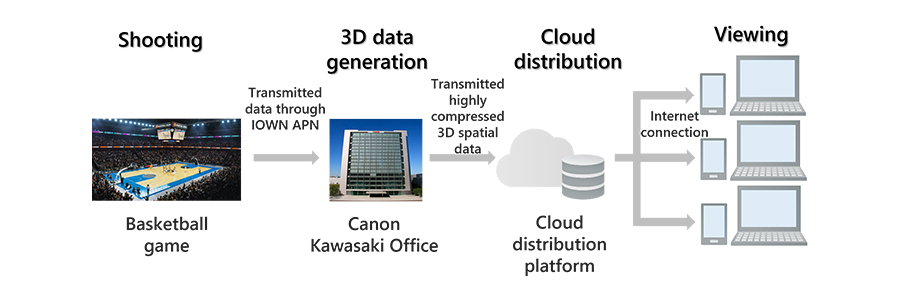
The technical trade-off is latency. Sixteen seconds may be acceptable for exploratory viewing, but it would complicate synchronization with a near-live television broadcast or real-time conversation about a play. Canon has not published comparable independent results for sustained network load, data usage, resolution or consumer-scale operating costs.
What matters for the next sports broadcast
Sports technology is moving along several different tracks: Sony’s 3D sprint replays create new broadcast perspectives, IBM’s tennis biomechanics work analyzes movement, and NBA smart-ball trials collect sensor data for research. Canon’s experiment instead tests how a fan chooses the view itself.
The next milestones are lower end-to-end delay, independent picture-quality measurements and repeatable demonstrations with larger audiences. Canon describes its claimed world-first status as based on its own survey; the supported achievement today is a company-reported, approximately 750-device live distribution test.
BitcoinVersus.Tech
BitcoinVersus.Tech Editor’s Note: We volunteer daily to ensure the credibility of the information on this platform is Verifiably True. If you would like to support our work and help further secure the integrity of our research initiatives, please scan the QR code below to donate 5,000 sats. For best results, scan the QR code from a laptop or larger screen.

Bitcoin address: 3C9o19EH5HSiwEPyCTmEKzxhNCbo2X6TTb. On a phone, open the QR image on another screen or copy and verify the address in your wallet before sending.
BitcoinVersus.tech is not a financial advisor. This media platform reports on financial subjects purely for informational purposes.


Leave a Reply