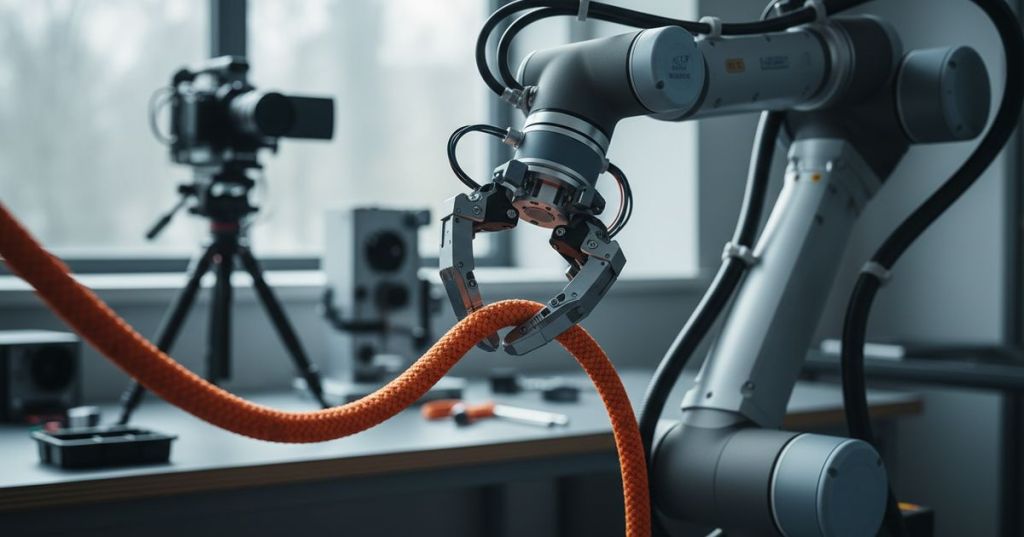
Carnegie Mellon University researchers highlighted Wiggle and Go on October 29, 2026, a method that lets a robotic arm test a rope with a brief movement before planning a throw or placement. The system estimates how that particular rope bends and swings before attempting the main task. Accepted for the 2026 Conference on Robot Learning, the project addresses a practical difficulty: flexible objects respond differently even when they look similar.
Carnegie Mellon’s research video shows the robotic arm testing and manipulating ropes. Source: Momentum Lab, CoRL 2026 research demonstration.
Learning a rope’s motion from one probe
The process starts with a small wiggle while a camera records the wave traveling through the rope. A neural network trained entirely in simulation then estimates physical properties that are passed to a trajectory optimizer. The arm uses those estimates to plan a goal-directed movement without repeatedly practicing that task on the physical rope.
That distinction matters for factory cable handling and other operations where failed attempts waste time. It complements robot dress-pack inspection, which deals with cables near moving machinery, and robot state estimation, which addresses uncertain sensor information.
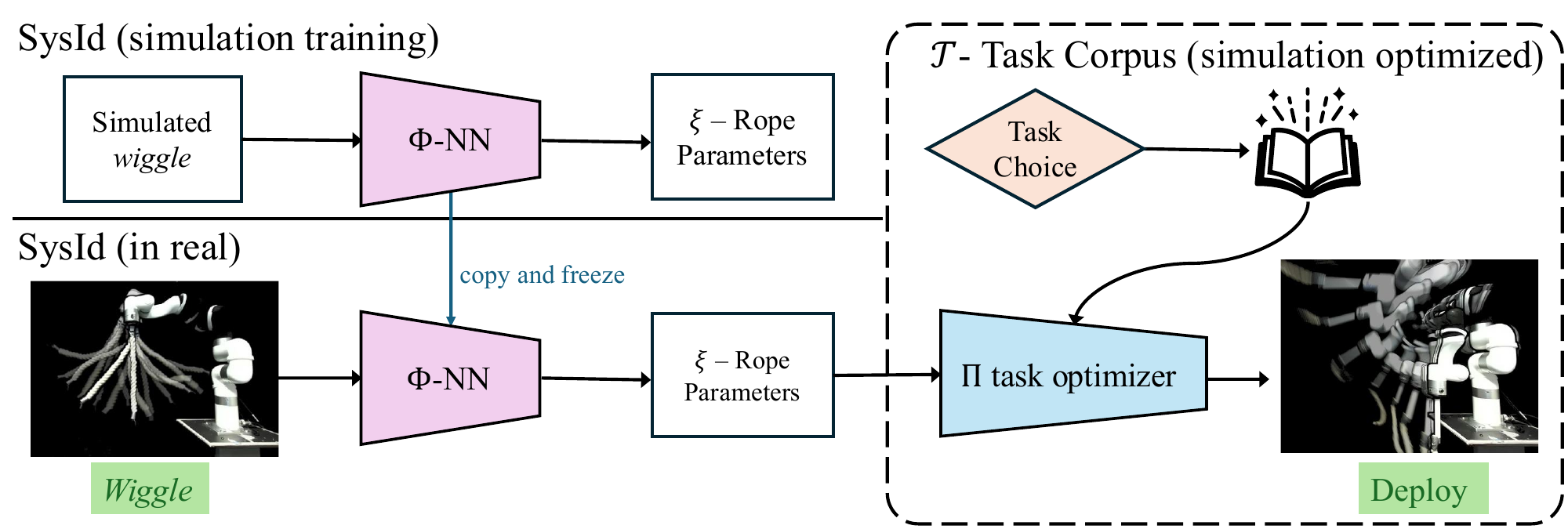
The research team’s system diagram shows simulation training, a real rope wiggle, estimated parameters and a task planner. Credit: Jakobsson and coauthors, 2026.
Real-world measurements
In the researchers’ physical target-striking tests, average three-dimensional error measured 3.55 centimeters with rope parameters inferred from the wiggle, compared with 15.29 centimeters for an uninformed baseline. That is an 11.74-centimeter difference, or about a 77% reduction in mean error. The team also reports more than 50% success on multi-objective lobbing and draping tasks, plus a 0.95 Pearson frequency correlation between simulated and real rope behavior on held-out actions.
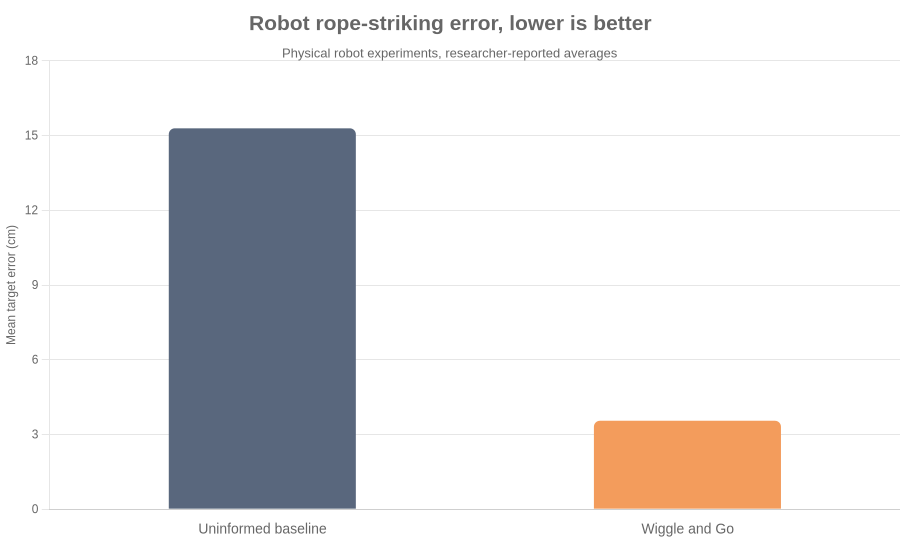
Average real-world three-dimensional target error: 15.29 cm without estimated rope properties versus 3.55 cm with Wiggle and Go. Data: Jakobsson et al., arXiv:2604.22102. Graphic: vertical categorical comparison using the visualizing-amounts method; zero-based scale, lower is better.
These are results from controlled experiments, not proof that a warehouse arm can reliably manipulate every cable or rescue line. The research paper was first submitted in April and revised in September; the university’s October announcement explained the work to a broader audience.
What engineers should watch next
The work addresses a different challenge from precision connector insertion, where parts are rigid. It also complements physical-AI training systems and interactive robotics world models, where transferring simulated behavior to hardware remains a major engineering problem.
The next useful evidence would be repeated trials with diverse cables, cluttered workplaces and measurable failure rates. The researchers plan to present the project at CoRL 2026 in Austin, Texas, in November.
BitcoinVersus.Tech Editor’s Note: We volunteer daily to ensure the credibility of the information on this platform is Verifiably True. If you would like to support our work and help further secure the integrity of our research initiatives, please scan the QR code below to donate 5,000 sats. For best results, scan the QR code from a laptop or larger screen.

Original BitcoinVersus.Tech QR code. Verify the address and amount before sending Bitcoin.
Bitcoin address: 3C9o19EH5HSiwEPyCTmEKzxhNCbo2X6TTb. On a phone, open the QR image on another screen or copy and verify the address in your wallet before sending.
BitcoinVersus.tech is not a financial advisor. This media platform reports on financial subjects purely for informational purposes.


Leave a Reply