
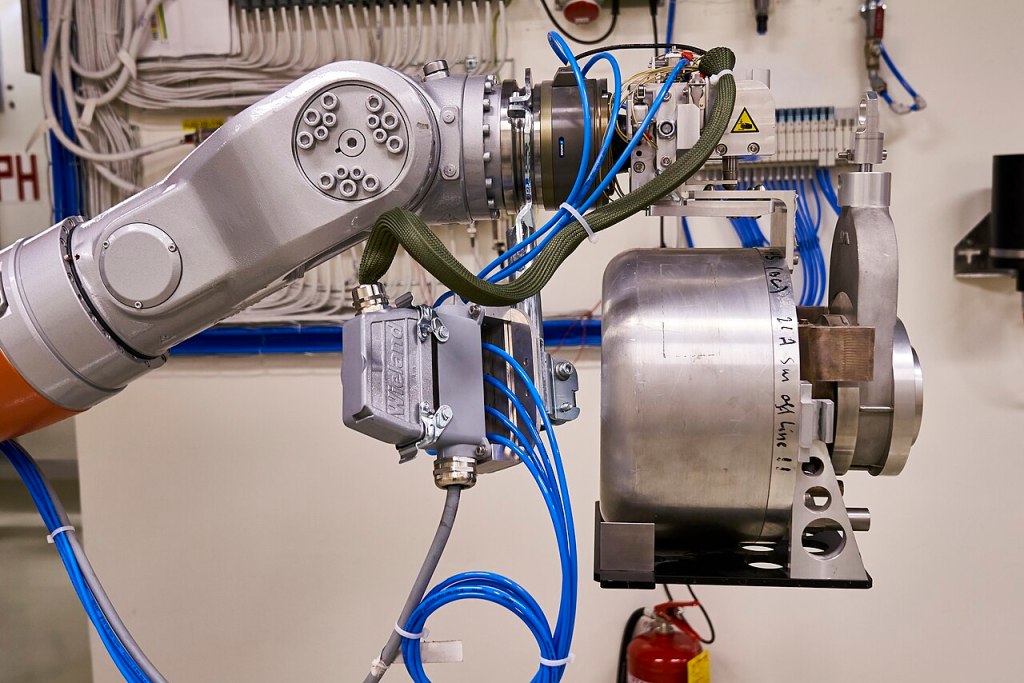
A robot dress pack guides and protects the cables and hoses that serve a moving robot and its tool. After OSRTC.011 on servo motors and gearboxes, this lesson focuses on the flexible connections around those moving joints. Igus’s IMTS 2026 explanation highlights repeated bending, wrist torsion, and snagging as cable-management challenges. The technician’s job is to recognize deterioration, compare routing with the approved design, and document evidence before a cable fault becomes a repeated production stop.
Key Takeaways
- Inspect the complete cable path, not just the connector nearest an alarm.
- Bending, twisting, abrasion, pinching, and connector strain are different failure mechanisms.
- Use the exact cable, carrier, and robot documentation for bend-radius limits and routing requirements.
- A stationary inspection and an authorized motion-verification test require different safety controls.
Elementary Overview
Think of the dress pack as a moving support system, not a bag for spare wire. It must allow the required travel while limiting unsupported loops and unwanted loading at the ends. A route that looks tidy in one pose may become tight or snagged in another. ABB describes retraction systems that keep external cables and hoses close to the arm and away from the tool. The correct arrangement depends on the actual robot, tooling, cable types, and programmed motion—not appearance alone.
Before Touching the Dress Pack
- Follow the employer’s energy-control procedure and the exact robot and end-of-arm-tool manuals. Work must be assigned to appropriately trained and authorized personnel.
- Treat electrical supplies, compressed air, spring or retractor tension, gravity, and other stored energy as possible hazards. A stopped program or emergency-stop button is not proof of energy isolation. OSHA’s hazardous-energy standard distinguishes control-circuit devices from energy-isolating devices.
- Complete the required isolation and verification before hands-on maintenance. Do not release an axis brake, open a pressurized line, or dismantle a tensioned retractor as part of a basic visual check.
- Review OSRTC.001 on safe workcell entry. This lesson is an inspection framework, not permission to enter a safeguarded space or bypass a safety function.
The Stationary Inspection Walkdown
- Establish a baseline. Identify the robot, tool, dress-pack model, cable part numbers, approved routing drawing, and last service record. Use consistent photographs to support the preventive-maintenance history.
- Follow the jacket. Look for cuts, worn surfaces, flattened sections, kinks, heat damage, contamination, or leakage. Record the exact location rather than writing only “bad cable.”
- Inspect guidance hardware. Look for cracked carrier links, missing retainers, displaced brackets, loose hardware, and contact marks. Check against the manufacturer’s specified assembly—not an improvised repair.
- Check bends and twist. Compare the installed route with the cable’s applicable dynamic-bending and torsion ratings. A cable suitable for a straight moving axis is not automatically suitable for a robot wrist. Do not invent one minimum radius for every cable in the bundle.
- Check strain relief and connectors. Look for jacket migration, connector loading, damaged boots, incomplete latching, or movement relative to documented reference positions. Tightening a clamp until it crushes the cable is not a routing correction.
- Check slack and retraction. Document loose loops, rubbing points, or tensioned sections. Follow the exact carrier instructions: for example, igus’s RSP guidance identifies both insufficient and excessive retraction tension as troubleshooting conditions.
Separate Inspection From Motion Verification
- A stationary inspection cannot prove clearance through the entire programmed path. Any motion test must be a separate, planned activity under the cell’s risk assessment, safeguarding, operating modes, and manufacturer instructions.
- Only trained personnel should conduct the authorized verification. Keep people clear of the hazardous motion area; never hold, pull, or “wiggle-test” a cable while the robot moves.
- Observe the approved motion sequence for tightening, loop growth, twisting, rubbing, and interference with tooling or fixtures. Stop and escalate a hazardous condition; do not change points merely to conceal a routing defect.
- If a fault repeats near one pose, record the pose, affected device, alarm, and timing. Correlation is a clue—not proof that the dress pack is the only cause. Keep alarm recovery and root-cause diagnosis separate from repeated resetting.
Practice
- Using training photographs or an isolated demonstration rig, mark three potential rubbing, strain, or snagging locations.
- Find the installed cable’s datasheet and distinguish its static-bend, dynamic-bend, and torsion specifications where provided.
- Write a work-order entry containing robot/tool identification, cable location, observations, photos, and the required escalation.
- Explain what a stationary check can establish and what remains for a separately authorized motion test.
Knowledge Check
- Why is a neat-looking route in the home pose insufficient?
- Does stopping the program establish energy isolation?
- What determines the acceptable minimum bend radius?
- Does a pose-related communication alarm prove a cable is defective?
Answers
- Other poses may tighten, twist, rub, or snag the bundle.
- No. The required hazardous-energy controls and verification still apply.
- The applicable cable and carrier specifications, installation, and motion conditions.
- No. Record and test the evidence using the approved procedure; power, connectors, devices, and other causes may also contribute.
Elementary Conclusion
Good dress-pack inspection follows the entire route and records what has changed. The aim is to keep motion from being transferred into damaging bends, unwanted twist, abrasion, or loaded connectors. Start with a safe stationary check, compare the hardware with its approved documentation, and leave motion verification to the authorized procedure. Clear records turn a vague intermittent fault into an inspectable maintenance problem.
Primary Sources
- igus: Six-Axis Cable Failures, Solved — manufacturer explanation, September 2026.
- igus: robot cable-carrier assembly videos and RSP assembly and troubleshooting.
- ABB: external DressPack with retract function.
- OSHA: control of hazardous energy, 29 CFR 1910.147.
BitcoinVersus.Tech Editor’s Note:
We volunteer daily to ensure the credibility of the information on this platform is Verifiably True. If you would like to support to help further secure the integrity of our research initiatives, please donate using the QR code provided

For best QR-code scanning results, please scan this donation code from a desktop or larger screen. Mobile screens may prevent camera recognition.


Leave a Reply