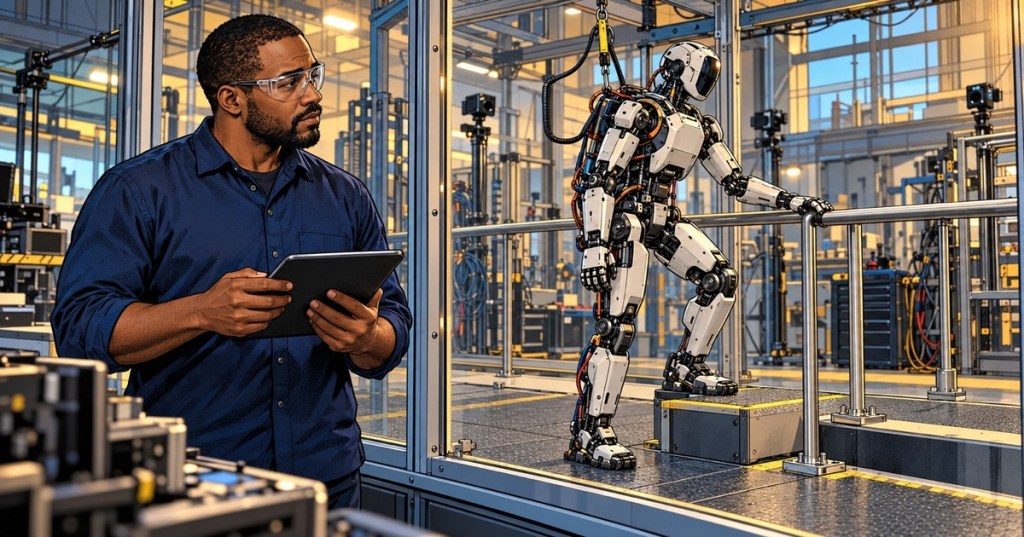
An overhead support is a protective test-cell system, not proof that a humanoid robot is safe. OSRTC.013 introduces the technician’s pre-test visual verification of a robot’s approved restraint or catch system before supervised stepping or balance trials. The illustration above shows the concept: a technician watches a humanoid under an overhead line, with barriers separating the observer from moving equipment. This continues OSRTC.012 on cable inspection without repeating its electrical-cable checks.
Key Takeaways
- Identify the difference between a passive catch tether, a body-weight support rig, and a cable supplying power or data.
- Treat the anchor, connector, robot attachment, and moving overhead carriage as one engineered load path.
- Document obvious damage, incorrect attachment, interference, and missing inspection records before an authorized test.
- Do not improvise rigging, calculate a new fall rating on the spot, or enter the test envelope to catch a robot.
Elementary Overview
Two-legged robots can lose balance when a foot slips, a controller fails, or the support surface changes. Some laboratories therefore use an overhead structure to catch a robot if a test fails. Other rigs intentionally support some of the robot’s weight. These two configurations behave differently, so technicians must identify the specific approved test setup and not assume that every visible overhead cable is a fall-protection device. A 2026 published humanoid-harness patent application describes transferring suspension forces through robot-body attachments; it illustrates engineering considerations, not a universal certified installation method.
The technician’s first question is: What, exactly, will stop this machine if it begins to fall? The answer must come from the site’s reviewed risk assessment, the approved support-system drawings, and the manufacturer instructions—not from the appearance of a cable or a successful earlier test. If that answer is missing, the test is not ready.
Recognize the Load Path
- Overhead structure: the approved gantry, beam, trolley, or equivalent support and its inspected mounting.
- Catch element: the specified line, strap, or lifting component, including rated fittings and termination hardware.
- Robot attachment: the manufacturer-approved mounting points or harness designed to carry the relevant forces; a decorative handle is not automatically an anchor.
- Motion envelope: the entire path in which the robot, tether, and moving carriage could swing or travel after balance is lost.
- Operator protection: barriers, exclusion distances, protective stops, and the site’s emergency response procedures.
A tether can protect the machine from a floor impact while creating a different hazard: sudden swinging, pinching, an overloaded attachment, or an unexpectedly moving overhead trolley. It is also possible for a line to snag during an otherwise successful gait. ISO 10218-2:2025 addresses integrated industrial robot applications and cells, but the standard’s scope excludes some service and other robots; use only the standards applicable to the specific system. The OSHA robotics standards overview distinguishes consensus guidance from enforceable OSHA regulations.
A successful motion clip shows what occurred during that trial, not whether the full support assembly passed its required inspection. For a technician, the decisive evidence is the current equipment identification, matching documentation, documented inspection status, and a clear planned test boundary.
Pre-Test Visual Verification
- Confirm authorization. Identify the test supervisor, the approved procedure and risk assessment, and the correct equipment records. Do not begin if responsibilities are unclear.
- Identify components. Compare the actual overhead structure, catch device, connectors, and robot attachment points with the documented setup. Look for wrong or unmarked hardware.
- Inspect without moving the rig. From an authorized safe position, note visible fraying, broken stitching, damaged fittings, bent hardware, unusual corrosion, loose fasteners, or obstructed routes. A visual check does not replace periodic qualified inspection.
- Examine clearances. Use the approved diagrams to recognize possible contact with the robot’s head, arms, adjacent barriers, fixtures, and overhead equipment. Do not manually reposition a suspended or energized robot.
- Check records and status. Confirm that qualified personnel have performed required rated-system inspections, installation verification, and maintenance under the site’s schedule.
- Record and escalate. Report discrepancies with component identification, location, photos taken from a safe position, and test status. Do not clear a defect through repeated resets.
A fall-restraint inspection is not a motion test. Dynamic loading, motion limits, trolley tracking, and system performance require an engineered verification plan executed by trained, authorized staff. OSHA’s hazardous-energy control rule matters when servicing applicable equipment; pressing an emergency stop alone does not establish energy isolation. Review OSRTC.001 on safeguarded entry before any hands-on work.
After a balance failure, recovery is a separate activity. Never enter a hazardous motion envelope just because the robot looks stationary or the catch line is holding it. Follow the approved stop, isolation, stabilization, inspection, and reauthorization process before restarting. This is especially important when a robot may self-right automatically or respond to a remote command.
Practice
- In the supplied cover image, identify the visible overhead line, robot attachment region, surrounding barriers, and the observing technician. Explain why the illustration cannot establish their load ratings.
- On a paper or digital diagram, trace the proposed support load path from the robot’s designated anchor to the engineered overhead structure.
- Prepare a sample defect report: “Left support line shows visible jacket wear near overhead carriage; test withheld pending qualified inspection.” Do not assert that the sample is a real inspection finding.
- List three records you would request before approving a supervised gait trial: a current inspection, the rig/robot manufacturer’s procedure, and the task-specific risk assessment.
Technician records should distinguish observed evidence from assumptions. A line that looks intact may still have an expired inspection; an emergency stop may work without controlling every stored-energy hazard. When required evidence is missing, document the gap and elevate it instead of improvising a demonstration.
Knowledge Check
- Does an overhead cable necessarily mean the robot is attached to an approved catch system?
- Why is a static visual inspection insufficient to prove performance during a fall?
- Who should approve rigging modifications or conduct dynamic support verification?
- What should the operator do when the inspection record cannot be found?
Answers
- No. It may carry power or data, support weight, or serve as a catch device; check the documented system.
- Loads, movement, clearances, and component behavior can change dynamically; qualified verification is needed.
- Authorized, qualified personnel following manufacturer instructions and the site’s engineered risk assessment.
- Withhold the test, document the missing evidence, and escalate for review.
Elementary Conclusion
Safe humanoid testing begins before the first step. Understand the overhead system’s intended purpose, recognize the complete load path, and document its condition from a safe position. A technician adds value by catching mismatches between the physical test cell and its approved design—not by treating a tether as permission to accept uncontrolled motion. For related technician skills, see OSRTC.007 on preventive maintenance and OSRTC.006 on fault recovery.
Primary References
- ISO 10218-1:2025 — Industrial Robots, for its defined application scope.
- ISO 10218-2:2025 — Robot Applications and Cells, for integrated industrial robot cell safety.
- OSHA: Robotics Standards and 29 CFR 1910.147, where applicable.
- Agility Robotics: Innovation at Agility — Balancing and Digit Gets Back Up After Falling.
- Humanoid Robot Harness System patent application; a design disclosure, not a certification.
BitcoinVersus.Tech Editor’s Note: We volunteer daily to ensure the credibility of the information on this platform is Verifiably True. If you would like to support to help further secure the integrity of our research initiatives, please donate using the QR code provided

For best QR-code scanning results, please scan this donation code from a desktop or larger screen. Mobile screens may prevent camera recognition.


Leave a Reply