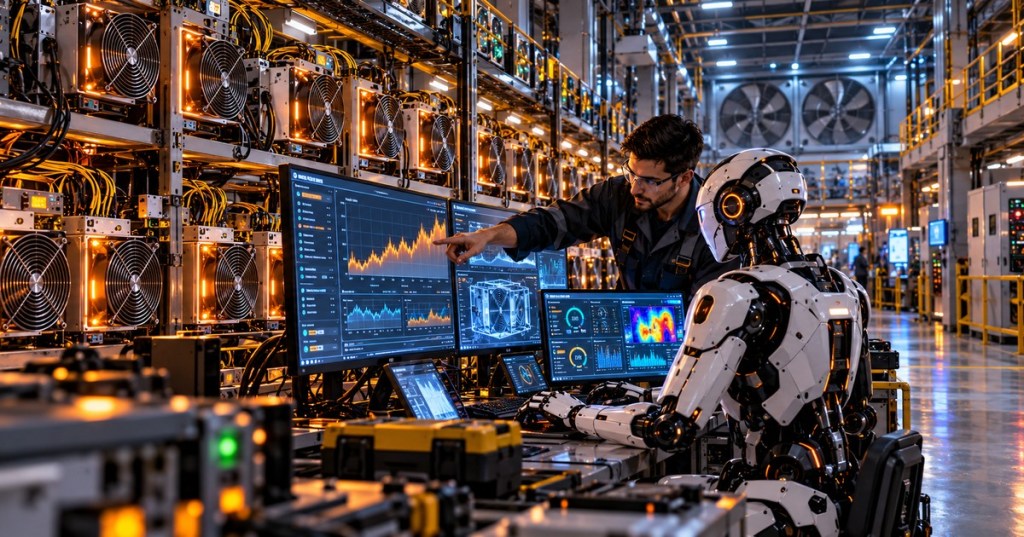
Could an AI agent run a Bitcoin mining operation? As an authorized software operator, increasingly yes; as the machine producing Bitcoin hashes, no. In an October 24, 2026 announcement, Tether said its QVAC agent already interacts with mining infrastructure through the open-source Mining Development Kit (MDK). Specialized ASICs still perform the SHA-256 computations.
Key Takeaways
- Tether reports a working QVAC-to-MDK integration, not independently audited autonomous management of a production fleet.
- Fifteen mining operators, manufacturers and pools have committed to MDK integrations; completion is not established.
- Agents could help analyze faults, coordinate monitoring and suggest permitted actions.
- Electrical protection, physical safety and access permissions must remain outside unrestricted model control.
The news builds on our earlier report on the 15 participating organizations, which include BITMAIN, Bitdeer, Canaan, MicroBT, Foundry, Luxor and F2Pool. The more consequential question now is how much operational responsibility miners can safely delegate to software agents.
An AI Operator Is Not a Replacement for an ASIC
An agent can read temperature, miner status, rejected-share rates, electrical demand, network connectivity and maintenance alarms. With carefully defined permissions, it might restart a failed service, flag a deteriorating hashboard or request a controlled power adjustment. Its output is a decision or command; the physical ASIC performs the hashing.
The original April 27 MDK launch introduced modular infrastructure built around a JavaScript SDK and React user-interface components. The October milestone adds commitments from outside vendors to maintain their own adapters, called Workers.
Tether’s official architecture documentation describes a Kernel, universal SDK and application toolkit. Workers translate equipment-specific interfaces into a shared operational language, allowing one monitoring or agent application to communicate with different systems without pretending their underlying firmware is identical.
What Autonomous Mining Still Has to Prove
Site-wide actions carry physical consequences. Operators should distinguish monitoring from actuation, enforce hardwired protections and deterministic thermal limits, restrict control permissions, and preserve human sign-off for electrical isolation. Our mining-network SNMP guide explains why reliable telemetry is foundational even before AI enters the control loop.
Tether says QVAC already operates directly on MDK, but its announcement supplies no independently audited figures for increased uptime, reduced downtime, improved joules per terahash or complete autonomous site operation. The actual outcome is still to be measured. The open-source MDK repository makes the software architecture available for technical inspection.
This matters for power management and profitability. An agent could eventually recommend decisions informed by electricity prices, curtailment signals and equipment health, but it would still require operator-approved policies and verified measurements. Our ASIC efficiency reporting examines hardware efficiency separately from software-assisted operations.
MDK’s stable 1.0 release was targeted for the end of 2026, according to Tether, rather than confirmed delivered. Like the emerging agent payments economy, autonomous Bitcoin mining now has a visible technical starting point. The unresolved test is whether agents can deliver dependable results under real-world industrial constraints.
BitcoinVersus.Tech Editor’s Note: We volunteer daily to ensure the credibility of the information on this platform is Verifiably True. If you would like to support to help further secure the integrity of our research initiatives, please donate using the QR code provided

For best QR-code scanning results, please scan this donation code from a desktop or larger screen. Mobile screens may prevent camera recognition.


Leave a Reply