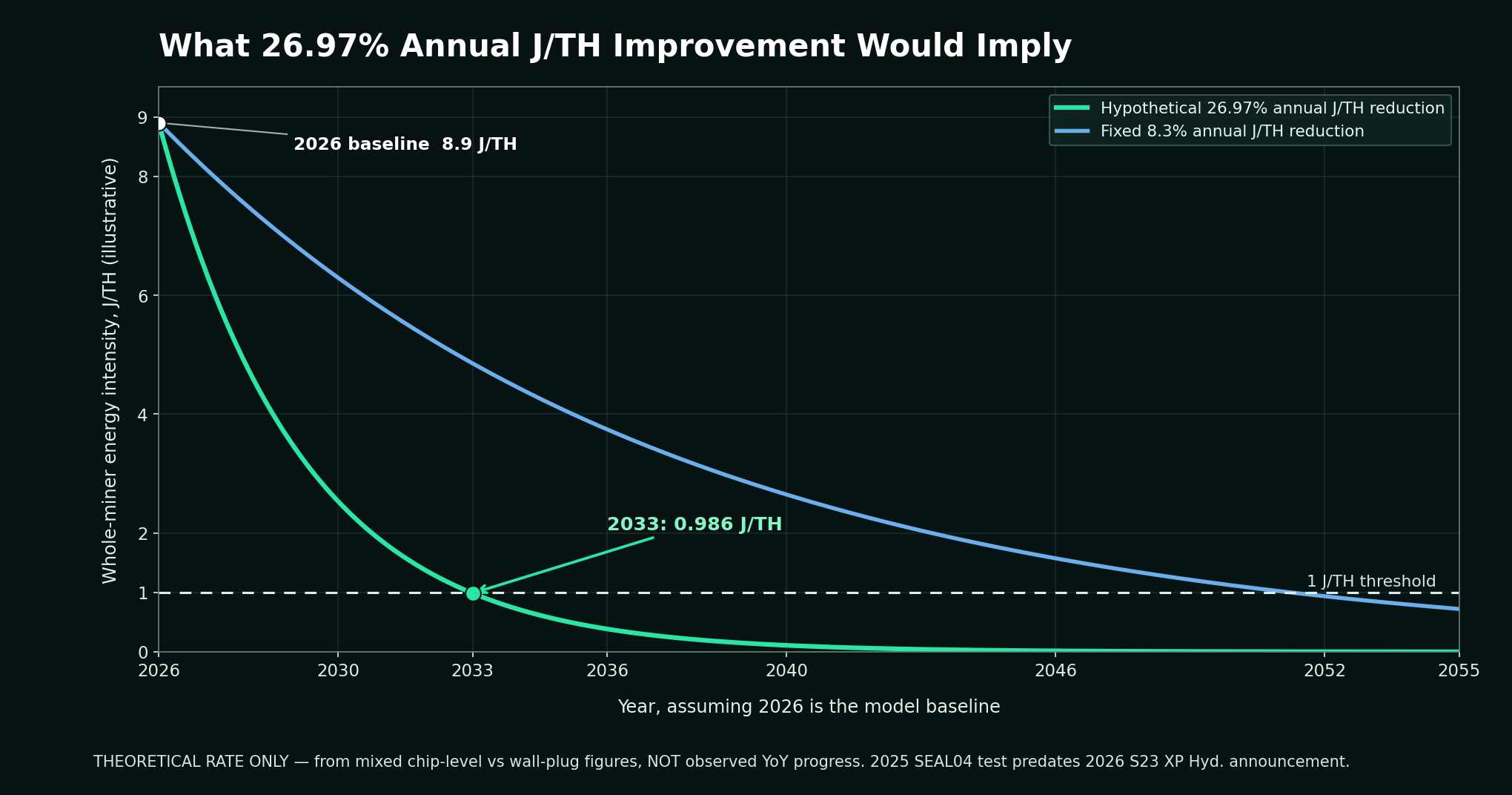
Bitcoin mining could mathematically approach 1 J/TH by 2033 if an annual 26.97% reduction in energy per terahash were sustained. The hypothesis compares BITMAIN’s 8.9 J/TH S23 XP Hyd. whole-miner specification with the 6.5 J/TH midpoint of Bitdeer’s SEAL04 chip-testing range. It is a theoretical comparison, not an observed year-over-year production trend.
The 26.97% Calculation
Bitdeer reported approximately 6–7 J/TH chip efficiency in its October 2025 operations report, issued November 10, under low-voltage, ultra-power-saving conditions. The SEAL04 roadmap places the chip generation in Q4 2025. BITMAIN announced its 8.9 J/TH S23 XP Hyd. in August 2026 for later delivery. These measurements therefore come from different manufacturers, dates and measurement boundaries.
The arithmetic is valid even though the timeline is not a real 12-month measurement: (8.9 − 6.5) ÷ 8.9 = 26.97% less energy per terahash. Its inverse, (8.9 ÷ 6.5) − 1 = 36.92%, means more hashes per joule. Calling either number an actual 2025–2026 whole-miner improvement would misrepresent the evidence.
How the 2033 Scenario Works
Applying the hypothetical annual reduction for seven years gives 8.9 × (6.5 ÷ 8.9)7 ≈ 0.986 J/TH in 2033. That closely matches the approximately 26.82% yearly reduction required to reach exactly 1 J/TH from an 8.9 baseline. By comparison, a constant 8.3% yearly reduction reaches the threshold around 2052.
Chip Testing Is Not Wall-Plug Performance
Chip-level success still must survive packaging, voltage conversion, controllers, thermal design and full-miner operation. Bitdeer’s April 2026 A4 Ultra Hydro announcement gave a 9.45 J/TH complete-miner rating, despite the earlier 6–7 J/TH silicon result. That gap is why the 2033 figure is a scenario, not a commercially validated forecast.
Key Takeaways
- 26.97%: hypothetical annual drop in J/TH from 8.9 to 6.5.
- 36.92%: equivalent increase in hashes per joule.
- 2033: modeled crossing, not a confirmed deployment target.
- Critical limitation: 6–7 J/TH is a prior chip test, not 2026 whole-miner performance.
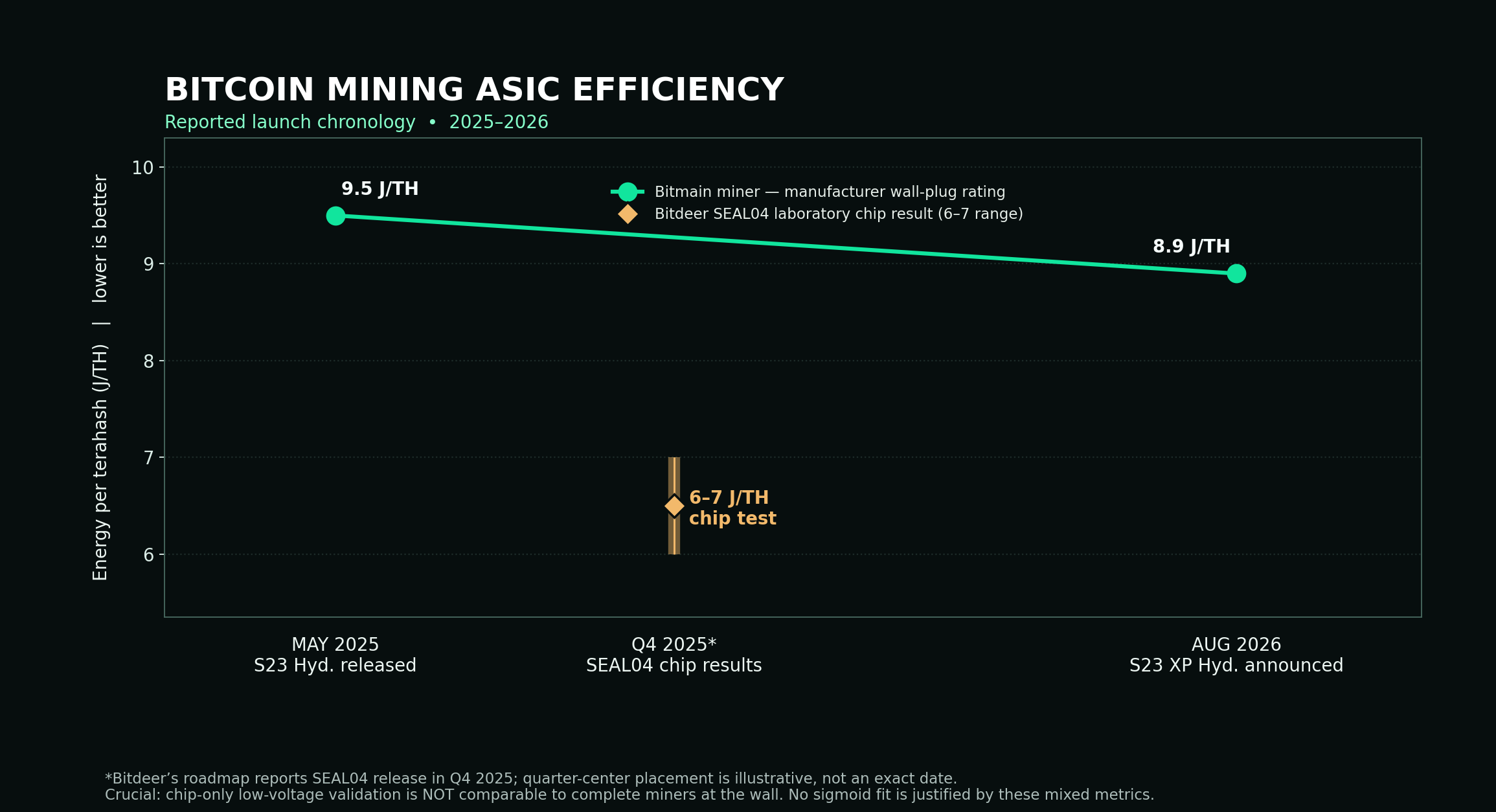
The new model accompanies BitcoinVersus.Tech’s chronological chip-versus-miner chart, 1 J/TH architecture investigation, 2025 SEAL03 reporting, and 2023 Power Is Money research. Because only two whole-miner points are available here, fitting a sigmoidal historical curve would imply evidence that does not exist.
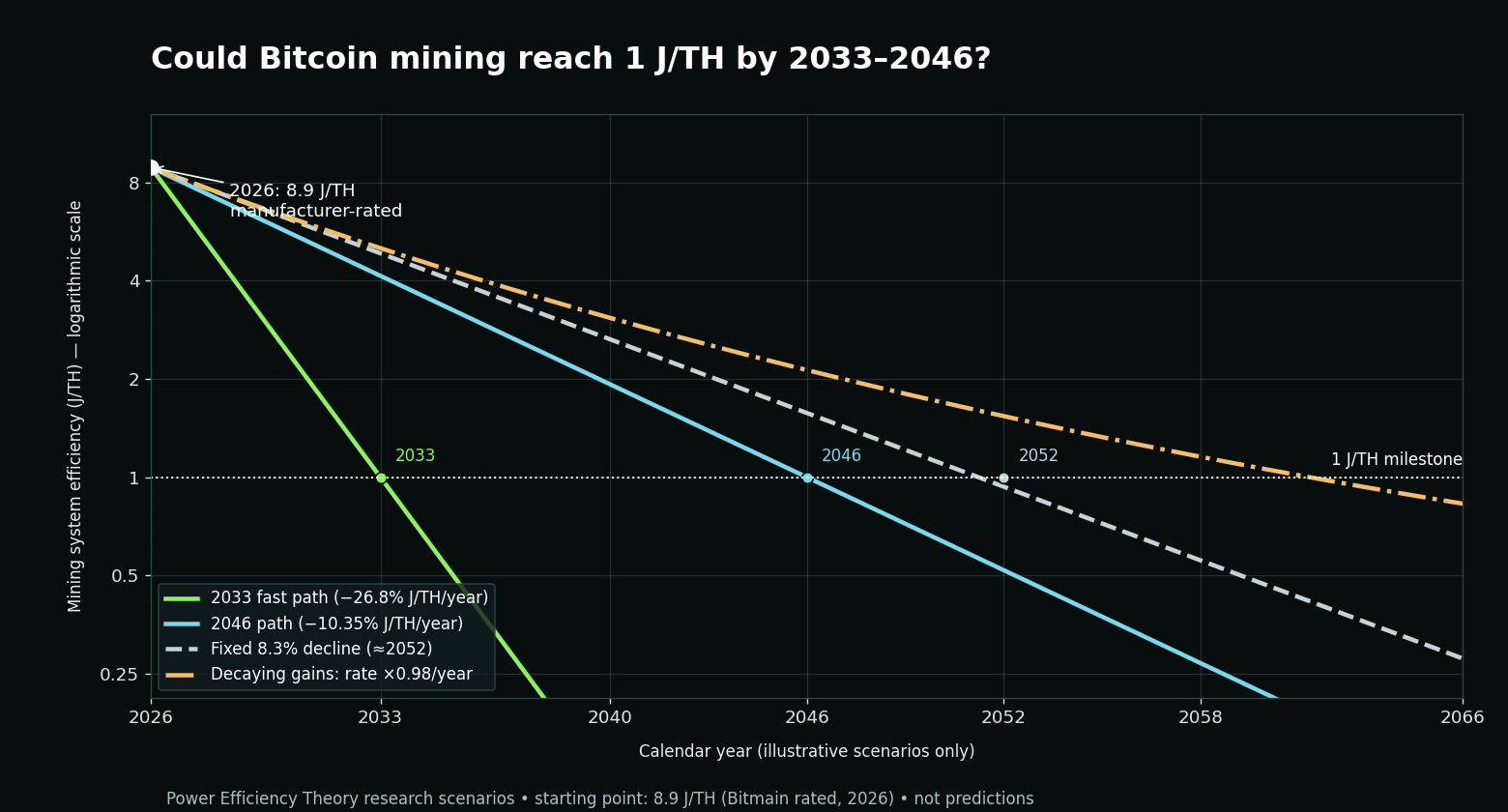
The essential next milestone is a repeatable sub-7 J/TH result at the wall, with published power, temperature, operating mode and production status. Until then, 2033 is a mathematically possible target, not a measured industry trajectory.
BitcoinVersus.Tech Editor’s Note: We volunteer daily to ensure the credibility of the information on this platform is Verifiably True. If you would like to support to help further secure the integrity of our research initiatives, please donate using the QR code provided

For best QR-code scanning results, please scan this donation code from a desktop or larger screen. Mobile screens may prevent camera recognition.


Leave a Reply