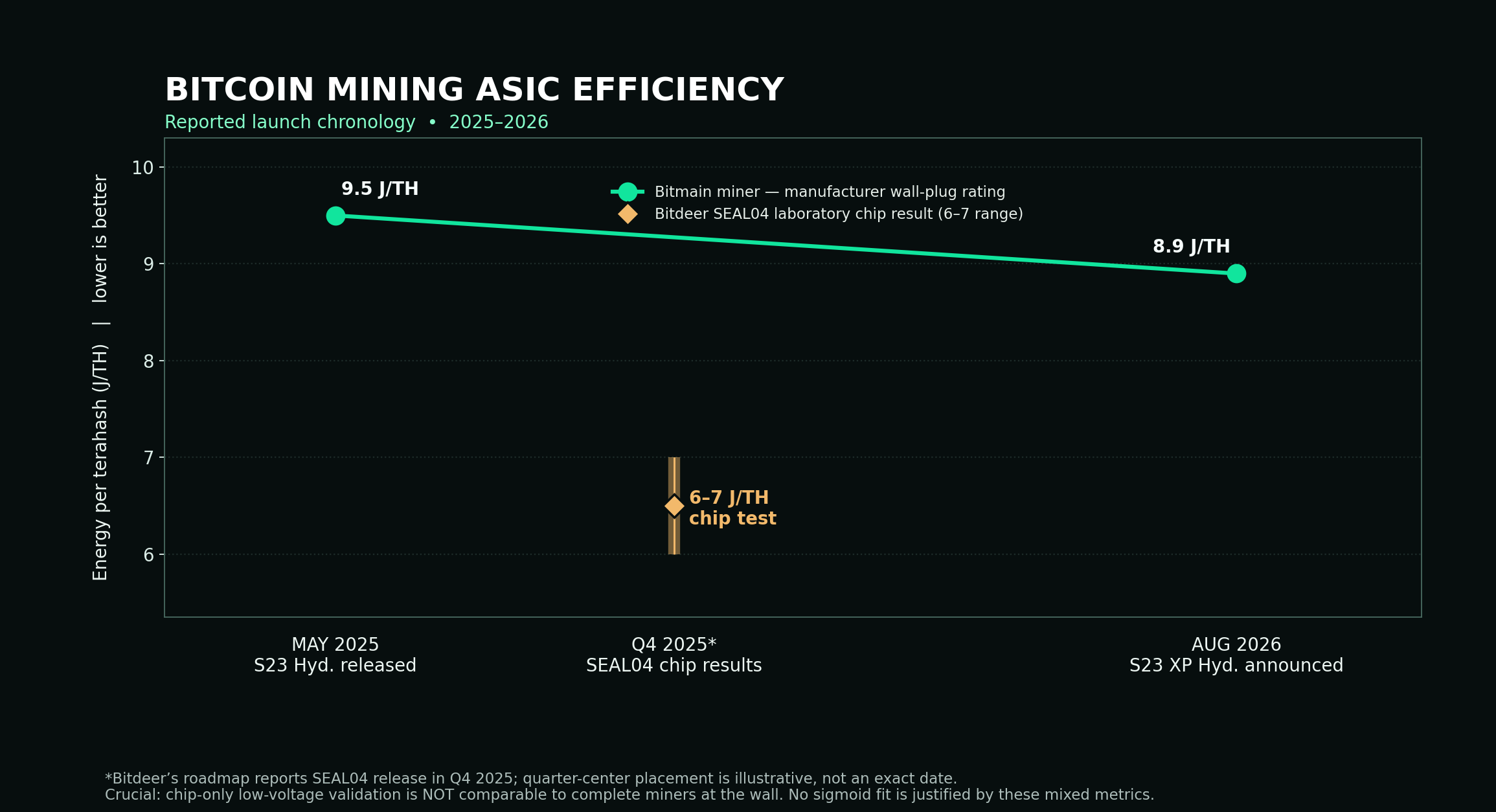
Bitcoin ASIC efficiency continues improving, but three often-quoted figures need careful labeling. BITMAIN rates its S23 Hyd. complete miner at 9.5 J/TH and S23 XP Hyd. at 8.9 J/TH. Bitdeer separately reports 6–7 J/TH for its SEAL04 chip under a low-voltage, ultra-power-saving test condition.
Three Different Disclosures
BITMAIN unveiled the S23 Hyd. in May 2025 and announced the S23 XP Hyd. in August 2026. Bitdeer dates the SEAL04 chip release to Q4 2025. These events belong on a chronological timeline, but chip and whole-miner efficiency should not be treated as the same measurement.
Important disclaimer: 6–7 J/TH is a chip-level validation result, not a verified production mining rig delivering 6.5 J/TH at the wall. Bitdeer launched SEAL04-powered A4 rigs in April 2026, with the A4 Ultra Hydro rated at 9.45 J/TH as a complete miner. The distinction is the measurement boundary, not whether SEAL04-powered hardware exists.
The newer BITMAIN S23 XP Hyd. is rated at 600 TH/s and 5,340 watts, or 8.9 J/TH. Its store listing schedules shipment from November 2026, so manufacturer specifications should not be confused with independently measured operating-fleet results.
What the Charts Show
The new chart marks Bitdeer’s 6–7 J/TH laboratory chip range separately from the two complete BITMAIN machines. Using 6.5 J/TH as a midpoint is only a visual convenience; it is not the measured energy efficiency of a commercial Bitdeer mining rig. In a hypothetical 12-month comparison from 8.9 to 6.5 J/TH, energy consumed per terahash falls 26.97%, equivalent to 36.92% more hashes per joule. This is not an observed year-over-year production improvement: the values come from different manufacturers, measurement boundaries and disclosure dates.
BitcoinVersus.Tech has examined power economics since 2023 and recently modeled possible 1 J/TH milestones in 2033, 2046 and later. Reusing that earlier projection alongside the new timeline makes an essential distinction: hypothetical technology pathways are not observed production performance.
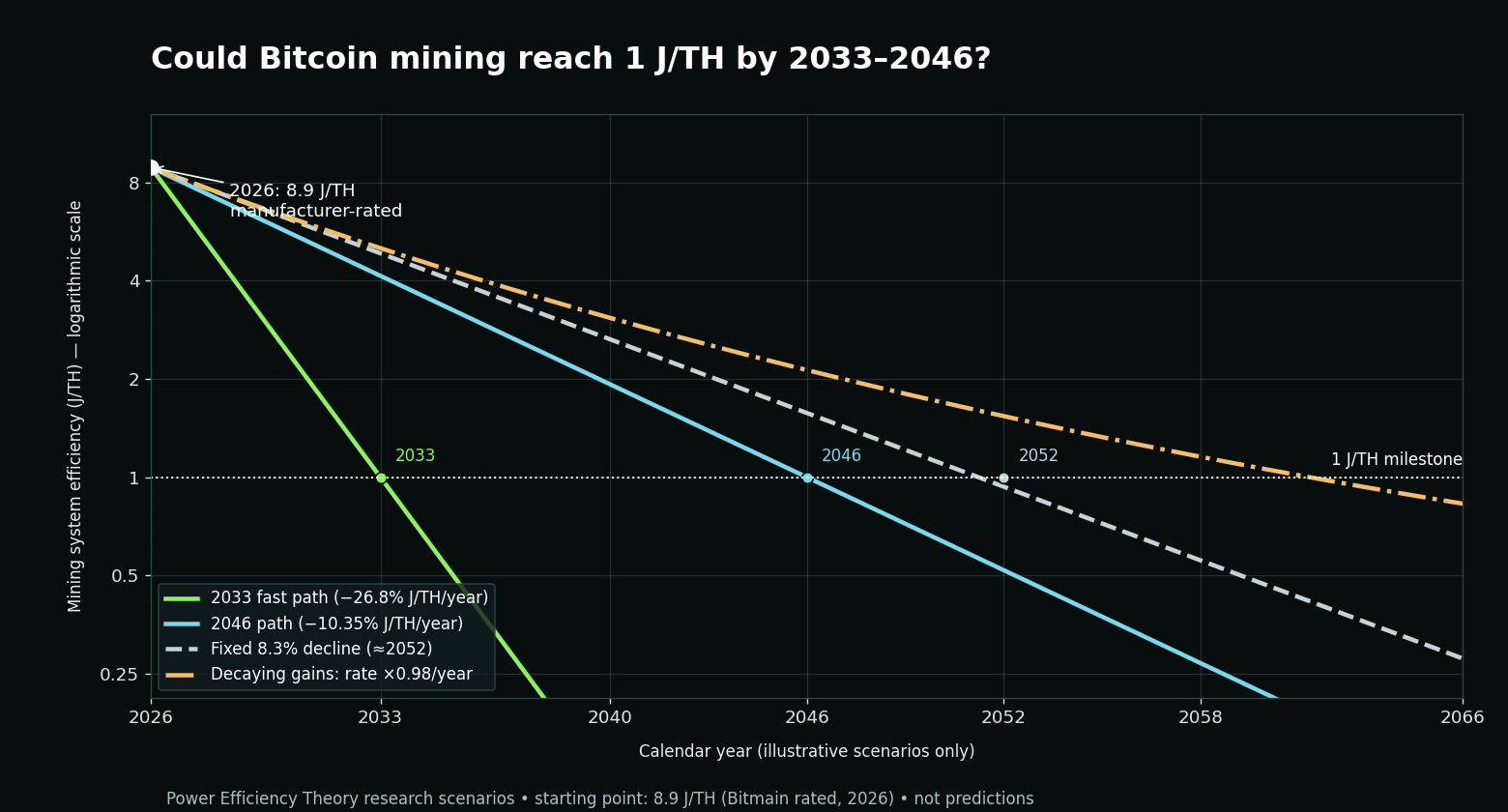
A sigmoidal curve is not suitable for just three differently measured values. Such an analysis requires a larger, comparable dataset covering chip tests, production wall-plug readings, and operating conditions. The future milestone to watch is a reproducible sub-7 J/TH complete miner validated during real operation.
BitcoinVersus.Tech Editor’s Note: We volunteer daily to ensure the credibility of the information on this platform is Verifiably True. If you would like to support to help further secure the integrity of our research initiatives, please donate using the QR code provided

For best QR-code scanning results, please scan this donation code from a desktop or larger screen. Mobile screens may prevent camera recognition.


Leave a Reply