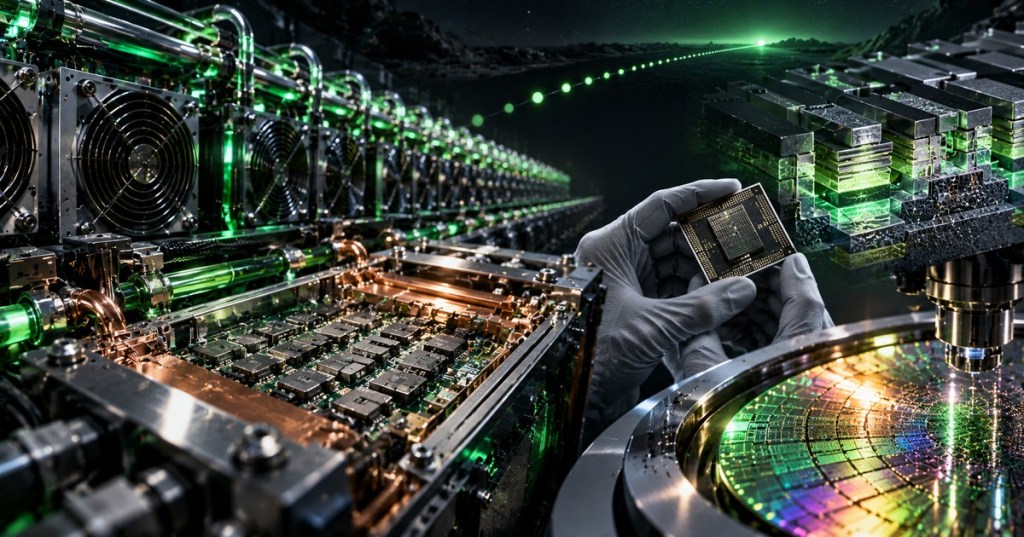
Could Bitcoin mining reach 1 joule per terahash by 2033—or might the threshold remain out of reach until 2046 or later? That is the question raised in BitcoinVersus.Tech’s latest Power Efficiency Theory post. Its central concern is that new Bitcoin ASIC generations may be delivering smaller efficiency gains than their predecessors. The important next question is which part of the technology must change: the SHA-256 architecture, the semiconductor process, the power system or some combination.
What Current Bitcoin Mining Hardware Actually Measures
One benchmark anchors the discussion. BITMAIN lists its ANTMINER S23 XP Hyd. at 600 TH/s, 5,340 watts and 8.9 J/TH. This is a manufacturer-rated wall-plug figure for a futures machine, not a population-wide measurement from field deployments. Its earlier S23 Hyd. was specified at 9.5 J/TH. That recent step is real on the manufacturers’ specification sheets, but it cannot alone establish that the rate of improvement must shrink every calendar year.
J/TH measures energy per terahash of SHA-256 work; lower is better. At an illustrative constant 1 EH/s, 8.9 J/TH implies about 8.9 MW of miner electrical load. At 1 J/TH it would require only 1 MW, before site overhead. That would be an 8.9-fold improvement in delivered work per joule from today’s reference, not proof of free energy or an absolute physical ceiling.
The distinction between chips and complete miners is crucial. Bitdeer’s SEAL04 roadmap reports approximately 6–7 J/TH at the chip level, whereas its complete A4 Ultra Hydro is rated at 9.45 J/TH. Power supplies, board distribution, controllers and other losses contribute to the difference. Better cooling can enable efficient operating conditions, but cooling by itself does not eliminate the energy required to toggle billions of transistors.
Key Takeaways
- Reference: S23 XP Hyd., 8.9 J/TH manufacturer-rated at the wall.
- 2033 case: 26.82% annual decline in J/TH from the 2026 baseline.
- 2046 case: 10.35% annual decline in J/TH.
- Fixed 8.3% case: Reaches 1 J/TH near 2051–2052, not 2046.
- Main question: Can CMOS chip, package and power-delivery innovations be compounded without prohibitive economic costs?
The Mathematics Behind 2033 And 2046
The original Bitcoin Mining Singularity research proposed 1 J/TH as a measurable technology milestone. In the October 16 scenario update, the site’s 8.3% AGR case was explicitly separated from an accelerated 2046 path. This follow-up asks what specific engineering innovations might make either endpoint realistic.
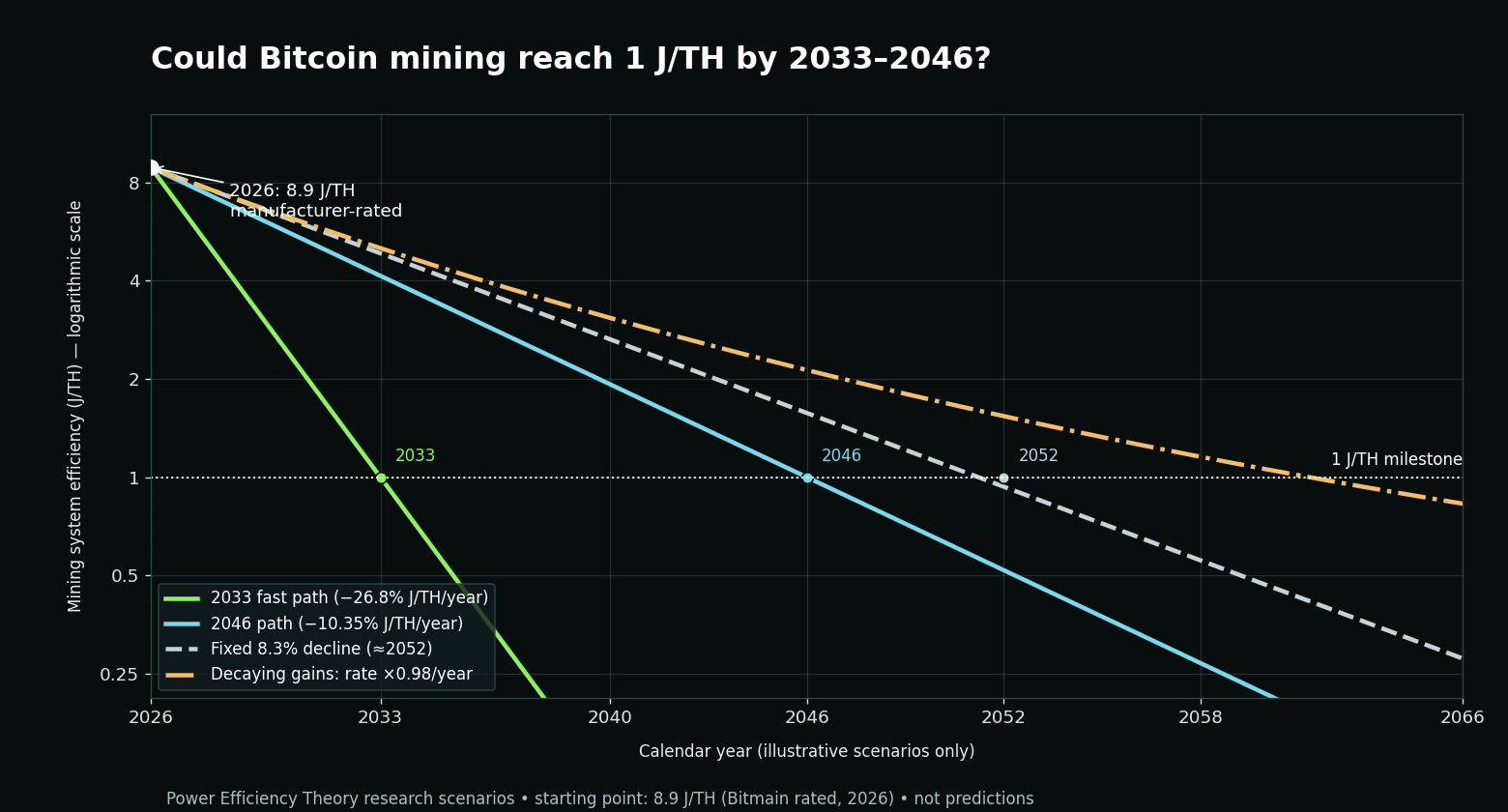
For a simplified constant percentage annual reduction in J/TH, let J(y) = 8.9 × (1 − r)(y−2026). Reaching 1 J/TH in 2033 requires r ≈ 26.82% for seven consecutive years. Reaching it in 2046 requires r ≈ 10.35% for 20 years. At a fixed 8.3%, the model first crosses 1 J/TH between 2051 and 2052; if that improvement rate decays over time, the crossing can move later still.
These percentages describe hypothetical reductions in the J/TH figure, not increases in hashrate and not a Power Efficiency Index valuation projection. A faster hashrate by itself does not establish a better J/TH rating. Neither model assumes a statistically estimated probability or guarantees continued semiconductor scaling.
| Illustrative path | Assumed annual J/TH change | Modeled milestone |
|---|---|---|
| 2033 high-acceleration case | 26.82% per year | 1.00 J/TH in 2033 |
| 2046 sustained-gains case | 10.35% per year | 1.00 J/TH in 2046 |
| Fixed recent-rate case | 8.3% per year | 1.00 J/TH near 2051–2052 |
| Diminishing-return sensitivity | Initial 8.3%, rate decays 2% relatively each year | Crosses roughly 2062 |
Can The Current SHA-256 ASIC Architecture Get There?
Today’s Bitcoin ASICs already use specialized CMOS logic designed to execute fixed SHA-256 operations very efficiently. Within that broad architecture, manufacturers can adjust datapath layouts, pipeline depth, clock distribution, voltage and frequency, switching activity and how power reaches the die. Optimizing an existing architecture is not the same as needing a replacement for Bitcoin’s proof-of-work algorithm.
Manufacturing can contribute as much as logic design. TSMC’s A16 nanosheet and backside-power technology is specified to reduce power 15–20% at the same speed versus N2P for certain designs, while helping power delivery and routing. Its N2 and future A14 process roadmap provides other transistor and design-technology improvements. These are foundry platform claims, not validated SHA-256 miner efficiency improvements; a particular ASIC must be redesigned, fabricated and measured before such percentages can be applied to J/TH.
The industry’s transistor transition is already relevant to mining. BitcoinVersus.Tech previously examined a TechInsights analysis of Samsung 3 nm gate-all-around technology in a WhatsMiner—evidence that mining ASIC designs can participate in leading-edge manufacturing. Progress may continue through newer nanosheet devices, better power grids, custom standard cells, tighter packaging and reduced switching losses. No public roadmap establishes how those increments combine into the roughly 89% reduction in current energy per hash needed to reach 1 J/TH.
Which New Semiconductor Technologies Might Be Needed?
A genuinely different architecture may become attractive when diminishing returns dominate. Possibilities include more aggressive low-voltage operation, fine-grained power control, deeper co-design between circuit topology and semiconductor process, specialized arithmetic cells and advanced three-dimensional integration. Each introduces practical penalties involving yield, leakage, thermal concentration, repairability, interconnects and cost. These are research directions, not announced commercial 1 J/TH products.
We should also avoid confusing the 1 J/TH milestone with the Landauer limit. That thermodynamic principle constrains the minimum energy of irreversible information erasure; it does not declare that all Bitcoin SHA-256 ASICs must stop improving at 1 J/TH. Quantum computing is likewise not an established low-energy shortcut that would deliver one terahash of Bitcoin-compatible proof-of-work for one joule.
The Economic Test And What To Measure
The manufacturing business matters. Leading nodes cost more to develop, tape out and fabricate, while miner profitability depends on energy prices, network difficulty, Bitcoin revenue per hash, uptime and capital expenditure. Even if a laboratory chip reaches 1 J/TH, the first economically manufacturable, repairable wall-plug miner might arrive considerably later. See BitcoinVersus.Tech’s ASIC-versus-site J/TH comparison and earlier Power Is Money research for the difference between theoretical progress and operating economics.
Slowing improvement rates deserve measurement rather than assumption. An effective research series should record each generation’s release date, process node, chip-only J/TH, measured wall-plug J/TH, operating mode, temperature and shipment volume. It should track comparable generations over several years instead of combining best-case lab figures with future commercial specifications. The distinction matters especially near single-digit J/TH, where cooling and power-delivery overhead become a greater share of the remaining budget.
Conclusion
Assessment: Conventional SHA-256-specific CMOS architecture is not known to be incapable of 1 J/TH, but no existing product or demonstrated scaling law proves it can get there on its own. 2033 is an exceptionally aggressive research scenario requiring sustained rapid gains or major advances; 2046 is mathematically less demanding, yet still uncertain if progress decays. New semiconductor manufacturing technologies, architectural refinements and system-level improvements are more plausible together than any single silver-bullet breakthrough.
The next milestone should be judged in two stages: first a reproducible chip-level result, then a tested complete miner at 1 J/TH at the wall with published operating conditions. Under Power Efficiency Theory, the Singularity date should change as verified hardware evidence changes. What matters is whether the technology curve can keep moving—not whether a memorable year survives the next ASIC generation.
BitcoinVersus.Tech Editor’s Note: We volunteer daily to ensure the credibility of the information on this platform is Verifiably True. If you would like to support to help further secure the integrity of our research initiatives, please donate using the QR code provided

For best QR-code scanning results, please scan this donation code from a desktop or larger screen. Mobile screens may prevent camera recognition.


Leave a Reply