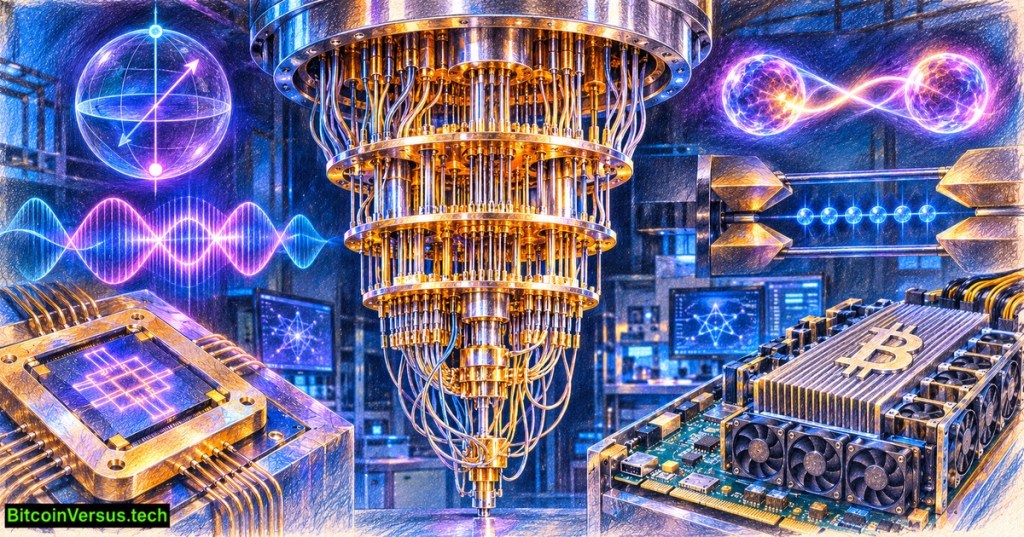
Quantum computing is a form of computation that controls quantum-mechanical systems to process information. Unlike an ordinary computer, which stores binary digits, a quantum computer manipulates qubits, using superposition, entanglement and interference. Certain algorithms can solve specifically structured mathematical problems much more efficiently than their best-known classical alternatives. Quantum computing does not make every program faster, read every possible answer at once, or render Bitcoin mining ASICs obsolete. NIST’s quantum computing overview provides an accessible foundation.
Reference status: Evergreen technical guide, reviewed November 19, 2026. Scope includes physics, hardware, software, error correction, real applications, limitations, Bitcoin, quantum mining and post-quantum security. Research milestones and future roadmaps can change; verified demonstrations and company targets are identified separately.
IBM Technology’s official introductory video explains the central concepts of quantum computing. Foundational education rather than a claim of universal computing superiority.
Contents
- Overview
- History and milestones
- Bits, qubits and quantum mechanics
- Quantum gates and circuits
- Hardware architectures
- How a quantum computer is built
- Noise, errors and fault tolerance
- Quantum algorithms
- What quantum computing is good for
- Benchmarks and limitations
- Quantum computing and Bitcoin
- Post-quantum cryptography
- Quantum networks and sensing
- Learning quantum computing
- Glossary
- Frequently asked questions
- References and further reading
Overview: what is a quantum computer?
A quantum computer is an engineered system that prepares qubits, performs controlled transformations and measures outcomes. The quantum processing unit, or QPU, runs specialized quantum circuits or other quantum operations. Classical processors still handle instructions, scheduling, error decoding, data preprocessing and final analysis. Quantum computing is best understood as a potential accelerator for selected workloads, not as a successor that removes CPUs, GPUs, networks or conventional storage.
A QPU may have hundreds or thousands of physical qubits while providing far fewer reliably protected logical qubits. Real computational usefulness depends on errors, connectivity, gate quality, circuit depth, logical operations and the classical system around the processor. NIST and IBM Quantum Learning distinguish measurable scientific progress from claims that simply count qubits.
History and milestones
| Year or period | Milestone | Why it matters |
|---|---|---|
| Early 1900s | Quantum mechanics develops | The physical theory underlying qubits, measurement and interference. |
| 1981–1985 | Feynman and Deutsch advance quantum computation ideas | Physical quantum systems become a formal model for computing. |
| 1994 | Peter Shor introduces quantum factoring and discrete-log algorithms | A future cryptographically relevant machine could threaten RSA and elliptic-curve signatures. |
| 1996 | Lov Grover presents unstructured quantum search | An ideal quadratic query speedup, not an automatic speedup for every application. |
| 2010s–2020s | Cloud QPUs and noisy intermediate-scale devices expand | Researchers test circuits and learn about performance and noise on real hardware. |
| 2024 | Google reports below-threshold surface-code memory on Willow | An experimental error-correction milestone, not a general-purpose fault-tolerant machine. |
| 2024 onward | NIST publishes core post-quantum cryptography standards | Organizations can begin migrating security before large-scale quantum attacks exist. |
Bits, qubits and quantum mechanics
Classical bits versus qubits
A classical bit has a value of 0 or 1. A qubit can be prepared in a quantum state written as α|0⟩ + β|1⟩, where α and β are generally complex amplitudes and |α|² + |β|² = 1. Measurement in the computational basis returns 0 with probability |α|² and 1 with probability |β|². A superposition is not a readable list containing every answer: one measurement yields one classical outcome, and the entire amplitude distribution cannot be freely copied or observed.
Superposition, phase, interference and entanglement
Superposition means a qubit can have amplitudes associated with multiple basis states. Phase is essential because quantum amplitudes can reinforce or cancel. Interference allows a well-designed algorithm to increase the probability of useful outcomes while suppressing others. Entanglement creates correlations between quantum systems that cannot always be explained by independently prepared states. Entanglement does not permit faster-than-light messaging.
The popular claim that n qubits run all 2n computations for free omits the hard part: constructing operations whose interference makes the desired answer measurable. Without a suitable algorithm, a vast state space can be computationally inaccessible. IBM’s quantum mechanics introduction covers the physical interpretation.
Quantum gates and circuits
A gate-model quantum algorithm prepares a state, applies reversible operations, then measures selected qubits. Gates act on amplitudes and phases. The circuit is repeated in multiple shots when statistical estimates are needed. Classical code often specifies the circuit and interprets the measured bit strings.
| Gate or operation | Typical role | Important caution |
|---|---|---|
| X | Flips the 0 and 1 basis states | Analogous to NOT only in the basis-state case. |
| H (Hadamard) | Creates or recombines superpositions | Interference depends on the surrounding circuit. |
| Z, S, T and rotations | Change relative phase or rotate qubit state | Phase can matter even without an immediately visible bit flip. |
| CNOT or CZ | Apply controlled two-qubit interactions | May generate entanglement, depending on the input. |
| Measurement | Converts a quantum outcome into a classical result | Outcomes are probabilistic; measurement disturbs the measured state. |
For example, applying H to a qubit initialized as 0 and then measuring yields roughly equal frequencies of 0 and 1 over many trials on an ideal device. Adding H a second time ideally returns the qubit to 0 through interference. An entangled two-qubit Bell-state experiment uses H followed by CNOT; correlated outputs demonstrate more than a pair of unrelated coin flips. Real experimental circuits contain noise and measurement errors.
Hardware architectures
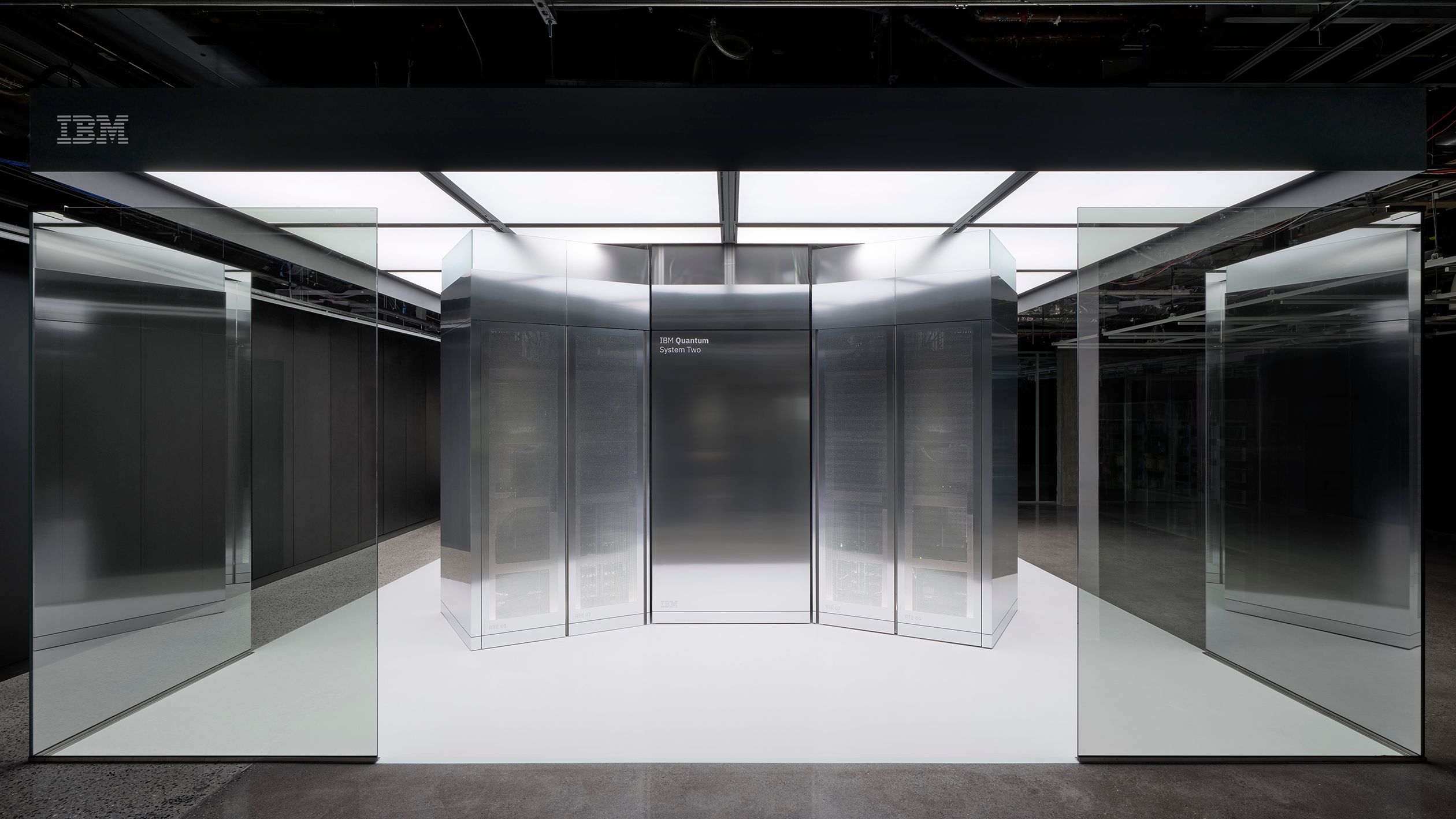
No one physical technology has won the long-term quantum computing race. The engineering requirements differ across superconducting circuits, ions, atoms, photons and semiconductor devices. Each architecture trades off physical qubit quality, size, connectivity, control complexity, operating conditions and manufacturing scalability.
| Architecture | How it encodes qubits | Strengths and constraints |
|---|---|---|
| Superconducting circuits | Microwave-controlled electrical states in cryogenic circuits | Fast gates and microfabrication; dilution refrigeration, wiring and crosstalk matter. |
| Trapped ions | Internal quantum states of charged atoms held in electromagnetic traps | High-quality operations and flexible connectivity; slower gates and optical control overhead. |
| Neutral atoms | Laser-controlled neutral atoms held in optical tweezers | Large reconfigurable arrays; laser stability, atom loss and gate reliability matter. |
| Photonic systems | States of individual photons in optical hardware | Natural communication compatibility; photon loss, sources and detectors are major challenges. |
| Semiconductor spins | Electron or nuclear spins in solid-state devices | Potential chip-manufacturing compatibility; precise control and uniformity remain difficult. |
| Topological approaches | Information encoded in protected collective states | A promising protection strategy still facing substantial proof and scale-up hurdles. |
Gate-model, analog and quantum annealing systems
Most algorithms in the preceding sections use the gate model, where controlled quantum operations form a circuit. Analog quantum simulators instead engineer interactions that emulate a target physical system. Quantum annealers, including commercial D-Wave platforms, steer a system toward low-energy configurations for optimization-style problems. Annealers are not interchangeable with universal fault-tolerant gate-model machines and do not directly run Shor’s cryptographic attack. Claims of commercial advantage require appropriate comparisons with classical optimization methods.
How a quantum computer is built
The full system usually includes a quantum processor, control electronics, lasers or microwave generators, calibration software, measurement hardware, a classical controller and a networked software interface. Many superconducting platforms cool the processor to millikelvin temperatures using a dilution refrigerator. The large gold or silver hanging structure often photographed is mostly refrigeration and wiring; the quantum chip itself occupies a much smaller component.
At execution time, a compiler translates high-level operations to gates compatible with a particular device. Pulses or optical controls implement those gates, measurement hardware retrieves results, and classical software collects statistics. As circuits grow, high-speed decoders are required to interpret error-syndrome data. Hybrid workflows use CPUs or GPUs alongside QPUs, as explored in BitcoinVersus.tech coverage of NVIDIA, IBM and Fermilab’s quantum-supercomputing collaboration.
Noise, errors and fault tolerance
Qubits are sensitive to decoherence, imperfect gates, measurement error, leakage and unwanted interaction with their environment. A device can run a short circuit while failing on the long sequence required for a useful algorithm. Error suppression improves physical control, error mitigation estimates the effect of noise after data collection, and quantum error correction encodes quantum information redundantly so errors can be detected and repaired without reading the protected logical state directly.
A logical qubit is encoded across multiple physical qubits plus repeated syndrome measurements. Its overhead depends on hardware error rates, algorithm size and the chosen code. Surface codes are prominent, while other families include quantum low-density parity-check codes. The error-correction threshold is a regime where adding protective redundancy can lower logical errors. Google demonstrated below-threshold surface-code memory on Willow in research published in Nature in December 2024. The achievement did not establish a universal cryptography-breaking computer. Read the primary paper.
Official Google Quantum AI demonstration explaining error correction and logical qubits. The film documents a research milestone, not a universally fault-tolerant commercial machine.
Roadmaps from vendors such as IBM describe future fault-tolerant systems with specified logical qubit and operation targets. Those are development plans, not delivered capabilities. A credible claim should identify logical error rate, operation fidelity, number of logical operations completed, experimental conditions and independent reproducibility.
Quantum algorithms
| Algorithm or family | Main idea | Practical status or limit |
|---|---|---|
| Shor | Factors integers and solves discrete logarithms efficiently in a suitable fault-tolerant model | Threatens RSA and elliptic-curve signatures at sufficient scale; not practical against modern keys on present devices. |
| Grover | Quadratic query speedup for an ideal unstructured search | Real speed depends on coherent oracle cost, error correction and timing constraints. |
| Quantum phase estimation | Extracts phase information from controlled quantum evolution | A foundation for several algorithms; precision can require long, reliable circuits. |
| Quantum simulation | Models quantum systems and materials | A major research motivation; benefits depend on system and validated accuracy. |
| VQE and QAOA | Hybrid heuristic circuits plus classical optimization | Interesting research tools, without general proof of commercial speedup over the best classical methods. |
Shor’s algorithm and Grover’s algorithm matter especially for digital security. Shor threatens the mathematical structure behind widely deployed asymmetric signatures and key exchange. Grover affects ideal brute-force search by reducing query complexity from roughly N to √N, but practical reversible computation is not free. Neither means that all AES, SHA-256 or Bitcoin transactions are instantly broken.
What quantum computing may be good for
The strongest scientific motivations include quantum chemistry, molecular energy levels, magnetic systems and materials research where accurate classical simulations can be expensive. Pharmaceutical discovery, catalysts, batteries and high-temperature materials are potential applications, but a useful output still requires validated chemistry and laboratory experiments. Optimization, finance and machine learning are active areas, although claims of broad quantum speedups frequently lack comparable classical baselines.
Quantum simulation is not the same as a quantum sensor or quantum network. A precise atomic clock, a magnetic-field sensor or a quantum key distribution link uses quantum phenomena without being a programmable general-purpose quantum computer. See prior BitcoinVersus.tech reporting on quantum navigation for a distinct technology category.
Benchmarks, advantage and limitations
A headline boasting many qubits may omit the actual error rate, connectivity or circuit depth. Useful evaluation includes single- and two-qubit gate fidelity, measurement fidelity, runtime, calibration stability, logical error rate, successful logical operations, application quality and comparisons with optimized classical hardware. Quantum advantage generally means a demonstrated advantage on a defined task; a narrowly chosen sampling benchmark does not mean superiority for databases, spreadsheets, gaming or AI training.
For example, Google’s Willow research reported a specific improvement in quantum error correction, while the company’s sampling experiments address other benchmarks. Neither alone establishes a practical replacement for a CPU or a useful cryptanalysis machine. Independent reproducibility and complete experiment descriptions matter more than unqualified comparisons to theoretical classical runtimes.
Quantum computing and Bitcoin
Bitcoin combines multiple cryptographic mechanisms. Transaction signatures based on ECDSA and BIP-340 Schnorr over secp256k1 authorize spends. SHA-256 and related hashing operations serve different purposes, including transaction identifiers, Merkle trees and proof of work. The quantum threats are therefore different. BitcoinVersus.tech separately examines whether quantum computers could compromise Bitcoin.
Signatures: where Shor matters
A sufficiently capable fault-tolerant quantum computer running Shor’s discrete-logarithm algorithm could derive a private key from a corresponding elliptic-curve public key. Bitcoin’s original ECDSA and Taproot’s Schnorr signatures are both affected by that underlying mathematical problem. Some payment forms, including unused pay-to-public-key-hash or pay-to-witness-public-key-hash outputs, initially reveal a hash rather than a full public key; spending reveals the key. Older pay-to-public-key outputs and Taproot key-path outputs already expose the relevant public key or tweaked key on-chain. Reusing an address can therefore widen exposure.
Key exposure is not the same as demonstrated theft. No publicly established quantum computer has recovered Bitcoin private keys from modern secp256k1 public keys at real-world scale. Attacks that must finish between transaction broadcast and confirmation face even tighter time constraints. Quantum-resilient spending designs would require consensus, wallet, software and operational changes; users should not assume a proposed upgrade is already activated.
Mining: where Grover matters
Bitcoin miners repeatedly compute double-SHA-256 hashes and compare outputs with a target. Grover-style amplitude amplification offers a theoretical quadratic query improvement for suitable search formulations. Yet a quantum SHA-256 oracle requires coherent reversible logic and extensive overhead. The search must finish against competition from high-throughput, parallel ASICs and a moving block template, while Bitcoin difficulty adjusts over time. A theoretical √N scaling result is not equivalent to a measured TH/s advantage or to immediately gaining majority hashrate.
Peer-reviewed quantum Bitcoin mining research examines those algorithmic conditions; it does not establish commercial quantum mining superiority. For real-world energy and efficiency constraints, compare BitcoinVersus.tech’s ASIC architecture efficiency analysis. The Bitcoin network’s principal nearer-term quantum migration problem concerns signatures, not an instant collapse of SHA-256 mining.
| Bitcoin component | Quantum concern | Cautious interpretation |
|---|---|---|
| ECDSA and Schnorr signatures | Shor’s discrete-log algorithm threatens exposed elliptic-curve public keys | Requires a large, error-corrected attacker and a migration strategy. |
| P2PKH / P2WPKH outputs | Public-key hash initially obscures a key until spending | Key reuse, spending and short exposure change the risk. |
| P2TR / Taproot outputs | A tweaked x-only public key is exposed in the output | Key-path exposure requires special attention in future proposals. |
| SHA-256 proof of work | Grover provides an idealized search-query advantage | Circuit cost, fault tolerance, block timing and ASIC competition dominate feasibility. |
Post-quantum cryptography: how systems prepare
Post-quantum cryptography, or PQC, comprises mathematical algorithms designed to resist known attacks by both conventional and quantum computers. The algorithms normally execute on ordinary processors; using PQC does not require owning a quantum computer. NIST finalized three foundational standards in August 2024: FIPS 203 for ML-KEM key establishment, FIPS 204 for ML-DSA digital signatures, and FIPS 205 for SLH-DSA hash-based digital signatures. See NIST’s standards project.
ML-KEM helps parties derive shared secrets for encrypted communications; it is not directly a Bitcoin transaction signature. ML-DSA and SLH-DSA provide different digital signature designs, each with trade-offs in public keys, signatures, verification and implementation. Organizations must inventory algorithms, protocols, long-lived data, embedded systems, firmware and trust roots. NIST’s October 2026 transition guidance describes a broad migration away from quantum-vulnerable federal cryptographic standards by 2035, with earlier treatment for some high-risk uses. That federal schedule is not a Bitcoin protocol deadline.
Bitcoin’s post-quantum migration requires a separate open review and consensus process. BIP 360 explores a script-tree output form without the quantum-vulnerable Taproot key-path spend. A proposal is not an activated consensus change, and complete post-quantum signatures raise additional issues involving blockchain data size, validation cost, wallet support and key migration. See the earlier post-quantum cryptography explainer and research on wallet signature experiments.
Official IBM Research film, June 2025, on the engineering required for large-scale fault tolerance. The stated system targets are a roadmap, not verified future delivery.
Quantum networks and sensing
Quantum networking distributes quantum states or entanglement between locations. Quantum key distribution relies on quantum communication but still needs authenticated classical infrastructure and specialized equipment. Quantum sensors exploit sensitive quantum states to measure time, fields or motion. Those technologies overlap with quantum computing research while serving different purposes. None should be described simply as a faster internet or a device able to transmit classical information instantaneously.
How to start learning quantum computing
A useful path begins with complex numbers, linear algebra, probability and basic programming. Learn vectors and matrices, then single-qubit states, Hadamard and phase gates, CNOT, entanglement, measurement and short circuits. Write the same tiny example in a simulator and on a real noisy device, comparing ideal probabilities with measured outputs. Next study multi-qubit gates, compilation, noise and error correction before attempting algorithms such as phase estimation.
IBM offers a first quantum program using Qiskit and a free educational library. Simulators are valuable, but conventional memory needed to represent a general n-qubit state grows exponentially with n. Real hardware access may have queue, account, calibration and execution limits. A classroom Bell-state demonstration is an excellent start; it is not evidence of commercially useful quantum advantage.
Glossary
| Term | Definition |
|---|---|
| Qubit | A controllable quantum two-level information system. |
| Amplitude | Complex-number weight of a basis-state component. |
| Superposition | A state with multiple nonzero basis-state amplitudes. |
| Entanglement | Quantum correlations not always reducible to independent local states. |
| Interference | Reinforcement or cancellation of probability amplitudes. |
| Gate | An intended transformation of quantum state. |
| Shot | One circuit preparation, execution and measurement sample. |
| Coherence | Preservation of phase relationships needed for quantum information. |
| Physical qubit | A particular physical degree of freedom used to encode quantum information. |
| Logical qubit | An encoded qubit protected by quantum error correction. |
| Syndrome | Classical information identifying likely error patterns without directly reading the protected logical value. |
| Fault tolerance | Ability to perform reliable computation using imperfect components and correction. |
| QPU | Quantum processing unit controlled by surrounding classical equipment. |
| Quantum advantage | Evidence that a quantum method outperforms specified classical methods on a defined task. |
| PQC | Classical cryptography designed to resist known quantum algorithms. |
Frequently asked questions
Are quantum computers already more powerful than ordinary computers?
Only on particular experimental tasks and under specified comparisons. For general software, modern CPUs and GPUs remain practical and more economical.
Does a qubit represent both 0 and 1 at once?
A qubit can have nonzero amplitudes for the 0 and 1 basis states, but one computational-basis measurement returns just one outcome. Phase, interference and measurement rules are essential.
Could a quantum computer instantly break Bitcoin?
No demonstrated system can do so. A future fault-tolerant machine could threaten exposed elliptic-curve public keys, while migration and operational decisions determine practical risk.
Can quantum computers mine Bitcoin faster than ASICs?
A theoretical Grover query speedup exists, but no verified quantum mining system has established a real-world advantage over high-throughput SHA-256 ASIC farms.
Is quantum computing the same as AI?
No. AI systems normally use classical hardware today. Quantum algorithms for machine learning remain a research area, and a QPU is not automatically a better AI accelerator.
Is a quantum computer always extremely cold?
No. Superconducting implementations require extreme refrigeration, while trapped ions, neutral atoms and many photonic approaches rely on other environmental and optical requirements.
What is the difference between physical and logical qubits?
A physical qubit is a hardware information carrier. A logical qubit is encoded across physical resources to resist errors; the resource overhead varies by architecture and code.
When will fault-tolerant quantum computers arrive?
There is no independently established delivery date for broadly useful, cryptographically relevant fault-tolerant systems. Vendor roadmaps are hypotheses and engineering commitments, not guarantees.
References and further reading
Primary and educational resources: NIST, Quantum Computing Explained; IBM Quantum Learning, Bits, Gates and Circuits; IBM Quantum Learning, Error Correction; Google Quantum AI, Nature error-correction study; NIST Post-Quantum Cryptography; NIST IR 8547 transition guidance, October 2026; Bitcoin BIP 340 Schnorr Signatures; Bitcoin BIP 360 proposal; Quantum Bitcoin Mining research. All material is educational; future hardware capabilities remain uncertain.
Editor’s Note: We volunteer daily to ensure the credibility of the information on this platform is Verifiably True. If you would like to support our work and help further secure the integrity of our research initiatives, please scan the QR code below to donate 5,000 sats.

Disclaimer: BitcoinVersus.tech provides independent science and technology journalism, not financial, investment, cryptographic deployment or engineering advice. Security guidance, standards, vendor claims and proposed protocol changes can evolve. Seek official documentation and qualified specialists before making consequential decisions.


Leave a Reply