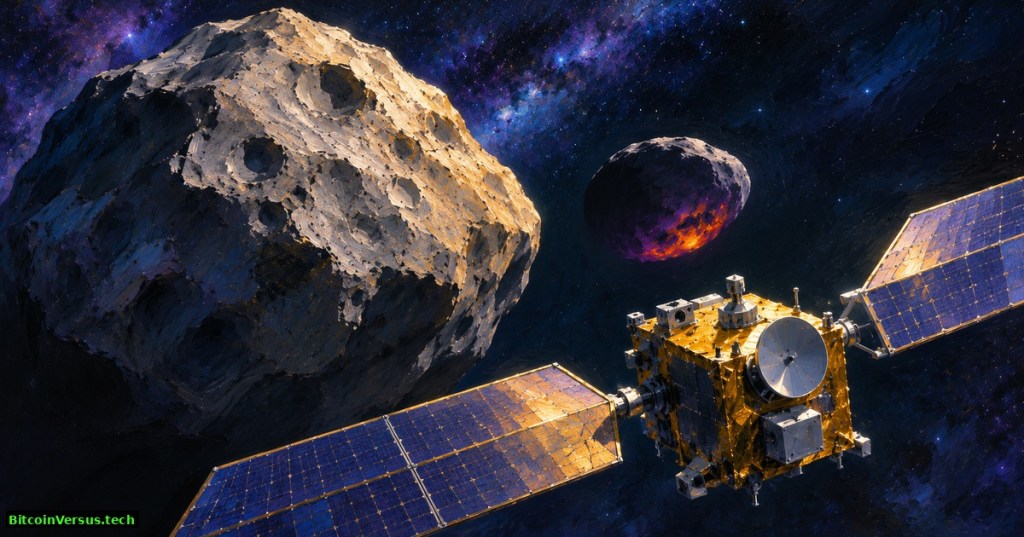
Europe’s Hera spacecraft has photographed a small asteroid that NASA struck four years ago, revealing the otherwise shadowed object with a Japanese-built infrared camera. The European Space Agency released the new observations on November 17, 2026. They were collected on November 6 from approximately 28.5 kilometers away, during Hera’s investigation of the Didymos binary asteroid system.
The new views combine ordinary monochrome photographs, multispectral measurements and thermal infrared imaging. The larger, roughly 780-meter Didymos dominates the scene. Its 151-meter moon, Dimorphos, is largely invisible in reflected sunlight, but appears in the thermal camera’s false-color image. ESA’s mission update calls attention to a useful distinction: an object may be too dark to see clearly at visible wavelengths while remaining detectable through emitted infrared radiation.
Official European Space Agency video published June 30, 2026, explaining the DART impact and Hera’s planned investigation. Archival mission context, not footage from the new infrared observation.
Three instruments, three views of one asteroid
Hera’s Asteroid Framing Camera captured Didymos in monochrome at about 2.7 meters per pixel, exposing surface features and the equatorial ridge on its rapidly rotating, spinning-top-shaped body. ESA says Didymos completes a rotation in roughly 2.2 hours. Mission scientists are evaluating how its rotation may move rocks and loose material toward the equator.
HyperScout H adds 25 spectral bands extending from visible red into near-infrared wavelengths. Comparing reflected-light spectra with laboratory mineral and meteorite measurements can help infer composition. Those spectral differences are not photographs showing the asteroid in colors visible to the naked eye.
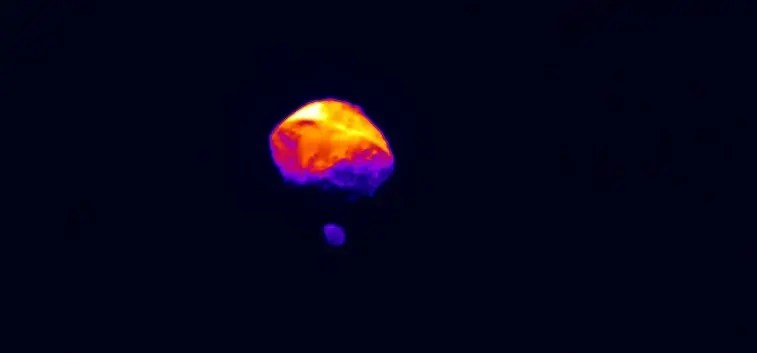
The third instrument, the Thermal Infrared Imager, or TIRI, was supplied and is operated by Japan’s space agency, JAXA. It measures infrared emissions that depend on temperature and surface characteristics. Researchers plan to use temperature patterns over time to distinguish rock and porous material from fine regolith. A brightly colored thermal rendering, however, cannot independently establish an exact surface temperature, mineral type or impact-crater shape without analysis.
Why NASA’s 2022 collision still matters
NASA’s Double Asteroid Redirection Test struck Dimorphos on September 26, 2022. The approximately 580-kilogram DART spacecraft hit at about 6.1 kilometers per second. Follow-up observations showed that Dimorphos completed its orbit around Didymos about 33 minutes faster than before. It was the first deliberate, measurable alteration of another celestial body’s orbital motion by a spacecraft.
Yet the orbital change alone does not tell researchers precisely how the collision redistributed material. Debris leaving an asteroid can add momentum beyond the spacecraft’s direct impact. Hera aims to estimate the moonlet’s mass, structure and shape to clarify why the experiment exceeded early model predictions. Claims of a newly discovered DART crater or a confirmed global reshaping would be premature before the close-up analysis.
Official ESA video published September 12, 2026, introducing the Hera mission’s science and communication platform. The material predates Hera’s November asteroid imagery.
The next images are scheduled for November 25
ESA plans to unveil detailed post-impact imagery of Dimorphos at a public event on November 25, 2026. The images available before that event are preliminary mission observations, not the full scientific outcome. Hera is working near the pair at approximately 25 to 30 kilometers rather than following a conventional circular orbit, an approach adapted to the asteroids’ weak gravity.
Over the coming months, Hera intends to bring its instruments closer and deploy two small CubeSats, Milani and Juventas. The work complements wider robotic exploration, including our coverage of ESA and JAXA’s BepiColombo mission and NASA CubeSat propulsion tests. Related reporting on electric thrusters and the Voyager spacecraft shows the range of hardware needed to study distant worlds.
For planetary defense, Hera’s greatest value will be turning a successful one-off collision into a better-characterized engineering technique. The thermal camera has already demonstrated why measuring an asteroid takes more than one kind of light. Whether future missions can predict an asteroid’s response reliably depends on the measurements yet to come.
Primary sources
- European Space Agency, November 17, 2026: Hera observing in visible, spectral and infrared light
- ESA, November 18, 2026: planned November 25 image presentation
- ESA: Hera’s low-gravity rendezvous operations
- JAXA Hera instrument and mission observation planning
- ESA official Hera mission page
Editor’s Note: We volunteer daily to ensure the credibility of the information on our platform is Verifiably True. If you would like to support our work and the integrity of our research initiatives, please scan the QR code below to donate 5,000 sats.

For mobile scanning, open the article on another display and scan the QR code with a Bitcoin wallet. Verify receiving address 3C9o19EH5HSiwEPyCTmEKzxhNCbo2X6TTb before sending.
BitcoinVersus.Tech provides science, technology and financial journalism for informational purposes and does not provide financial, investment or professional engineering advice.


Leave a Reply