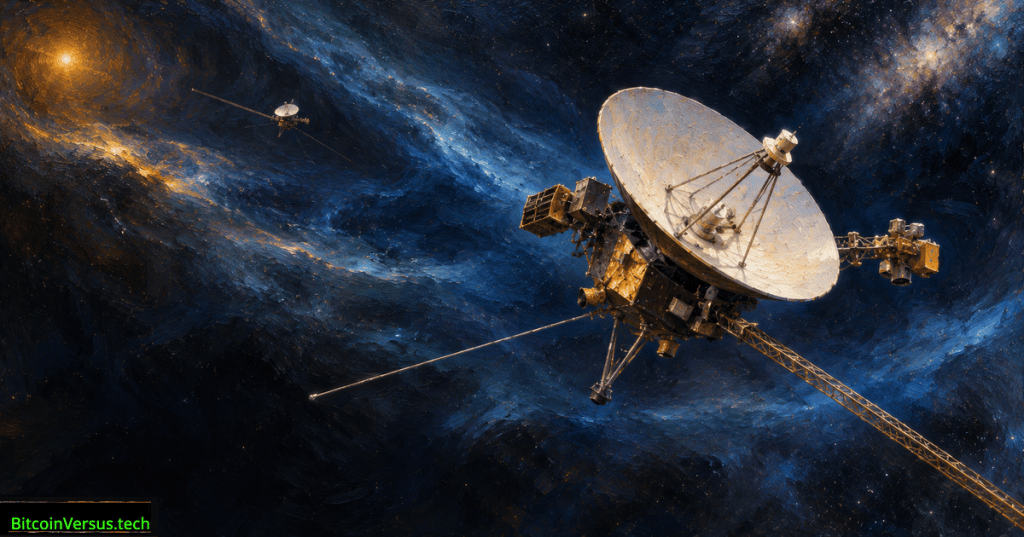
Where are NASA’s Voyager spacecraft after nearly half a century? As of November 18, 2026, Voyager 1 is approximately 25.902 billion kilometers, or 16.094 billion miles, from Earth. Voyager 2 follows a different interstellar route at roughly 21.68 billion kilometers, or 13.47 billion miles, from Earth. Both are robotic space probes, not satellites orbiting Earth, and both have crossed the boundary of the Sun’s protective solar-wind bubble.
At 2:16:07 a.m. Pacific on Wednesday, Voyager 1 became the first human-made object one light-day from Earth, according to NASA. A radio signal traveling at light speed now takes approximately 24 hours one way. Voyager 2’s signal needs approximately 20 hours and five minutes. NASA’s official Voyager location page links to interactive three-dimensional views of both spacecraft. Distances change continuously and slightly with Earth’s orbital position.
NASA Jet Propulsion Laboratory: “How Far Away Is Voyager 1? One Light-Day, Explained,” November 2026. Official mission visualization and technical context.
Two spacecraft traveling in different directions
Voyager 1 departed Earth on September 5, 1977. After encounters with Jupiter and Saturn, including Saturn’s moon Titan, it headed approximately 35 degrees above the plane of the planets, toward the constellation Ophiuchus. Voyager 2 launched August 20, 1977, visited Jupiter, Saturn, Uranus and Neptune, and now travels about 48 degrees below that plane, generally toward Sagittarius and Pavo. The probes are not flying together or targeting the same destination.
Voyager 1 crossed the heliopause, the boundary between the solar wind and surrounding interstellar plasma, in August 2012. Voyager 2 crossed in November 2018. Neither spacecraft has left the Sun’s larger gravitational domain or passed the Oort Cloud, the immense and distant region of icy bodies potentially extending tens of thousands of astronomical units outward.
NASA Solar System’s original November 18 confirmation on X records Voyager 1 reaching one light-day from Earth. The milestone complements, rather than replaces, the separate Voyager 2 position measurement.
What does a 40-hour conversation mean?
The Deep Space Network uses large radio antennas on Earth to exchange telemetry and commands with the probes. A simple command-and-response exchange with Voyager 1 takes roughly 48 hours, even before teams analyze the reply. Voyager 2’s equivalent light-travel round trip is about 40 hours. Engineers therefore cannot steer either spacecraft in real time like a drone.
NASA’s April 2026 instrument table lists magnetometers and plasma-wave subsystems operating on both spacecraft. The cosmic-ray subsystem remains active on Voyager 2 but was switched off on Voyager 1 to conserve power. Imaging cameras have been inactive since 1989 or 1990. Neither probe is sending contemporary pictures of the stars ahead. Their priority is measuring particles and fields in interstellar space.
NASA Jet Propulsion Laboratory: “Voyager Spacecraft: Humanity’s Farthest Journey,” an archival mission video explaining the twins’ planetary encounters and ongoing exploration.
How much farther can they go?
The Voyagers carry radioisotope power supplies that lose electrical output over time. NASA has switched off heaters and instruments to preserve communications and priority science. Mission managers must balance remaining power against the cost of operating old hardware under extreme thermal and communication constraints. Sustained contact into the next decade is possible, but no fixed shutdown date is guaranteed.
NASA estimates Voyager 1 will reach the inner Oort Cloud in approximately 300 years and may require about 30,000 years to pass through it. Voyager 2 is expected to reach the one-light-day milestone in 2035, even if it is no longer communicating by then. A distant stellar flyby for either craft remains tens of thousands of years away.
How to follow their positions
For the most useful current visualization, open NASA’s mission tracker and choose either spacecraft. BitcoinVersus.Tech previously examined Voyager 1’s one-light-day milestone, while reports on BepiColombo’s Mercury approach, ESCAPADE’s Mars-bound flight, and iodine-powered spacecraft propulsion provide comparisons for trajectory planning and spacecraft longevity.
Their positions are no longer near any planet. Each Voyager is moving through the thin material between stars, carrying a Golden Record and continuing a scientific mission that far outlasted its original itinerary.
Sources: NASA, current positions and instrument status; NASA, trajectory and Oort Cloud FAQ; NASA, November 2026 milestone advisory; NASA Solar System, November 18, 2026; independent live-distance estimate based on NASA/JPL data.


Leave a Reply