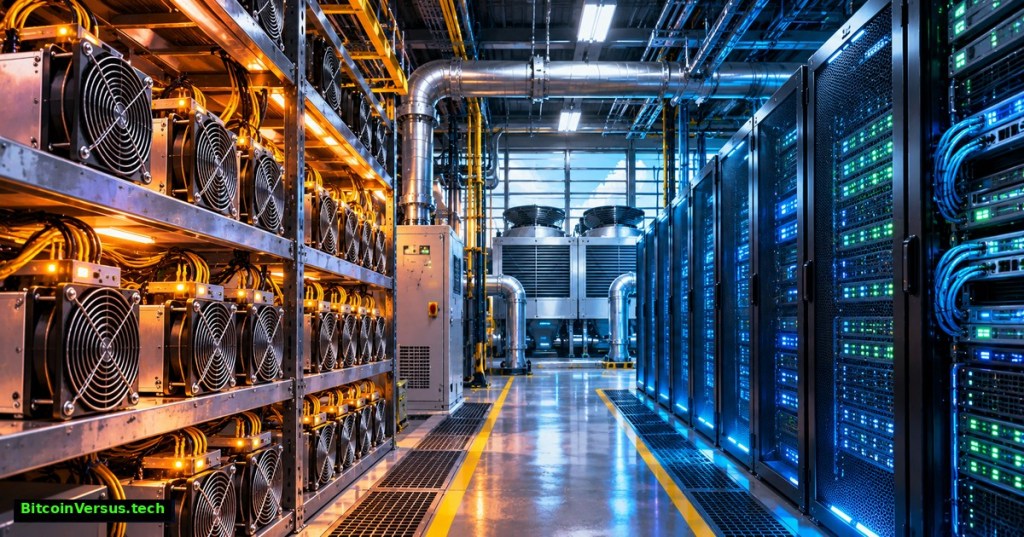
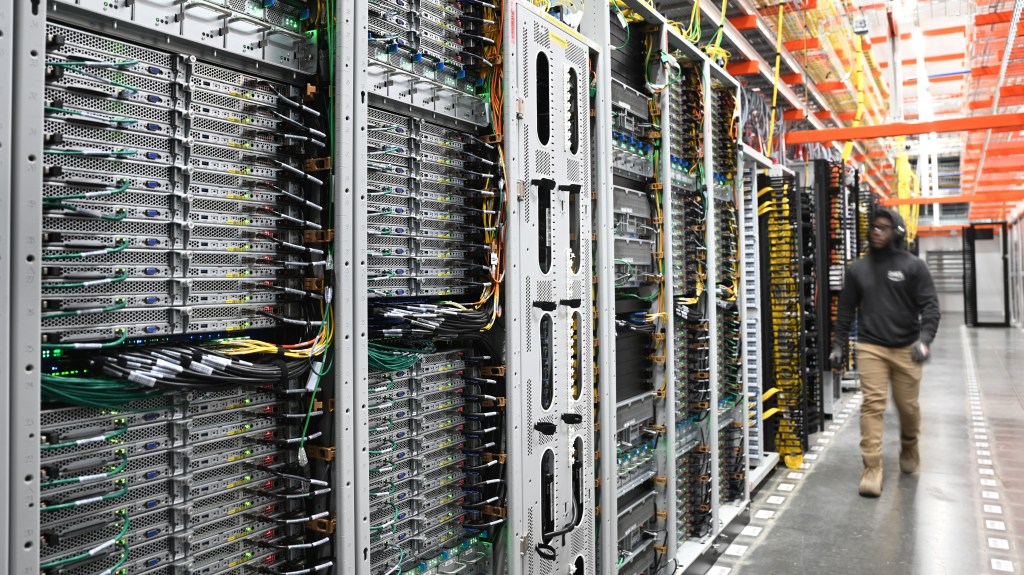
Bitcoin mines and cloud computing facilities can look remarkably alike. Both rely on electrical distribution, cooling systems, networking, equipment racks, monitoring software and technicians. Yet the machines inside perform fundamentally different jobs. Bitcoin mining uses specialized chips to compete for proof-of-work blocks; cloud computing rents flexible computing resources to customers. Understanding the difference matters as mining companies seek opportunities in AI and high-performance computing. The common physical infrastructure creates opportunities, but it does not make the underlying computers interchangeable.
Where Bitcoin mining and cloud computing overlap
Power is central to both businesses. Operators plan transformers, switchgear, power distribution, ventilation or liquid cooling, and safe equipment maintenance. Both track temperatures, device failures, electrical load, network connectivity and operating expenses. Skilled technicians replace failed components, manage firmware, monitor telemetry and restore service after outages. Environmental effects depend on actual electricity sources, water use and construction, rather than the label attached to a building. The U.S. Energy Information Administration describes how mining operations respond to electricity prices and grid conditions.
Bitdeer Official, March 29, 2024: archival tour of a Bitcoin mining facility in Washington state. The site demonstrates ASIC infrastructure, not virtual cloud servers.
What the computers actually calculate
Bitcoin mining equipment uses application-specific integrated circuits, or ASICs, designed for repeated SHA-256 proof-of-work hashing. Mining software supplies block headers and a difficulty target; the hardware searches for qualifying hashes. A miner reports work to its pool or solo node, and blocks are validated by Bitcoin network rules. Bitcoin’s developer guide explains the process.
Cloud infrastructure uses CPUs, memory, storage, network interfaces and, for certain services, GPUs or other accelerators. A virtual machine can run websites, databases, analytics or software development workloads. AWS describes Amazon EC2 as configurable, on-demand virtual servers. Mining ASICs cannot become general-purpose cloud servers through a firmware update. Meanwhile, cloud providers routinely move between different workload types and customer configurations.
Electricity, networking and uptime differ
Consider a hypothetical miner producing 200 terahashes per second at 15 joules per terahash. Multiplying the two gives 3,000 watts, or 3 kilowatts. At continuous full load, the ASIC alone consumes 72 kilowatt-hours daily, costing $4.32 at an illustrative electricity price of $0.06 per kilowatt-hour. Cooling, power-system losses and other site costs add more. Profitability also depends on Bitcoin price, network difficulty, block rewards, transaction fees and equipment costs.
For a cloud provider, relevant measures include vCPU or GPU capacity, memory, storage throughput, latency, availability and contracted service revenue. Mining traffic often consists of comparatively small jobs and pool shares; cloud tenants may require substantial east-west data movement, storage access and low-latency connections. Many mines can temporarily curtail electricity use when prices rise. Customer-facing cloud applications typically require tighter availability commitments, although some cloud workloads can also be interrupted.
Amazon Web Services, July 14, 2021: official archival explanation of on-demand cloud compute, storage and databases. Not a tour of a Bitcoin mine or a claim about the economics of either business in 2026.
Can a Bitcoin mine become a cloud data center?
Operators can potentially reuse land, grid connections, buildings and some electrical systems. A conversion often requires different racks, network fabric, fiber connectivity, redundancy, security, backup power and cooling suited to high-density GPU or CPU servers. ASICs generally leave the site. Bitdeer separately documents why GPU data centers require different engineering than mines in its technical comparison.
BitcoinVersus.Tech has covered Core Scientific’s proposed mining exit, an AI conversion planned at a former Bitcoin mine, IREN’s shrinking installed mining capacity and IREN’s cloud revenue ambitions. Planned transitions and revenue forecasts should not be confused with completed customer deployments.
A Bitcoin mine sells exposure to computational competition and network rewards, while a cloud operator sells access to useful computing services. Both are energy-intensive technology infrastructure, but their chips, revenue models, networks and uptime obligations define different businesses. A capable operator may understand both, provided the engineering and economics are assessed separately.
Primary references: Bitcoin Developer Guide; AWS EC2 documentation; U.S. Energy Information Administration; Bitdeer facility engineering comparison.


Leave a Reply