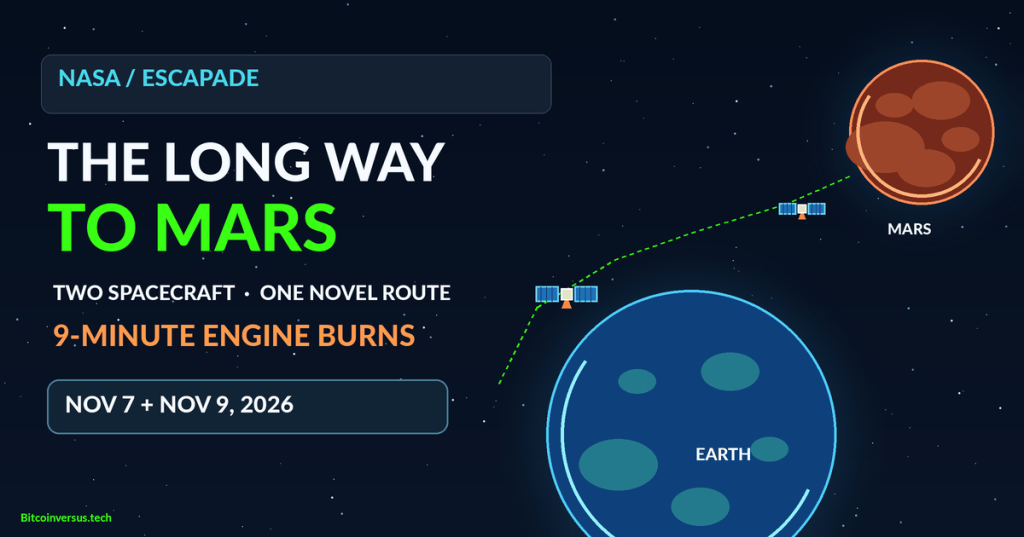
Most missions to Mars must depart when Earth and the Red Planet occupy favorable positions in their orbits, a launch opportunity recurring roughly every 26 months. NASA’s twin ESCAPADE spacecraft have taken a different approach: launch early, wait on a long excursion near the Earth–Sun L2 region, return toward Earth, and fire their engines during close flybys to begin the final interplanetary journey.
A NASA briefing dated November 2, 2026 scheduled powered Earth flybys for November 7 and November 9. Each maneuver includes an approximately nine-minute engine burn while Earth’s gravity redirects the spacecraft toward Mars. As of November 8, NASA’s public ESCAPADE mission blog reviewed for the article had not published a post-burn confirmation for the November 7 maneuver. The scheduled date should not be mistaken for verified success.
NASA Goddard’s official ESCAPADE mission explainer, published November 13, 2025. Historical mission overview; not footage of the November 2026 powered flybys. Source: NASA Goddard/YouTube.
The Oberth effect makes timing crucial
A gravity assist changes a spacecraft’s trajectory and velocity relative to the Sun by using a moving planet’s gravitational field. An Oberth maneuver adds a rocket burn when the vehicle is traveling particularly fast, allowing the same propulsion impulse to deliver more useful orbital-energy change than a burn performed far from the planet. The approach has a long theoretical history, but NASA described a Mars-bound spacecraft performing a powered Earth flyby as a first-of-its-kind mission objective.
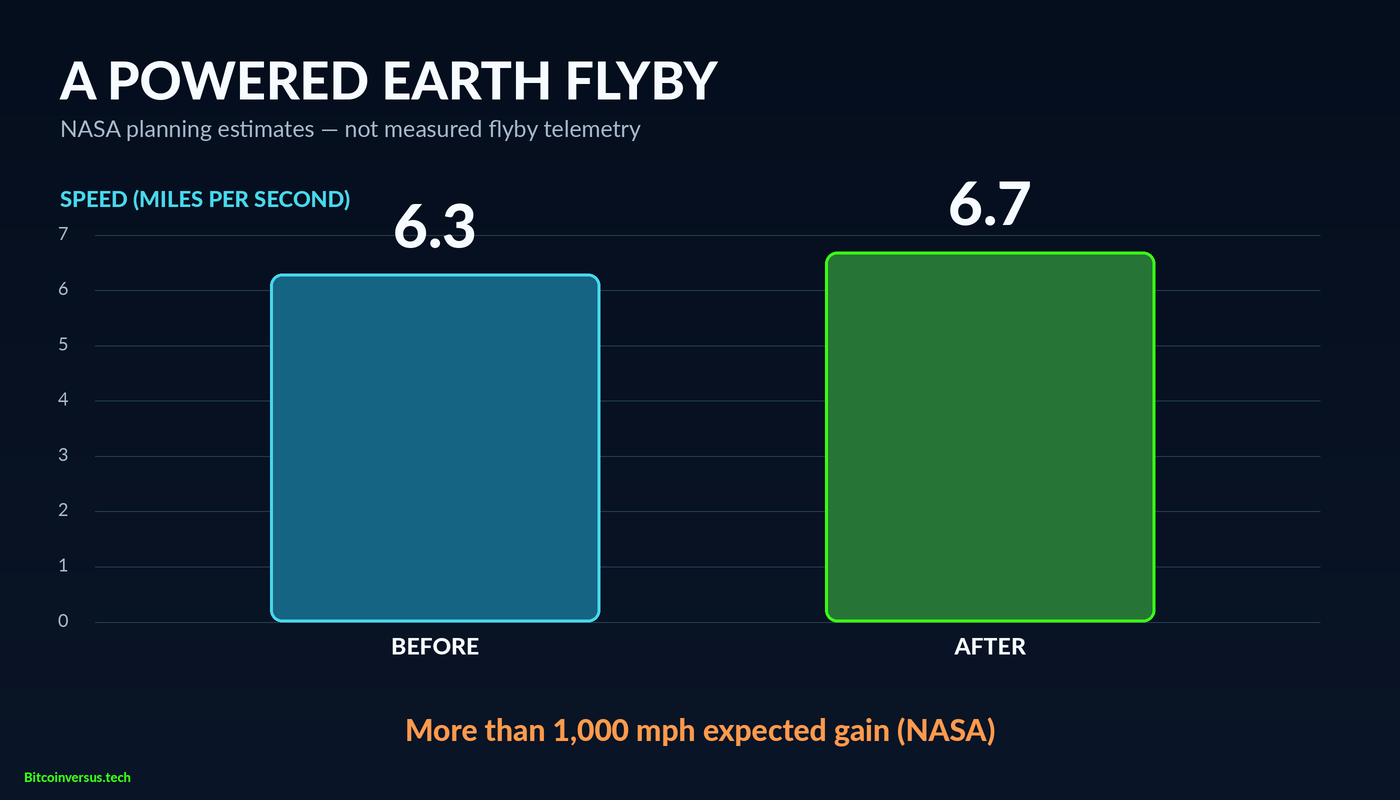
The agency expects the injection burn to raise speed from approximately 6.3 to 6.7 miles per second, an increase exceeding 1,000 miles per hour. Subtracting those rounded endpoints gives about 0.4 miles per second, or 1,440 miles per hour; the calculated difference is illustrative, not a separately measured velocity increment. The figures concern the projected flyby, not a confirmed post-maneuver telemetry report.
ESCAPADE’s route adds a flexible alternative to conventional Mars departures, not a guarantee of cheaper travel for every mission. Trajectory planning, spacecraft reliability and propulsion performance remain critical. The 2025 launch used Blue Origin’s New Glenn; earlier BitcoinVersus.Tech reporting on NASA’s New Glenn launch-services catalog outlines the broader launcher family. Rocket hardware and orbital-flight mechanics differ from the staging principles used during ascent.
Two departures, ten months, then Mars
The two refrigerator-sized spacecraft, nicknamed Blue and Gold, were launched on November 13, 2025. NASA planned closest approaches between approximately 600 and 1,100 miles above Earth. Blue’s burn was scheduled for November 7; Gold’s was scheduled for approximately 5:51 a.m. Eastern on November 9. NASA and partner Advanced Space published sky charts allowing observers to locate the faint spacecraft with telescopes.
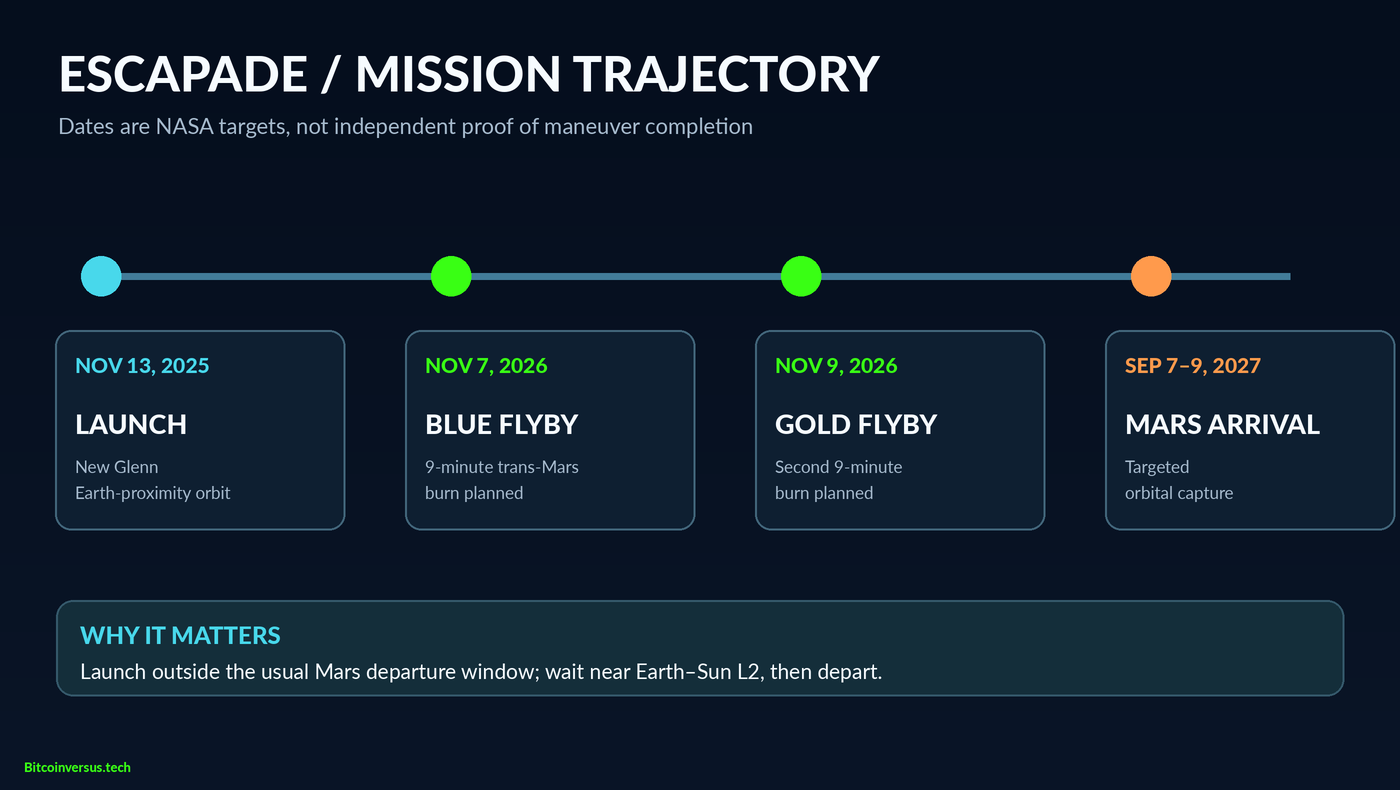
The scheduled Mars arrivals are September 7 and September 9, 2027, after roughly ten months of cruise. Each spacecraft is expected to execute a separate 11-minute orbit-insertion burn before beginning orbit adjustments. NASA’s mission profile envisions science operations beginning in 2028, eventually allowing paired measurements of Mars’ magnetic environment. Those dates remain projections dependent on navigation and future maneuvers.
Why send two spacecraft instead of one?
The solar wind is a stream of charged particles moving outward from the Sun, often near one million miles per hour. Mars has no Earth-like global dipole magnetic field. ESCAPADE aims to measure how incoming particles interact with localized crustal fields and the upper atmosphere, helping researchers distinguish changes in space from changes over time. The two probes can sample a shared region minutes apart and later occupy complementary orbits.
Such measurements could improve models of atmospheric loss and exposure to space weather for future explorers. Related space-hardened computing components and small-satellite propulsion experiments show other engineering challenges that emerge beyond Earth. None establishes the unreported ESCAPADE burn outcome.
The mission already collected observations in a distant part of Earth’s magnetotail during the holding trajectory, according to NASA, although detailed scientific results had not yet been released. Long-range human exploration also depends on timelines far beyond a single robotic flight, as examined in earlier analysis of proposed human Mars missions.
ESCAPADE’s strongest immediate result is architectural: a spacecraft can launch before the usual transfer window and wait near Earth for a later departure opportunity. Confirmed engine-burn outcomes, updated trajectory solutions and eventual Mars insertion will determine how far the demonstration advances beyond its ambitious design.
Primary sources: NASA, November 2, 2026; NASA ESCAPADE mission record; NASA Scientific Visualization Studio, November 2; Advanced Space, November 6; NASA Goddard official mission video, November 2025.
Editor’s Note: Historical launch details are verified against NASA’s mission record. The November 7 and November 9 Earth burns and 2027 arrival dates come from NASA pre-maneuver planning materials. No confirmed post-burn trajectory results were available from the NASA mission blog at the time of editing on November 8, 2026. The original cover is a conceptual illustration rather than a mission photograph. In-story speed and timeline graphics show NASA targets, not measured flight telemetry. The official 2025 NASA video explains the mission and does not depict either scheduled 2026 flyby.
Support BitcoinVersus.Tech
To support independent technology reporting, scan the original donation QR below for an optional 5,000-satoshi contribution. On a phone, display the code on another screen and scan with a compatible Bitcoin wallet, or import the saved QR image if supported. Verify the destination and amount before confirming payment.

We volunteer daily to ensure the information on this platform is Verifiably True. If you would like to support the research, please scan QR code.


Leave a Reply