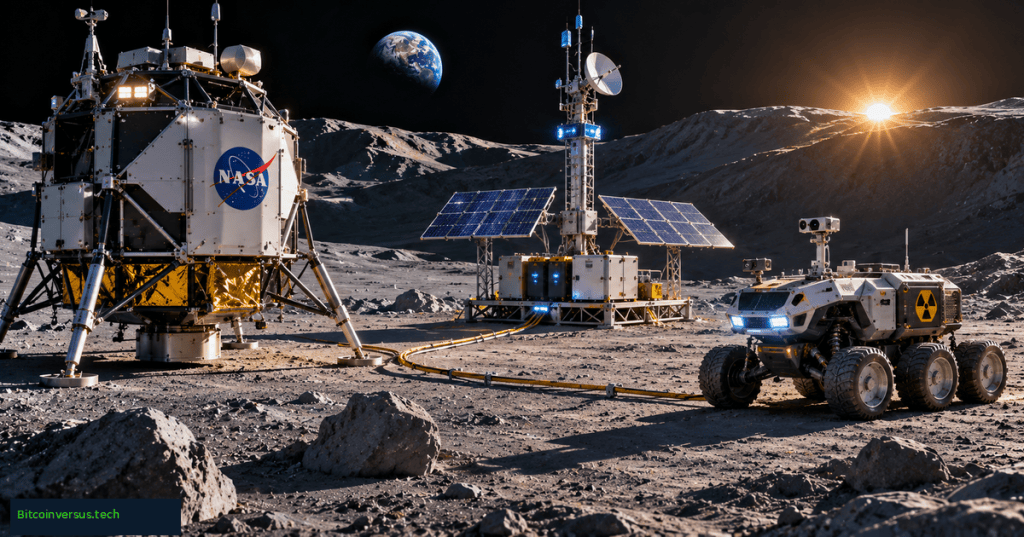
A permanent Moon outpost needs more than a crewed lander: cargo transportation, electric power, communications and robotic reconnaissance must be operating before astronauts can remain on the lunar surface. NASA announced a new procurement framework and infrastructure selections at its MAX POWER event on November 7, 2026, naming eight companies eligible to compete for lunar cargo work under a contract with a combined ceiling of $10 billion. The agency is developing the architecture for a sustained presence near the Moon’s South Pole.
NASA, “NASA Moon Base: November 2026 Update,” November 7, 2026. Official 96-minute MAX POWER news conference at Kennedy Space Center. Source: NASA / NASA YouTube channel.
Eight Providers, One $10 Billion Ceiling
The second Commercial Lunar Payload Services framework, CLPS 2, allows Blue Origin, Firefly Aerospace, Intuitive Machines, ispace US, Lockheed Martin Space, Northrop Grumman Space Systems, SpaceX and Voyager Technologies to compete for lunar-delivery task orders. It is a ten-year, multiple-award, indefinite-delivery/indefinite-quantity arrangement. The $10 billion figure represents the combined maximum value of future orders, not eight paid contracts or $10 billion already obligated. NASA separately raised the older CLPS 1.0 ceiling from $2.6 billion to $4.2 billion.
Lunar cargo delivery involves controlled descent, propulsion, navigation, payload deployment and survival of extreme surface temperatures. Prior BitcoinVersus.Tech reporting explains how lunar landers manage heat and landing hazards and three selected Moon Base investigations of ice and terrain. The new procurement expands the group eligible to bid for additional missions; it does not guarantee a mission to every company.
Nuclear Rover and a Lunar Power Network
NASA also advanced PROMISE, a six-wheeled nuclear-powered rover designed to investigate the south-polar surface and subsurface, including shadowed areas where sunlight cannot supply continuous solar power. The Jet Propulsion Laboratory plans to adapt spare components and engineering models from the Curiosity and Perseverance Mars programs. Blue Origin is to deliver PROMISE using a lunar lander under a separate award.
For electrical infrastructure, NASA selected Honeybee Robotics for storage components, Redwire for solar generation and Yank Technologies for wireless power-transfer hardware. Engineers will combine and test the components in a miniCAST power-and-communications tower concept. Component awards are early engineering steps, not evidence that a functioning lunar power grid exists. NASA selected SpaceX for a separate 2028 cislunar communications demonstration using Starship to deploy satellites, rather than an operational Moon Base communications network already in place.
NASA, “NASA Moon Base: The First Six Months,” September 8, 2026. Official overview of the lunar infrastructure campaign; background footage predates the November 7 contract announcement.
2028 Moon Landing, Mars Technology and Uncertainty
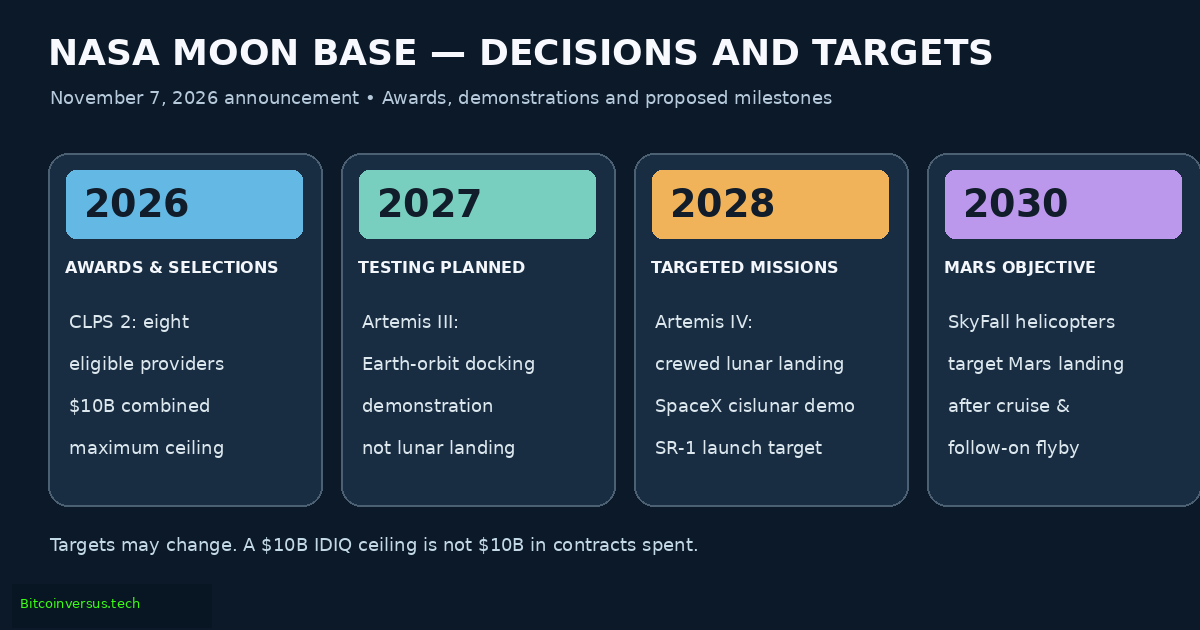
NASA currently targets Artemis III in 2027 as an Earth-orbit docking rehearsal and Artemis IV in 2028 for a crewed lunar landing. The revised plan differs from earlier descriptions of Artemis III as the landing mission; previous Artemis coverage documents the transition. NASA’s inspector general identified four canceled or repurposed Artemis systems with a combined $5.9 billion in current contract value; that figure should not be described as an equal amount of cash irretrievably spent.
A separate Mars project, Space Reactor-1 Freedom, remains targeted for launch in late 2028. NASA says the nuclear-electric-propulsion demonstrator will carry three SkyFall helicopters. Mars deployment and landing are later mission stages, with SkyFall’s landing target in 2030, rather than a 2028 arrival. The distinct ESCAPADE Mars mission pursues different research objectives. Meanwhile, NASA’s new astronaut recruitment period runs through December 3, 2026.
Key risks include contractor performance, launch readiness, power storage during lunar darkness, communications resilience, radiation protection and unproven flight hardware. The space-qualified computing equipment needed to control robotic systems must also survive harsh environments. NASA’s announcements expand its acquisition and test plans; a working permanent base is still a future goal.
Primary sources: NASA November 7 Moon Base awards announcement; NASA Artemis acceleration update, November 4; NASA SR-1 Freedom mission; NASA SkyFall mission; NASA OIG memo, June 24; NASA astronaut recruitment.
BitcoinVersus.Tech Editor’s Note
Published November 8, 2026. NASA’s $10 billion CLPS 2 figure is a ten-year maximum award framework, not disbursed spending. Mission dates are agency targets rather than completed milestones. The $5.9 billion inspector-general figure represents current contract values of canceled or repurposed programs, not a verified amount fully wasted. The featured cover and milestone graphic are conceptual BitcoinVersus.Tech illustrations, not imagery of hardware already operating on the Moon. Videos originate from NASA’s official channel; independent playback testing is reported separately.
We volunteer daily to ensure the information on this platform is Verifiably True. If you would like to support the research, please scan QR code.

Readers may contribute an optional 5,000 satoshis to support independent research. Scan the original QR from a second screen using a Bitcoin wallet, or use a compatible saved-image scanner on mobile. Confirm destination 3C9o19EH5HSiwEPyCTmEKzxhNCbo2X6TTb and the amount before sending.
BitcoinVersus.Tech is not a financial advisor. Financial coverage is provided purely for informational purposes.


Leave a Reply