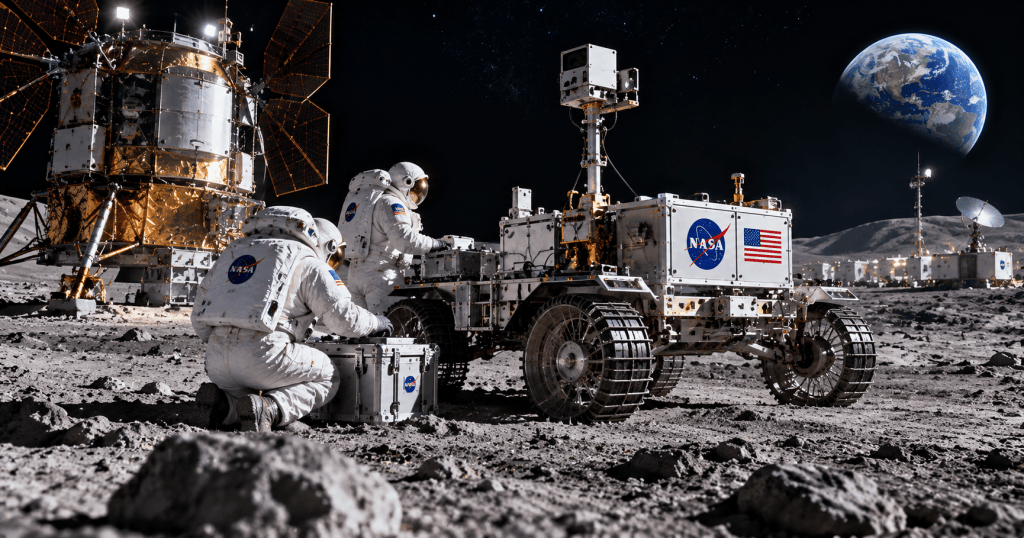
Before NASA can build a long-duration outpost on the Moon, engineers need answers to three basic questions: what can damage the hardware, where natural shelter might exist, and where usable water ice actually sits in the lunar surface.
NASA has now selected three new payload suites to attack those problems. In its September 30 announcement, the agency named LEMS-SP, GIMLI, and DISCO as new investigations under its PRISM program, with delivery planned through Commercial Lunar Payload Services.
A specific October 1 X post from Australia in Space summarized the selection as three new science investigations aimed directly at NASA’s Moon Base planning.
LEMS-SP Is a Lunar Hazard Station
The Lunar Environment Monitoring Station – South Pole, or LEMS-SP, is designed as a long-duration environmental monitor. It will watch for micrometeoroid impacts, track volatile material moving through the Moon’s extremely thin exosphere, and use a short-period seismometer to detect moonquakes and other seismic activity.
That is infrastructure data, not just planetary science. A future habitat, rover garage, power station, communications mast, or landing zone needs to be designed around what the lunar environment actually does over time.
Micrometeoroids are particularly important because the Moon has no thick atmosphere to burn them up before impact. Even small particles can become a long-duration reliability problem for exposed radiators, solar arrays, cables, windows, seals, and robotic equipment.
BitcoinVersus.Tech recently looked at the communications side of sustained lunar operations in Nokia’s 4G LTE network on the Moon. LEMS-SP addresses the layer underneath that network: the physical environment every antenna, rover, and base station eventually has to survive.
GIMLI Will Look for a Natural Underground Shelter
The Geophysical Investigation for Mapping Lunar Interior, or GIMLI, will target the Marius Hills Pit and look beneath the surface for evidence of a larger lava tube.
Lava tubes are interesting for a simple engineering reason: rock is already shielding. If a large underground void exists and can be safely accessed, it could provide protection from radiation, extreme thermal swings, and micrometeoroids without requiring astronauts to launch every kilogram of shielding from Earth.
That does not mean NASA has selected a lava tube as a habitat. GIMLI’s job comes earlier: determine what is actually there, map the geometry, and understand whether the pit connects to a meaningful underground structure.
Independent coverage from Innovation News Network emphasizes the same practical point: natural subsurface voids could eventually offer thermal stability and radiation protection if future missions confirm they are large and accessible enough.
DISCO Will Measure Ice Where Rovers May Actually Need It
The third payload, Depth Imager with Spectral and Color Optics, or DISCO, is aimed at lunar micro-cold traps where ice can remain stable in permanently or persistently cold terrain.
Orbital instruments can identify regions that appear rich in hydrogen or ice, but a base needs ground truth. DISCO is intended to make direct measurements of where ice exists, how much is present, and how the surrounding regolith behaves.
That matters because lunar ice is not useful merely because it exists. Engineers need to know whether it is concentrated enough to extract, whether the terrain can support machines, and how excavation, landing exhaust, rover traffic, and thermal cycles change the surface.
If water can eventually be processed locally, it could support drinking water, oxygen production, and potentially hydrogen and oxygen propellant. But that entire resource chain depends on mapping real deposits instead of designing around broad orbital estimates.
The Science Package Is Really an Engineering Survey
Taken together, the three investigations form something close to an early site-engineering survey for long-duration lunar operations.
LEMS-SP characterizes hazards. GIMLI asks whether the Moon provides natural shielding. DISCO measures a resource that could reduce what future crews have to bring from Earth.
The same test-before-deployment philosophy appears in smaller NASA spacecraft too. BitcoinVersus.Tech recently covered NASA’s dual-mode propulsion CubeSat clearing ground tests, where a new propulsion architecture had to survive spin, vacuum, and leak testing before flight.
On the Moon, the scale is larger but the logic is similar: characterize the environment first, then design hardware around measured conditions instead of assumptions.
CLPS Turns Commercial Landers Into a Lunar Test Network
NASA plans to deliver the new payloads through Commercial Lunar Payload Services. That means the science instruments can ride on commercially provided lunar landers instead of waiting for one enormous government mission.
A higher cadence of smaller deliveries gives engineers more chances to test sensors, mobility, communications, power, excavation, and autonomous operations before astronauts depend on them.
BitcoinVersus.Tech’s recent coverage of Starship reaching orbit and deploying 26 Starlink V3 satellites shows the same broader trend on the transportation side: space infrastructure becomes more practical as launch and payload deployment move toward higher cadence and larger operating fleets.
A Moon Base Needs Data Before It Needs Walls
The most interesting part of NASA’s announcement is that none of the three payloads is a habitat.
They are the instruments that tell engineers what kind of habitat makes sense.
If the seismic environment is harsher than expected, foundations and equipment mounts change. If a lava tube is large and accessible, shielding strategy changes. If useful ice sits in specific cold traps, rover routes, power systems, excavation equipment, and landing zones may change.
That is what sustained lunar engineering looks like before construction begins: measure the hazards, map the terrain, locate the resources, and then build the architecture around the Moon that actually exists.
BitcoinVersus.Tech
Advertisement
Editor’s Note:
We volunteer daily to ensure the credibility of the information on this platform is Verifiably True. If you would like to support our research initiatives, please donate here: 3C9o19EH5HSiwEPyCTmEKzxhNCbo2X6TTb
BitcoinVersus.tech is not a financial advisor. This media platform reports on financial subjects purely for informational purposes.


Leave a Reply