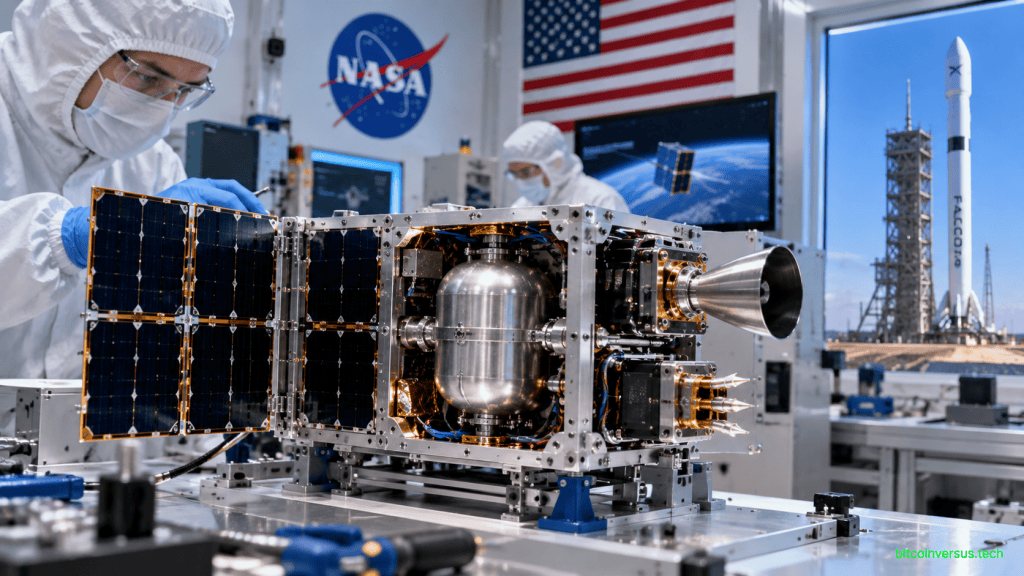
NASA has completed a major round of ground testing on a shoebox-size spacecraft that will attempt something unusual in orbit: feed both a high-thrust chemical engine and efficient electric thrusters from the same non-toxic propellant tank.
The agency says its ASCENT Propulsion Dual Mode 6U CubeSat has passed leak, thermal-vacuum and spin testing at Marshall Space Flight Center. The flight demonstration is manifested to launch no earlier than October 1 aboard a SpaceX Falcon 9 from Vandenberg Space Force Base in California.
That launch vehicle is already central to NASA’s commercial-space infrastructure. BitcoinVersus.Tech recently covered NASA adding three SpaceX crew flights and the separate $1.6 billion Space Force Falcon 9 award.
One tank, two very different engines
Traditional spacecraft often separate rapid chemical maneuvers from highly efficient electric propulsion. NASA’s demonstration instead uses one central tank of ASCENT, or Advanced Spacecraft Energetic Non-Toxic propellant, to support both modes.
The chemical engine supplies comparatively high thrust for faster orbital changes. Electrospray thrusters developed by MIT provide the lower-thrust, high-efficiency side of the system. This established SciShow Space explainer shows why electrospray propulsion is particularly attractive for very small spacecraft.
Combining those propulsion modes could reduce duplicated tanks and plumbing, leaving more mass and volume for payloads. That same engineering pressure toward denser, more capable systems also appears in heterogeneous semiconductor integration, where specialized components are combined rather than forcing one device to perform every job.
The spacecraft survived its ground tests
NASA engineers pressurized the spacecraft with helium inside a vacuum chamber to verify the shared propulsion plumbing and seals. The CubeSat also underwent thermal-vacuum testing to reproduce the vacuum and temperature extremes of orbit, followed by spin testing to characterize its mass properties and center of gravity.
NASA says the hardware will next receive final system checkouts and solar-array integration before shipment for launch. Once deployed about 325 miles above Earth, the spacecraft is planned to spend nine months alternating between chemical and electric maneuvers.
Small spacecraft are becoming infrastructure
The mission is more than a propulsion experiment. Smaller propulsion packages could create additional room for sensors, communications equipment and scientific payloads while opening missions to smaller launch vehicles.
That matters as orbital hardware becomes increasingly modular. BitcoinVersus.Tech has also examined robotic orbital assembly for space solar power, the expanding commercial space hardware ecosystem, and radiation-hardened processors proposed for space computing. Propulsion, power, computing and communications are increasingly parts of the same orbital infrastructure problem.
The important next milestone is flight data. Ground qualification shows that the integrated hardware survived its test environment, but the nine-month mission will determine whether one propellant architecture can repeatedly support both thrust modes in orbit.
BitcoinVersus.Tech
Advertisement: Follow BitcoinVersus.Tech for independent coverage of Bitcoin, mining hardware, artificial intelligence, data centers, semiconductors, robotics, energy and space technology.
Disclaimer: BitcoinVersus.Tech provides news, analysis and educational information for general informational purposes. Nothing in this article is financial, investment, legal or professional advice. Readers should independently verify information and make their own decisions.


Leave a Reply