Space-based solar power has spent decades living somewhere between engineering research and science fiction. A newly announced orbital demonstration is designed to test one of the practical technologies needed to move it closer to large-scale infrastructure.
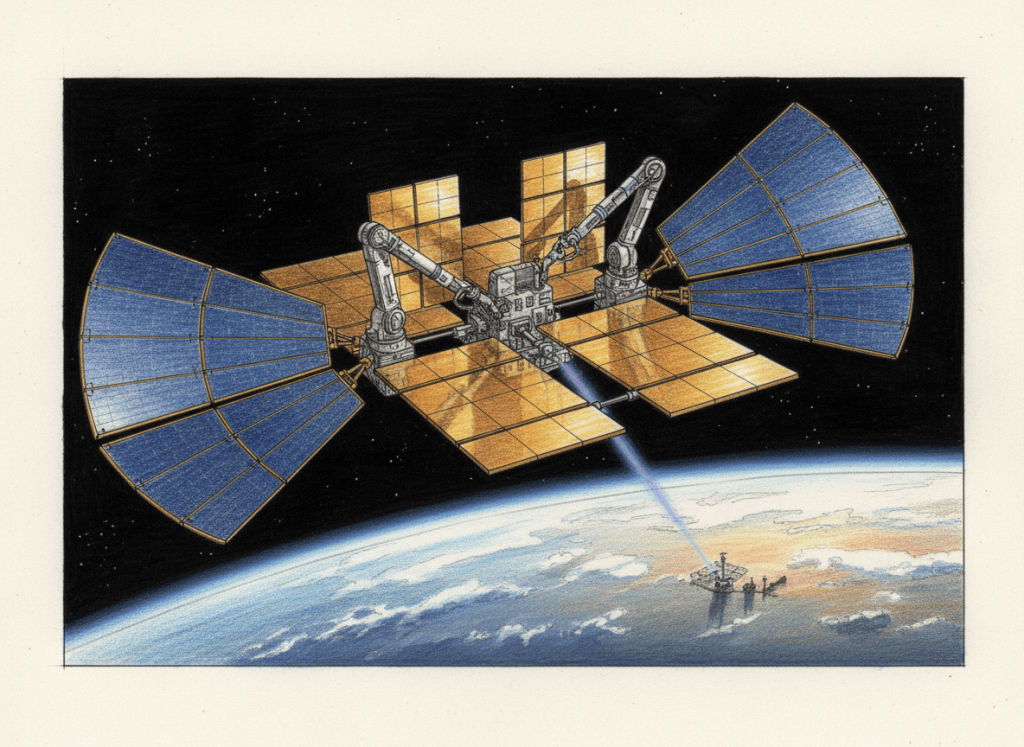
On September 21, 2026, Katalyst Space announced that it had been selected through the Operational Energy Capability Improvement Fund for the Advanced Scalable Growth Architecture for Robotic Deployment, or ASGARD, program. Katalyst says the project will develop and launch a robotic spacecraft capable of assembling a large power-beaming structure in orbit.
The system centers on Katalyst’s NEXUS spacecraft and modular power-beaming tiles being developed by the U.S. Naval Research Laboratory. After reaching low Earth orbit, NEXUS is expected to use robotic arms to assemble those modules into a larger structure. The tiles are designed to collect solar energy, convert it into radio-frequency microwave energy and transmit that energy toward Earth.
Why Build It in Orbit?
Launch vehicles impose strict volume limits on spacecraft. That creates a basic scaling problem for space solar power: increasing electrical collection generally means increasing collection area, but eventually the structure becomes too large to launch as one conventional spacecraft.
ASGARD’s proposed solution is analogous to construction rather than deployment. Components can be launched in a compact form and then assembled robotically after reaching orbit.
Katalyst says the architecture is intended to be resupplied and expanded over time, with a long-term concept that could grow from kilowatt-class systems toward megawatts. That remains an ambition rather than a demonstrated capability, but the orbital assembly experiment is intended to test some of the engineering required to get there.
Power Beaming Already Has an Engineering History
The underlying idea is not starting from zero. The U.S. Naval Research Laboratory has conducted earlier demonstrations of wireless power transmission and has researched photovoltaic radio-frequency antenna hardware for collecting solar energy in orbit and converting it for transmission.
ASGARD combines several of these threads: solar collection, electromagnetic power transmission and robotic orbital construction. That combination is the more interesting development.
Energy Infrastructure Beyond Earth
Space solar power has an unusual physical advantage: a satellite can collect sunlight without the same atmospheric filtering experienced by terrestrial panels. But collecting energy is only one part of the system.
An operational network would also need efficient conversion, thermal management, accurate beam control, receiving infrastructure, orbital maintenance and acceptable end-to-end economics. ASGARD will not answer all of those questions.
Instead, it is intended to demonstrate whether modular power-beaming hardware can be assembled and operated at meaningful scale after launch. If successful, that would address one of the architectural constraints that has historically made very large orbital power systems difficult to deploy.
The project also illustrates a broader trend covered by BitcoinVersus.tech: energy infrastructure is becoming increasingly intertwined with advanced computing, automation and specialized hardware. Recent coverage of CXMT’s fifth-generation DRAM manufacturing examined another part of that hardware stack, while our Bitcoin mining efficiency coverage shows why improvements in electrical delivery and computational efficiency increasingly matter together.
For space power, however, the next important measurement is not a theoretical megawatt system. It is whether a robotic spacecraft can successfully assemble the hardware in orbit and demonstrate that the energy pathway works as designed.
Sources: Katalyst Space, U.S. Naval Research Laboratory and Via Satellite. Katalyst announced ASGARD on September 21, 2026.
BitcoinVersus.Tech Editor’s Note:
We volunteer daily to ensure the credibility of the information on this platform is Verifiably True. If you would like to support to help further secure the integrity of our research initiatives, please donate here: 3C9o19EH5HSiwEPyCTmEKzxhNCbo2X6TTb
https://x.com/1BitcoinVersus/status/1937006164555993338
BitcoinVersus.tech is not a financial advisor. This media platform reports on financial subjects purely for informational purposes.


Leave a Reply