A mechanical energy-storage technology designed around a rapidly spinning mass rather than electrochemical battery cells has reached a new testing milestone.
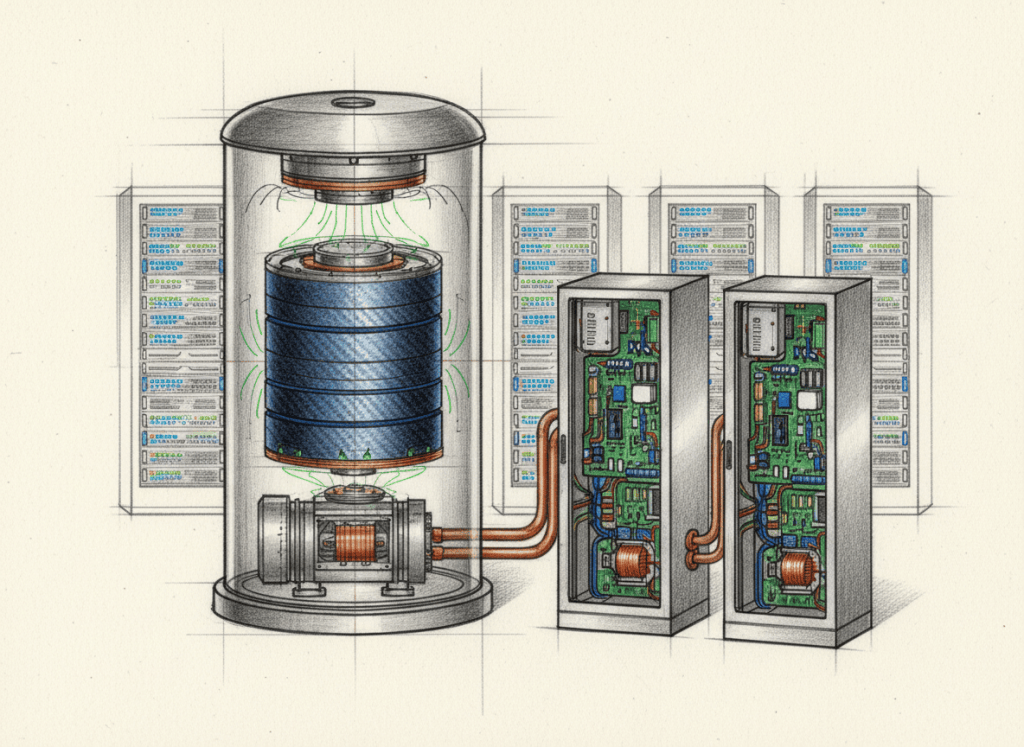
On September 21, 2026, Qnetic announced that its Pulsar 200-kWh flywheel energy-storage prototype has begun low-speed integrated testing. The company says the program is validating its control, safety and power-electronics systems before progressively increasing rotational speed.
According to Qnetic, Pulsar has completed its first 100 continuous charge-discharge cycles with zero faults or capacity degradation. Those are company-reported early test results rather than proof of long-term commercial performance. Qnetic also reports that its separately tested motor produced 130 kW at 97.3% efficiency and exceeded 11,000 rpm.
A Battery That Stores Energy as Motion
Flywheels work differently from lithium-ion batteries. Electricity drives a motor that accelerates a rotor, storing energy as rotational kinetic energy. When electricity is needed again, the system reverses the process and uses the spinning rotor to drive electrical generation.
Qnetic says Pulsar combines composite materials, magnetic bearings and power electronics. Its development targets include rapid response, high cycle counts and reduced performance degradation over a long operating life. Those long-term performance targets still require validation.
Why Data Centers Matter
Qnetic identifies AI data centers, renewable-energy integration, grid balancing, microgrids and industrial power resilience as potential applications. Modern data centers can place large and rapidly changing loads on electrical infrastructure. Storage close to the load can potentially absorb short-duration fluctuations, provide ride-through capability or complement other backup-power systems.
BitcoinVersus.tech has been following the same convergence between electrical infrastructure and high-density computing. Our recent coverage of Bitcoin mining efficiency reaching 8.9 J/TH illustrates why electrical efficiency increasingly matters alongside raw compute performance. Our report on space-based solar power and robotic orbital assembly examines another emerging approach to future energy infrastructure.
The Next Test Is More Important Than the First 100 Cycles
Pulsar has not yet demonstrated all of Qnetic’s long-term performance claims. The company says data from the prototype will be shared with the Electric Power Research Institute (EPRI) through its deRISKED program. Qnetic entered that evaluation with sponsorship from Sacramento Municipal Utility District.
Full-speed operation and longer-duration testing should provide stronger evidence about efficiency, reliability, thermal behavior and degradation. A prototype completing 100 cycles without a fault is an engineering milestone; it is not the same as demonstrating years of operation in a commercial data center or electrical grid.
The important development is that Qnetic has moved from assembly and component validation into integrated operation of a full-scale 200-kWh machine. For a technology built around repeatedly storing electricity as physical motion, the next measurements—how efficiently it cycles, how reliably it operates and how its performance changes with time—will determine whether the flywheel becomes a practical alternative or complement to conventional batteries.
Sources: Qnetic testing announcement, September 21, 2026; Qnetic motor testing results; EPRI deRISKED program participation information.
BitcoinVersus.Tech Editor’s Note:
We volunteer daily to ensure the credibility of the information on this platform is Verifiably True. If you would like to support to help further secure the integrity of our research initiatives, please donate here: 3C9o19EH5HSiwEPyCTmEKzxhNCbo2X6TTb
https://x.com/1BitcoinVersus/status/1937006164555993338
BitcoinVersus.tech is not a financial advisor. This media platform reports on financial subjects purely for informational purposes.


Leave a Reply