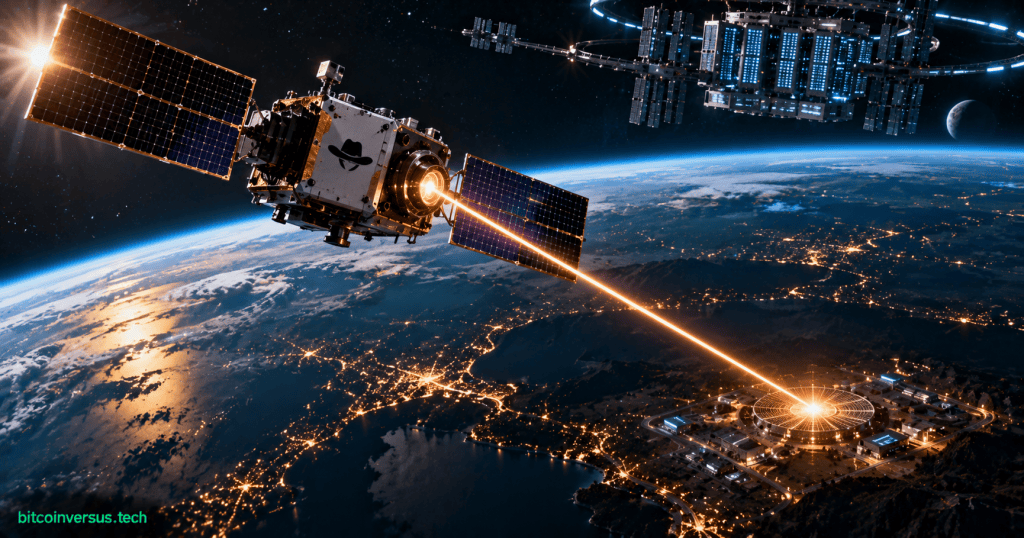
A satellite launched today carrying a strange proposition for the future of energy and computing: collect sunlight in orbit, turn it into a laser, and aim that energy back toward Earth.
Cowboy Space’s Reason-1 rode to orbit on SpaceX’s Transporter-18 mission. The spacecraft is intended to attempt a kilowatt-class laser power-beaming experiment from low Earth orbit to a ground receiver—and to test optical and thermal systems the company ultimately wants to use for AI data centers in space.
Cowboy Space introduced the spacecraft in a specific Reason-1 post on X, describing power beaming as the first step toward mastering the optical systems needed between Earth and orbital data centers.
A power plant that never touches the grid
The attraction of space solar power is easy to understand. Solar hardware in orbit can operate without clouds, weather or nighttime interruptions on the same schedule as ground-mounted panels. The hard part is getting that energy somewhere useful.
Reason-1 is Cowboy Space’s attempt to test one possible answer. The satellite carries a high-power laser, large-aperture optics and beam-steering hardware. According to Cowboy Space’s own description of its architecture, the larger plan is a constellation that uses orbital solar power to operate GPU data centers, with optical systems moving information between orbit and Earth.
The key word is attempt. Launching Reason-1 does not mean Cowboy Space has already delivered usable electrical power from orbit to a customer. The spacecraft must commission successfully and then demonstrate the actual beam-to-receiver link.
The laser experiment is really a data-center experiment
The same technology needed to accurately point a high-power beam at Earth overlaps with the optical communications problem facing orbital compute: moving enormous quantities of data through free space while keeping transmitters and receivers aligned.
That is why Reason-1 fits directly beside the orbital-compute projects BitcoinVersus has been tracking. Google’s Project Suncatcher is testing the idea of putting TPU-class AI hardware in orbit. Starcloud is planning ASIC computing in space. And space-solar projects are already pushing toward orbital assembly tests.
“Starlink for energy” is the bigger pitch
Independent reporting from Axios puts Reason-1 in an unusually busy launch for experimental orbital infrastructure. Transporter-18 carried 130 payloads, including Google’s orbital-compute test hardware and Star Catcher’s attempt to demonstrate energy transfer between spacecraft.
Cowboy Space founder Baiju Bhatt described the longer-term idea to Axios as something like a “Starlink for energy”: power delivered to places where building conventional grid infrastructure is difficult. Potential applications range from remote industrial operations to high-endurance systems and eventually the company’s own computing infrastructure.
Then comes the one-megawatt orbital data center
Cowboy Space’s ambition goes far beyond one satellite. Its proposed architecture treats the upper stage of a future launch vehicle as useful infrastructure after launch instead of disposable transportation. The company describes that stage as a one-megawatt data center with active thermal management and integrated compute.
That would attack two of terrestrial AI’s biggest constraints at once: access to electrical generation and the years-long wait for large grid interconnections. It would introduce a completely different set of problems—launch cost, radiation, cooling in vacuum, maintenance, debris risk and the need to move huge amounts of data between orbit and Earth.
Reason-1 does not solve those problems today. What it does is put one of the foundational technologies into orbit where it can finally be tested instead of modeled.
The real milestone comes when the receiver lights up
The launch itself is only phase one. The important number will be measured power at the ground receiver, followed by pointing accuracy, end-to-end efficiency and repeatability. Until those results exist, Reason-1 should be understood as an orbital engineering experiment—not a functioning space power utility.
But the direction is remarkable. The AI infrastructure race started by building bigger data centers. Then it became a race for dedicated power plants. Now several companies are asking whether the next data center—and perhaps part of its power grid—belongs above the atmosphere.
BitcoinVersus.Tech
Advertisement
Editor’s Note
The featured artwork is a conceptual illustration of the planned Reason-1 power-beaming experiment, not evidence that the satellite has already completed a successful energy-transfer test. This article will distinguish announced design goals from demonstrated on-orbit results.
Support independent BitcoinVersus.Tech reporting with Bitcoin donations at: 3C9o19EH5HSiwEPyCTmEKzxhNCbo2X6TTb
BitcoinVersus.tech is not a financial advisor. This media platform reports on financial subjects purely for informational purposes.


Leave a Reply