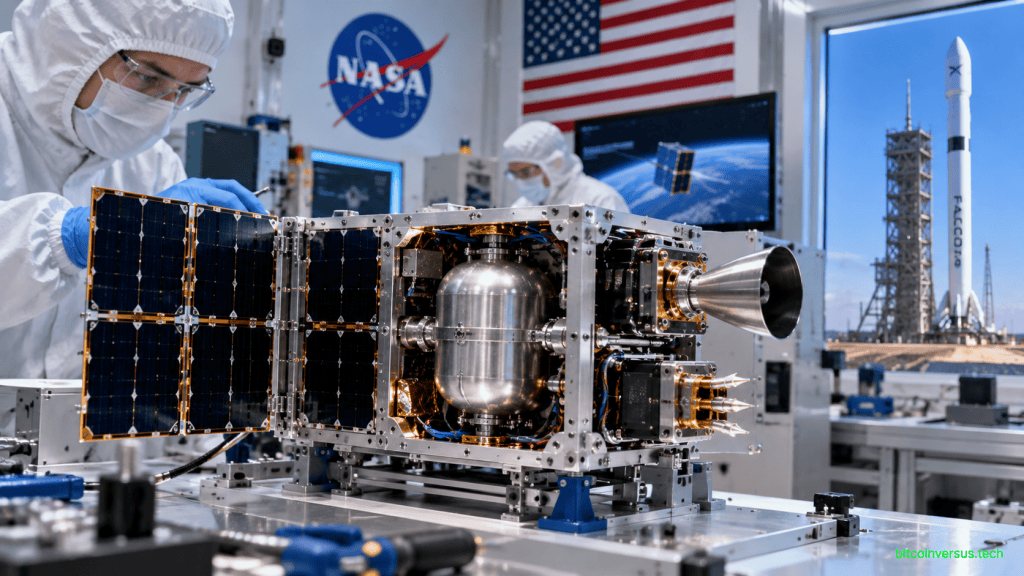
Starcloud is adding a Bitcoin-mining experiment to the orbital-compute race.
ASICs are planned for Starcloud-2
Starcloud co-founder and CEO Philip Johnston said the company plans to place Bitcoin-mining ASICs on Starcloud-2, its next spacecraft, which is expected to launch later in 2026. The disclosure was reported by Tom’s Hardware.
Starcloud’s public mission is orbital data-center infrastructure. Its website emphasizes continuous solar energy and radiative cooling, while the Bitcoin workload would provide a tightly defined test of compute, power and thermal performance.
Starcloud is building solar-powered data centers in orbit, where specialized compute could test near-continuous sunlight and radiative cooling.
— Starcloud @Starcloud_
Starcloud’s official account provides public mission context; the ASIC disclosure remains a planned demonstration, not operating hashrate.
Why Bitcoin mining is a useful orbital test
An ASIC performs one specialized function, uses measurable power and produces directly comparable hashrate. That makes Bitcoin mining a useful benchmark even if an initial payload would be too small to affect the global network.
Johnston said ASICs can be far cheaper per kilowatt than high-end AI accelerators. The comparison supports Starcloud’s broader argument that energy-intensive compute could eventually move away from terrestrial grid and permitting constraints. The company’s white paper describes solar availability and radiative cooling as key advantages.
Space does not remove engineering constraints
Vacuum eliminates airflow cooling, so spacecraft must move heat through conduction, heat pipes and radiators. Radiation, launch vibration, limited serviceability and launch cost also remain significant barriers.
A successful Starcloud-2 mission would show that a specialized mining workload can operate alongside other compute payloads. It would not prove that orbital Bitcoin mining is already cheaper than a well-sited terrestrial mine.
Mining follows energy and cooling
The proposal extends a familiar mining principle into orbit: operators follow available energy, cooling and connectivity. That connects with BitcoinVersus.tech coverage of miners shifting megawatts from ASICs to AI, Luxor’s AI infrastructure expansion, BitFuFu’s managed hashrate growth and ASIC efficiency and electricity cost.
For now, the question is whether a small ASIC payload can validate orbital power, thermal and operating assumptions. It is not yet a claim that space will replace conventional Bitcoin mines.
Related video
NBC News’ report on Starcloud’s AI-equipped satellite provides visual context for the spacecraft platform. It does not show Bitcoin mining.
Sources and disclaimer
Primary context: Starcloud and its Starcloud-2 mission page. Additional reporting: Tom’s Hardware and NVIDIA.
BitcoinVersus.tech separates announced plans from operating results. Verify figures with primary sources; market and mining conditions can change quickly.
BitcoinVersus.tech on X
Follow BitcoinVersus.tech for original reporting on Bitcoin mining, ASIC efficiency, energy infrastructure and industrial compute.
— BitcoinVersus.tech @BitcoinVersus
Disclaimer: Educational and editorial content only. Nothing here is investment advice.


Leave a Reply