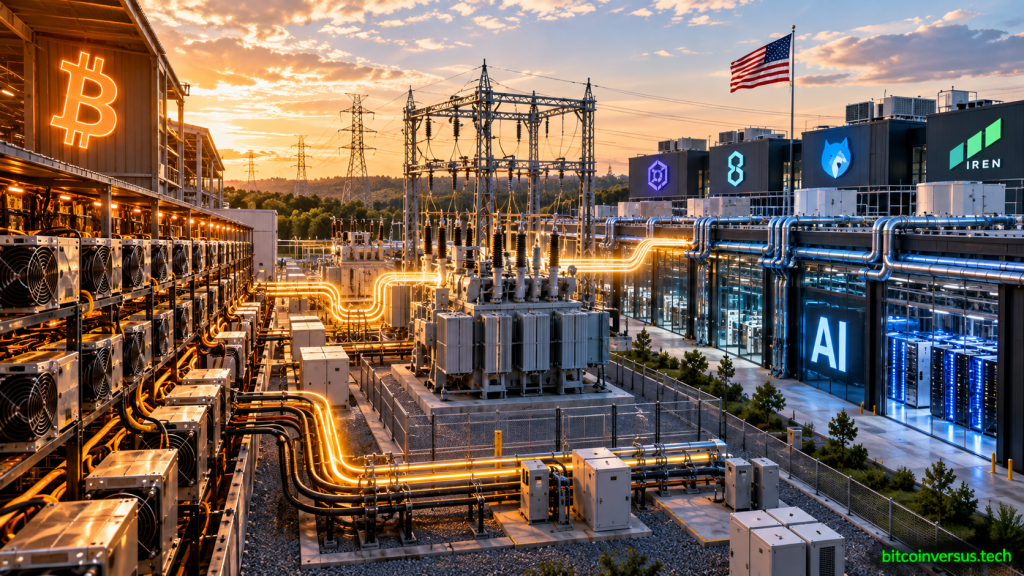
The most durable asset created by the Bitcoin mining boom may not be an ASIC at all. It may be the energized land, substations and grid access surrounding it. A new Reuters Breakingviews analysis says the widening AI power shortage is putting a premium on exactly the infrastructure miners spent years assembling.
The scarce asset is becoming the megawatt
Recent analysis cites Morgan Stanley estimates for 68 GW of U.S. data-center power demand between 2026 and 2028 against projected supply that is about 38 GW lower. Bernstein previously estimated crypto miners control roughly 14 GW of operating and planned capacity.
That imbalance helps explain why Cipher Digital, TeraWulf and Hut 8 are increasingly developing powered shells: facilities where the landlord supplies the site, power infrastructure and data-center envelope while a tenant brings or controls the compute. IREN has pursued a more vertically integrated route that includes owning and operating AI compute infrastructure.
The distinction matters. Reuters cites Jefferies research putting powered-shell revenue at as much as roughly $2 million per megawatt annually, while neocloud-style compute contracts can produce much more revenue but also expose the operator to GPU purchases, depreciation and technology cycles. Another recent assessment likewise highlights existing power infrastructure as a core advantage for former mining companies moving into AI.
Hut 8 shows what the landlord model looks like
A recent construction update shared on X illustrates the model at Hut 8’s River Bend campus, where the physical project centers on large-scale power and data-center infrastructure rather than Bitcoin ASIC deployment.
BitcoinVersus.tech has followed that transition directly through Hut 8’s Beacon Point development and Luxor’s expansion from Bitcoin mining into AI infrastructure. Both developments reinforce a broader pattern: mining companies already understand high-density electrical loads, site operations and power procurement.
Creditworthy tenants can reshape financing
Powered-shell economics are not only about rent. Long-duration contracts and financially strong counterparties can also make enormous construction programs easier to finance. An earlier industry discussion around Hut 8 highlighted the role of strong counterparties and project credit in financing data-center construction.
Bitcoin mining still has a role in the power stack
The shift does not necessarily mean every available megawatt should leave Bitcoin. Mining remains unusually flexible because ASIC loads can be curtailed rapidly, and BitcoinVersus.tech recently examined how Bitcoin mining could operate behind higher-value AI loads as a buyer of otherwise unused electricity.
The emerging hierarchy is therefore more nuanced than a simple mining-to-AI conversion. Where long-term AI tenants can pay premium rates, powered shells can monetize scarce interconnections. Where AI demand is intermittent or new generation is oversized, flexible mining can still absorb surplus energy. The common denominator is control of power.
BitcoinVersus.Tech Editor’s Note: Revenue-per-megawatt figures cited above are industry estimates, not guaranteed project economics. Actual returns depend on lease structure, financing, construction costs, tenant credit, utilization, power pricing and delivery schedules.
Support independent Bitcoin mining, data-center and power infrastructure reporting: 3C9o19EH5HSiwEPyCTmEKzxhNCbo2X6TTb
BitcoinVersus.tech is not a financial advisor. This media platform reports on financial subjects purely for informational purposes.


Leave a Reply