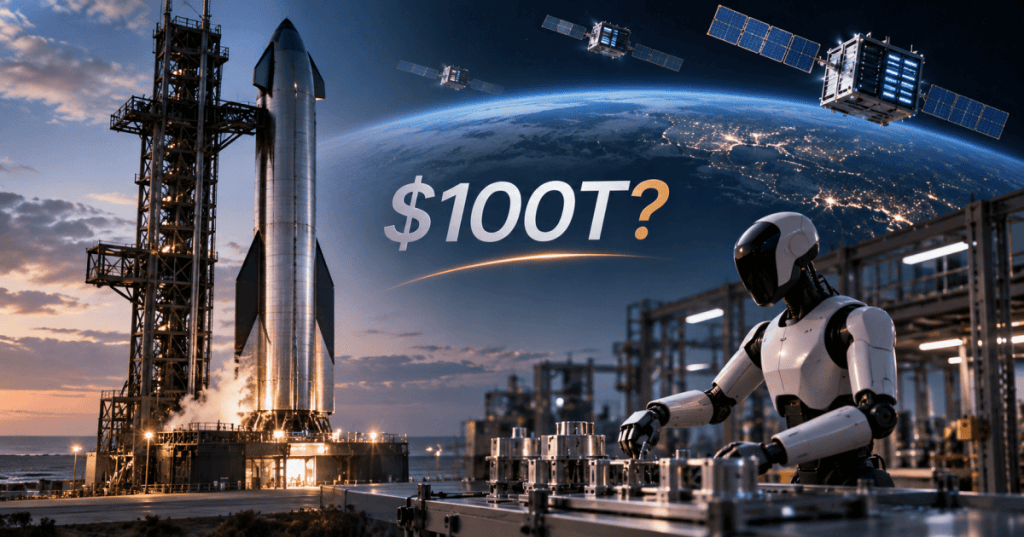
Starcloud founder and CEO Philip Johnston said in an October 31, 2026 interview that SpaceX could exceed $100 trillion in market capitalization within ten years. Speaking with Molly O’Shea on Sourcery, Johnston supported Elon Musk’s own long-range forecast and attributed much of the potential to Tesla’s Optimus humanoid robots eventually accelerating manufacturing. The estimate is his personal prediction, not a SpaceX financial target or independently established valuation.
The remarks begin around 19:30 in a tour of Starcloud’s spacecraft factory. Johnston predicts SpaceX might be worth even more than $100 trillion by the mid-2030s. O’Shea framed the forecast as conditional on business plans succeeding and the absence of a major world war. The interview supplies no forecast financial statements or independently validated valuation model.
Sourcery with Molly O’Shea, “Inside Starcloud’s $2B Space Factory” (October 31, 2026). The 19:30–21:00 portion contains Johnston’s SpaceX valuation, Optimus factory and Tesla-acquisition predictions. Original interview supplied by the editor.
Optimus manufacturing is central to the prediction
Asked why a company could attain such a valuation, Johnston described a future in which Optimus robots help construct factories that manufacture more robots. He compared that feedback mechanism with recursive advances in software intelligence moving into physical production. Commercial implementation would require substantial progress in robotics reliability, dexterity, industrial integration and component availability. Self-replicating robot factories have not been demonstrated at the scale implied by the argument.
Johnston then asserted that SpaceX would acquire Tesla after certain share restrictions are resolved. No purchase agreement, regulatory filing, board authorization or confirmed transaction timetable was supplied. The interview expresses an entrepreneur’s expectation rather than evidence that an acquisition is underway. Any merger would also require valuation, governance, financing and regulatory considerations.
BitcoinVersus.Tech previously covered Elon Musk’s October $100 trillion SpaceX projection. Johnston’s remarks add a proposed robotics-driven manufacturing mechanism and a separate, unconfirmed Tesla purchase prediction. They do not represent a new SpaceX announcement.
Sequoia Capital, “Greetings, Earthlings: Philip Johnston of Starcloud on Data Centers in Space” (March 2026). Earlier interview gives background on orbital compute and launch economics, not proof of the new valuation.
Orbital computing is another proposed growth engine
Johnston’s company develops satellites intended to host AI computing hardware. During the Sourcery tour, he discussed Starcloud 3 designs, approximately 235 kilowatts per spacecraft, and a long-term concept encompassing tens of thousands of orbital systems. Such figures are engineering plans rather than measured operational capacity across a deployed constellation.
BitcoinVersus.Tech’s Starcloud factory report examines the NVIDIA GPU hardware, launch reservations and manufacturing work shown in the same interview. Earlier coverage of Starcloud’s Bitcoin-mining ASIC proposal outlines another experimental use for orbital computing. Neither establishes that the business will generate the economic value required by Johnston’s SpaceX forecast.
Orbital data centers must overcome high launch expense, cooling in a vacuum, radiation exposure, communications limits and servicing constraints. The physics of cooling orbital AI data centers remains especially significant, as spacecraft reject waste heat largely through radiators. Falling launch costs alone do not prove a commercially superior computing system.
SpaceX, “Starship — Test Like You Fly” (April 2026). The official film documents reusable-launch engineering; it does not validate Johnston’s projected corporate valuation.
The gap between a forecast and market capitalization
Market-data provider Stock Analysis reported SpaceX’s market capitalization near $1.68 trillion at the November 5 close. A $100 trillion market value would be roughly sixty times greater. Market capitalization equals the market price of outstanding shares multiplied by their quantity; it is not a company’s annual revenue, cash balance or ten-year capital expenditure.
A successful outcome would depend on substantial growth across launch services, satellite connectivity, computing and potentially robotics, as well as investor willingness to assign a very large valuation. Capital requirements, competition, regulation, operational failures and an unproven Tesla transaction could materially change the trajectory. Johnston’s description of robotic manufacturing is a thesis, not a measured financial projection.
The next evidence to watch is actual Starship launch economics, production results from humanoid robotics, orbital-compute customer revenue and any formal SpaceX–Tesla disclosure. Until those figures become available, the forecast remains speculative, despite being stated directly by the head of a SpaceX launch customer.
Editor’s Note: Primary evidence is Molly O’Shea’s October 31 interview with Philip Johnston and the transcript and chapter list published by Sourcery. The $100 trillion projection and future Tesla purchase are Johnston’s speculative claims, not SpaceX guidance or a confirmed acquisition. Market capitalization is dated November 5, 2026. The featured image is conceptual artwork; background videos predate the interview.

For mobile scanning, open the article on another display and scan the original QR with a compatible Bitcoin wallet. Verify the destination before donating 5,000 sats: 3C9o19EH5HSiwEPyCTmEKzxhNCbo2X6TTb.
We volunteer daily to ensure the credibility of the information on this platform is Verifiably True. If you would like to support our work and help further secure the integrity of our research initiatives, please scan the QR code below to donate 5,000 sats.
BitcoinVersus.tech is not a financial advisor. This media platform reports on financial subjects purely for informational purposes.


Leave a Reply