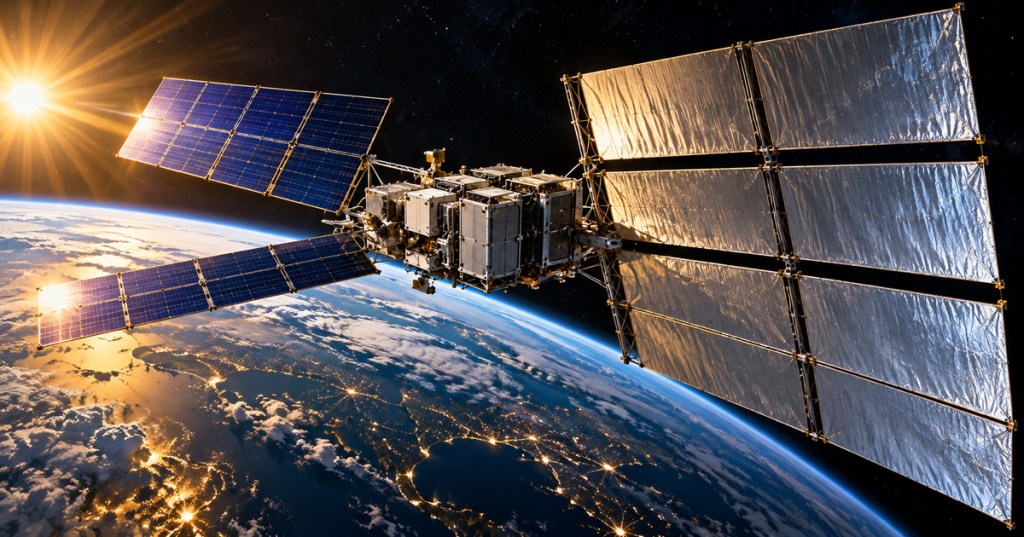
SpaceX founder Elon Musk’s proposal to place AI data centers in orbit is facing a quantifiable engineering objection: the computers may be launched above Earth’s atmosphere, but their waste heat still needs somewhere to go. A October 26 analysis by the YouTube channel Astraveo challenges the economic and thermal assumptions behind the concept, particularly the radiator panels needed to cool thousands of computing satellites.
The criticism concerns scale rather than a violation of physics. Spacecraft can release heat by emitting infrared radiation, but there is essentially no surrounding air to carry it away. Radiator temperature, surface area, orientation and mass therefore become central design constraints.
Astraveo’s October 26 video, “SpaceX’s $2 Trillion Bet Has a Physics Problem,” examines power generation, spacecraft maintenance and cooling using the Stefan–Boltzmann law. Its conclusions are the creator’s analysis, not a SpaceX test result.
What SpaceX actually proposes
SpaceX’s proposed first-generation AI1 satellite is designed for 120 kilowatts of sustained computing power and 150 kW peak. In a June technical presentation, Musk described approximately 110 square meters of deployable liquid radiator, with both faces radiating away from the Sun. His design assumption was 1,400 watts rejected per square meter, counting both sides.
At that specified heat-rejection rate, 110 square meters could nominally dissipate 154 kW. That is close to the system’s 150 kW peak rating, but it is a design assumption, not proof of measured performance in orbit. The available margin also depends on non-computing electrical loads, external heating, coolant-loop temperatures and degradation.
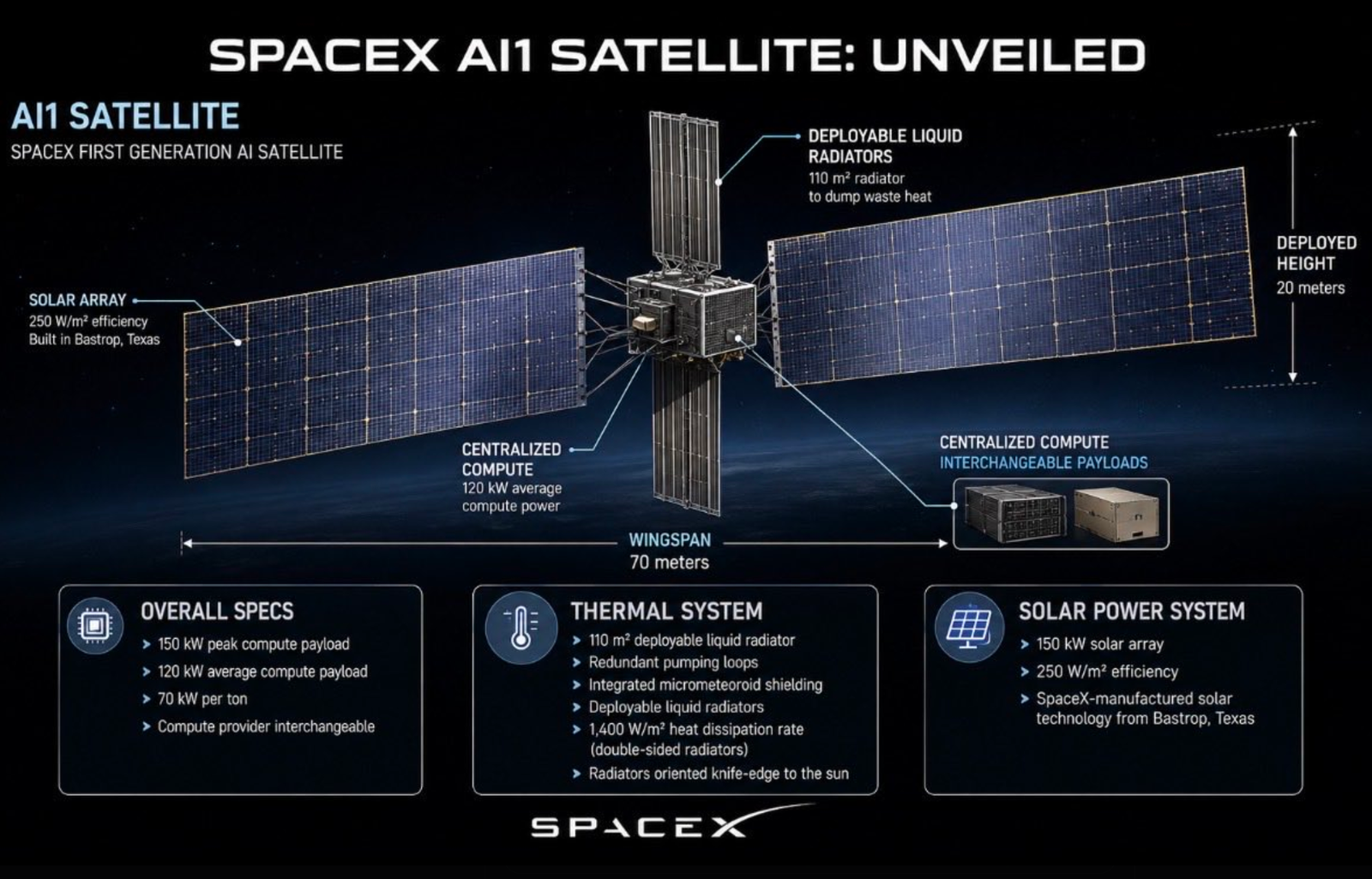
Musk argues SpaceX can extend technology developed for Starlink, including spacecraft manufacturing, solar arrays and thermal management, rather than invent an entirely new cooling method. SpaceX has proposed a constellation of up to one million orbital computing satellites, but the full system has not been demonstrated at that scale.
SpaceX’s June 2026 technical discussion with Musk, Ian Dahl and Dan Huot presents the company’s case for orbital AI hardware and explains its proposed radiator approach. Footage is published by VideoFromSpace with SpaceX credit.
How much radiator area would 100 MW require?
The underlying physics is Q = εσAT⁴ for one radiating face under ideal conditions: heat rejection increases with surface emissivity and the fourth power of absolute temperature. For a panel radiating from both unobstructed faces, an idealized approximation doubles that output. Real satellites receive energy from sunlight and Earth and lose efficiency through imperfect orientations and temperature gradients.
Applying that optimistic two-sided model to a hypothetical 100 MW computing load, with emissivity 0.90, yields radiator panel footprints of approximately 124,000 square meters at 25°C, 84,500 m² at 55°C, 59,500 m² at 85°C, and 43,200 m² at 115°C. These are aggregate radiator areas for the hypothetical load, not estimates of the size of one AI1 spacecraft.
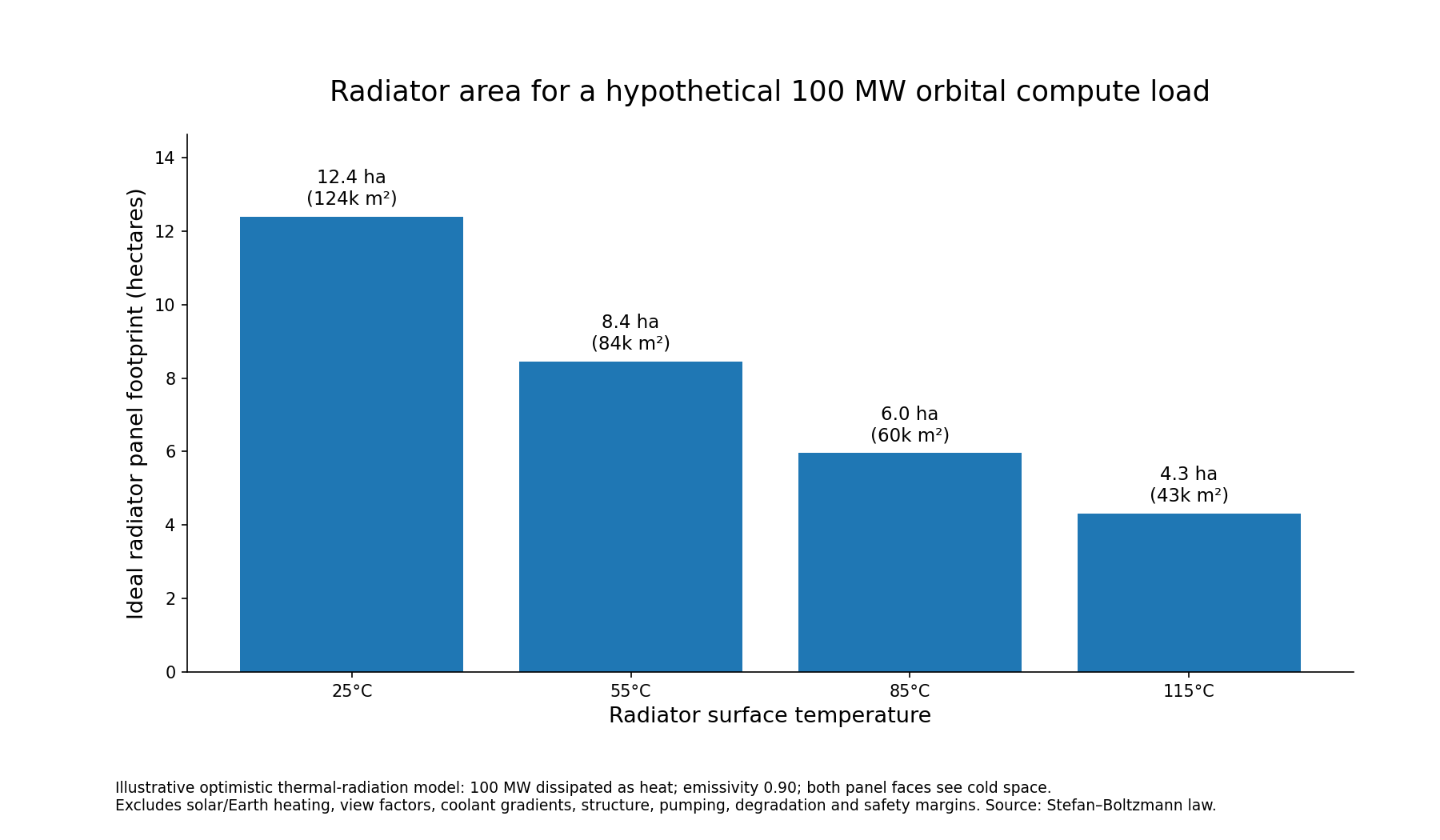
Running radiator surfaces hotter shrinks their required area, but the heat must be transferred from chips into a coolant loop before reaching those panels. Higher temperatures can complicate the reliability and operating limits of processors, memory, electronics and pumps. The model also omits structural mass, damage protection and environmental heating; it is an optimistic sensitivity analysis, not a complete spacecraft design.
A June IEEE Spectrum engineering analysis illustrated the same issue with a different set of assumptions: approximately 80 square meters of radiators for a 40 kW AI rack. Those figures should not be substituted directly into SpaceX’s hotter, double-sided design, because assumptions about radiator temperature and environmental heat loads materially change the result.
What has already been proven
Space cooling is established technology. NASA’s International Space Station thermal-control system uses liquid ammonia loops and six external radiators; a 2026 NASA engineering paper documents a radiator-panel anomaly and years of monitoring before reintegration. The U.S. Government Accountability Office said in April that large orbital data-center cooling systems remain unproven at the proposed scale.
The technical question is therefore not whether a radiator works in space. It is whether SpaceX can deploy, protect, orient and replace enough radiator surface—and solar generation, networking and computing hardware—at a cost competitive with terrestrial infrastructure. Radiation damage, orbital debris, upgrade cycles and launch economics add to the uncertainty.
SpaceX’s concept is ambitious and technically plausible in principle. What remains missing is public evidence that AI1-class cooling performance, launch economics and long-term reliability can be repeated across a commercial constellation. Until those results exist, orbital data centers are a serious engineering proposal, not an established replacement for facilities on Earth.
BitcoinVersus.Tech — Independent reporting on energy, data centers, AI hardware and computing infrastructure.
Editor’s Note: We volunteer daily to ensure the credibility of the information on this platform is Verifiably True. If you value independent technology reporting, scan the original Bitcoin donation QR below to donate 5,000 sats. Best results on a laptop or larger screen.

On mobile, save or screenshot the QR image and use your Bitcoin wallet’s scan-from-photo option if available; otherwise, display the QR on another device and scan it with your phone.
BitcoinVersus.tech is not a financial advisor. This media platform reports on financial subjects purely for informational purposes.


Leave a Reply