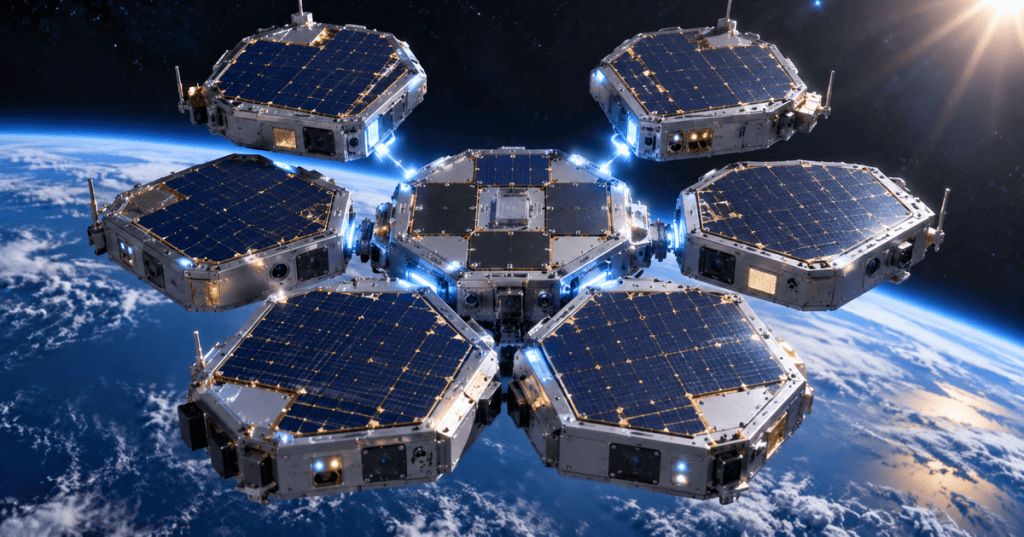
Rendezvous Robotics announced on October 28, 2026, that it raised $20 million in an oversubscribed seed round led by MaC Venture Capital and Toyota Ventures. Based in Golden, Colorado, the company is developing satellite modules that autonomously connect and reorganize in orbit, aiming to make larger spacecraft possible without launching them as one rigid object.
Its planned demonstration, scheduled no earlier than April 2028, would deploy seven independent tiles, assemble them into one spacecraft, separate them, and reassemble them in another arrangement. The company says it has reserved a rideshare opportunity, but the mission has not flown and no performance results have been independently demonstrated for that free-flying system.
The technology began at MIT
TESSERAE modular spacecraft research — MIT Media Lab, July 2026. Historical demonstration/context, not footage from the October 28, 2026 funding announcement.
The architecture descends from TESSERAE, research developed by Ariel Ekblaw at MIT. Earlier prototype tiles were tested on Blue Origin’s New Shepard and aboard the International Space Station. MIT’s research overview explains how electromagnetic bonds and onboard sensing help modules connect in microgravity; those controlled tests do not establish that a fleet of operational satellites can do the same.
Rather than use astronaut assembly or a separate robotic arm, Rendezvous wants the individual tiles to steer, align, latch and establish electrical connections. The longer-term ambition includes much larger communications antennas, solar arrays and replaceable computing sections. The attraction is straightforward: a launch fairing limits a traditional spacecraft’s size, while separately launched elements may eventually exceed that constraint.
Two different assembly demonstrations
TESSERAE Space Habitat Pavilion, an Earth-based exhibit — Aurelia Institute. Historical demonstration/context, not footage from the October 28, 2026 funding announcement.
A separate TESSERAE fifth-generation experiment is scheduled for December 2026 aboard the ISS. The planned 32-tile enclosed microgravity test is distinct from the seven-tile free-space mission in 2028. The earlier hardware uses cameras, sensors and electropermanent magnets; scaling such components changes the engineering challenge.
If the technology works, operators might swap failed parts or expand power and compute capability without retiring an entire vehicle. That prospect intersects with current attempts to develop orbital computing and power infrastructure, but larger structures still confront thermal, mass, propulsion and reliability limits.
The business and engineering test
Rendezvous Robotics: Building Large Scale Self-Assembling Structures in Space — Space Startup News, September 2025. Historical demonstration/context, not footage from the October 28, 2026 funding announcement.
Rendezvous has not disclosed a commercial price per tile, operational lifetime, orbital servicing costs or a customer contract tied to the planned 2028 demonstration. A seed financing round is evidence of investor interest, not proof of flight readiness. The video below predates the financing and is included as technical background.
The next milestones are the November 2026 parabolic-flight campaign, the December ISS experiment, and the proposed 2028 flight. Those outcomes will matter more than renderings for judging whether self-assembly offers advantages over conventional deployable space hardware or spacecraft servicing.
BitcoinVersus.Tech
BitcoinVersus.Tech Editor’s Note: We volunteer daily to ensure the credibility of the information on this platform is Verifiably True. If you would like to support our work and help further secure the integrity of our research initiatives, please scan the QR code below to donate 5,000 sats. For best results, scan the QR code from a laptop or larger screen.

Bitcoin address: 3C9o19EH5HSiwEPyCTmEKzxhNCbo2X6TTb. On a phone, open the QR image on another screen or copy and verify the address in your wallet before sending.
BitcoinVersus.tech is not a financial advisor. This media platform reports on financial subjects purely for informational purposes.


Leave a Reply