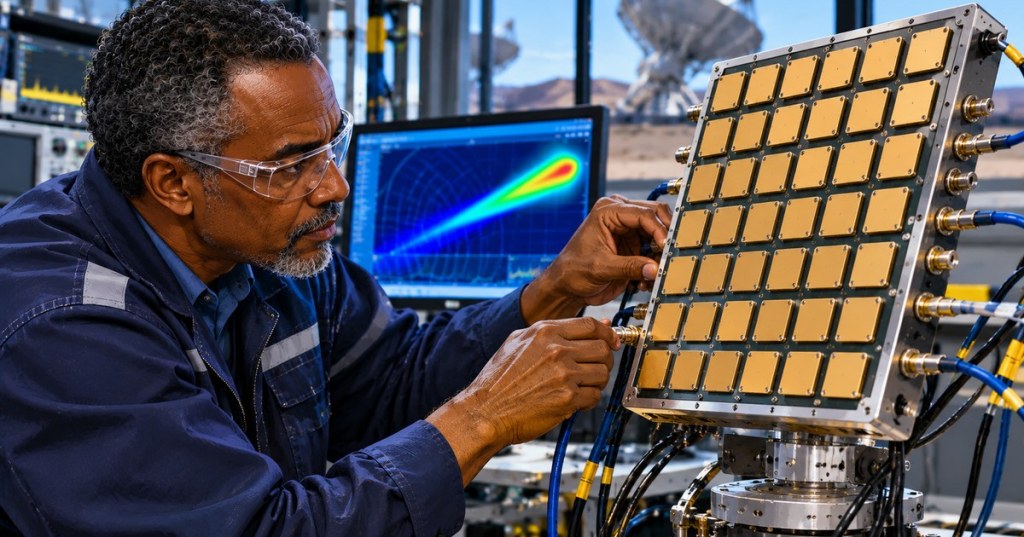
A phased-array antenna is a collection of smaller antennas that work together to transmit or receive a directed radio beam without physically turning the entire array. Electronic beam steering is used in radar, satellite communications, 5G networks and experimental wireless-power systems.
Unlike a rotating dish, a phased array changes the timing or phase of signals at individual antenna elements. When their waves arrive together in a selected direction, they reinforce one another. In other directions, they may partially cancel. This is called constructive and destructive interference, as explained by Analog Devices.
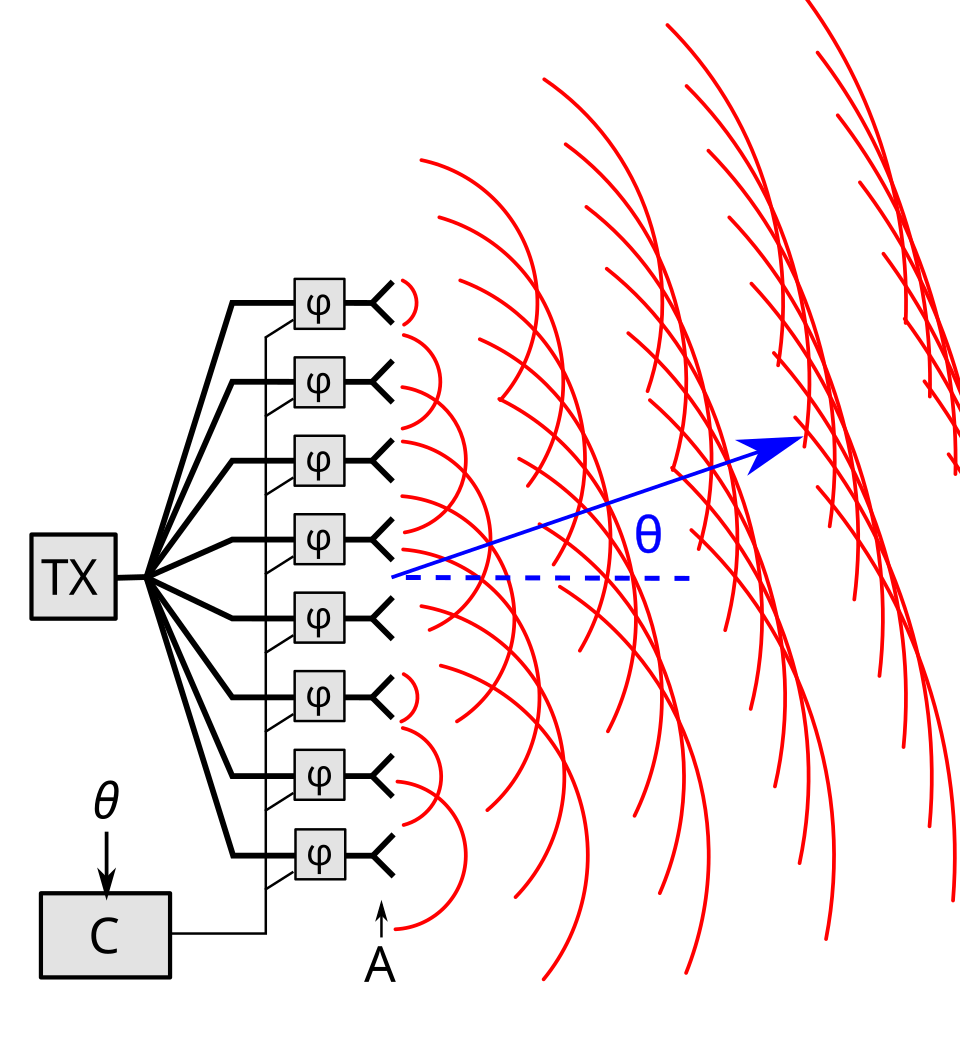
A simplified phased-array diagram showing phase shifters, antenna elements and wavefront direction. Source: Chetvorno/Wikimedia Commons, CC0.
How Does Electronic Beam Steering Work?
A computer assigns a phase offset to each element. The sequence of offsets tilts the direction where the waves add together, called the main lobe. For a basic linear array, the adjacent-element phase difference depends on element spacing, operating wavelength and steering angle. Real arrays often use two-dimensional grids to control both horizontal and vertical directions.
Marshall Bruner explains phased arrays, steering angles, antenna patterns and near-field versus far-field behavior through animations.
Antenna engineers also control unwanted side lobes and interference. Analog radio-frequency phase shifters and digital beamforming are alternative architectures with different cost, power and processing trade-offs. NOAA’s phased-array radar research shows how electronic steering can focus scans where storms are occurring.
Why Wavelength and Spacing Matter
The wavelength equals the speed of light divided by frequency. At 2.4 GHz it is approximately 12.49 centimeters; at 24 GHz, approximately 1.25 centimeters. A common illustrative spacing is half a wavelength, although practical designs vary.
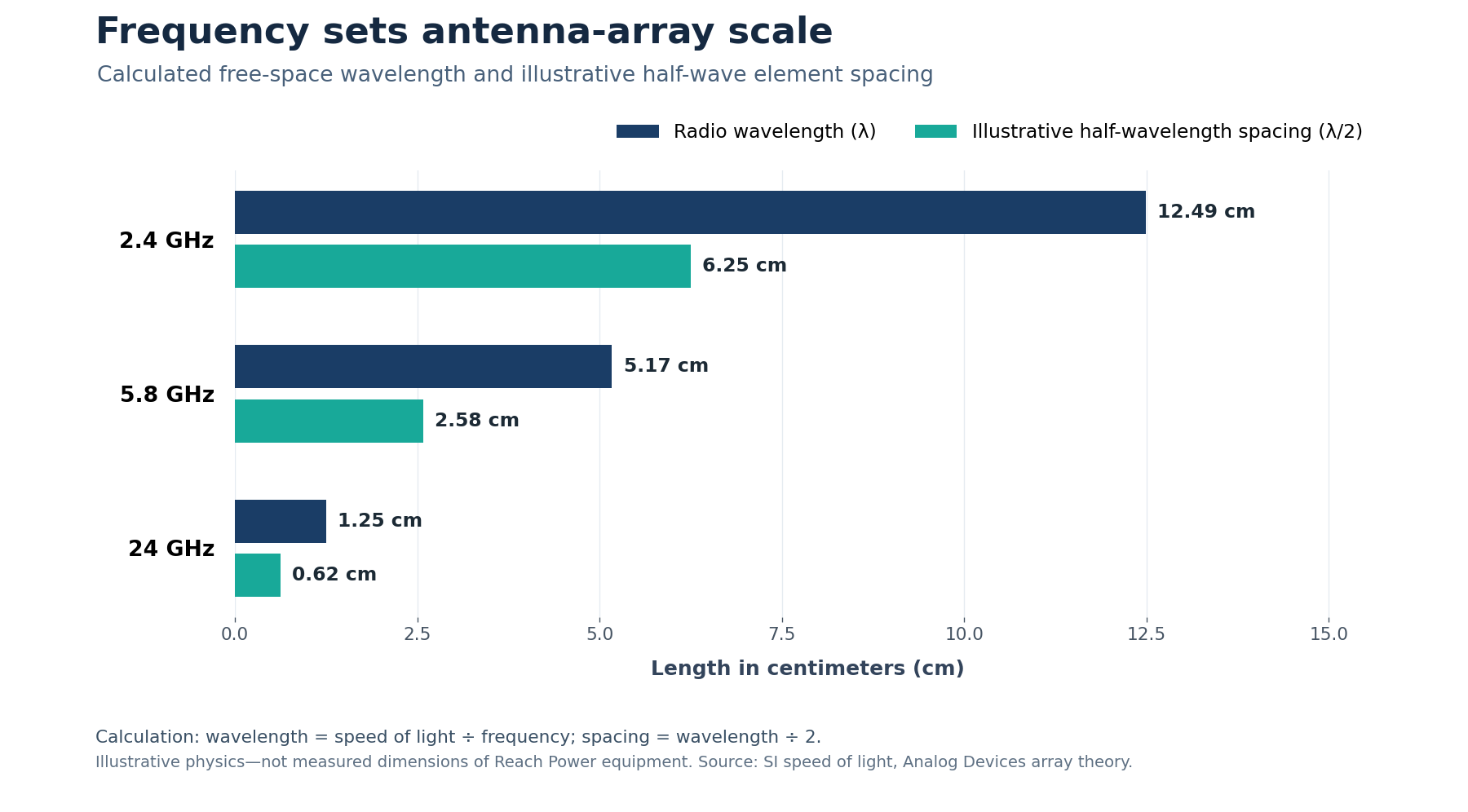
Calculated free-space wavelengths and illustrative half-wave spacing. These are physics-based values, not measurements of a particular product.
Spacing that is too large can produce additional strong beams called grating lobes. Steering far from straight ahead can also reduce useful gain. Faster electronic targeting does not create energy or eliminate transmitter losses.
Phased-array simulation visualizing beam direction as the relative phase between antenna elements changes.
Where Phased Arrays Are Used
A phased array may track aircraft, communicate with a satellite or direct RF energy toward a receiver. BitcoinVersus.Tech previously covered Reach Power’s transmitter hardware, wireless-powered drone flight, open-source satellite-linked 5G and next-generation satellite ground stations.
The important distinction: beam steering controls where radio energy travels. It does not guarantee that the receiver captures every transmitted watt. Actual performance still depends on antenna gain, distance, alignment, hardware efficiency and operating conditions.
Support BitcoinVersus.Tech
We volunteer daily to ensure the credibility of the information on this platform is Verifiably True. Please scan the original QR code below to donate 5,000 sats if you would like to support our independent reporting. For best results, open this page on a laptop or larger screen.

On mobile, display the QR code on another screen to scan it with a Bitcoin wallet; alternatively, use a wallet’s saved-image QR-scanning feature if available. Bitcoin donation address: 3C9o19EH5HSiwEPyCTmEKzxhNCbo2X6TTb.
BitcoinVersus.tech is not a financial advisor. This media platform reports on financial subjects purely for informational purposes.


Leave a Reply