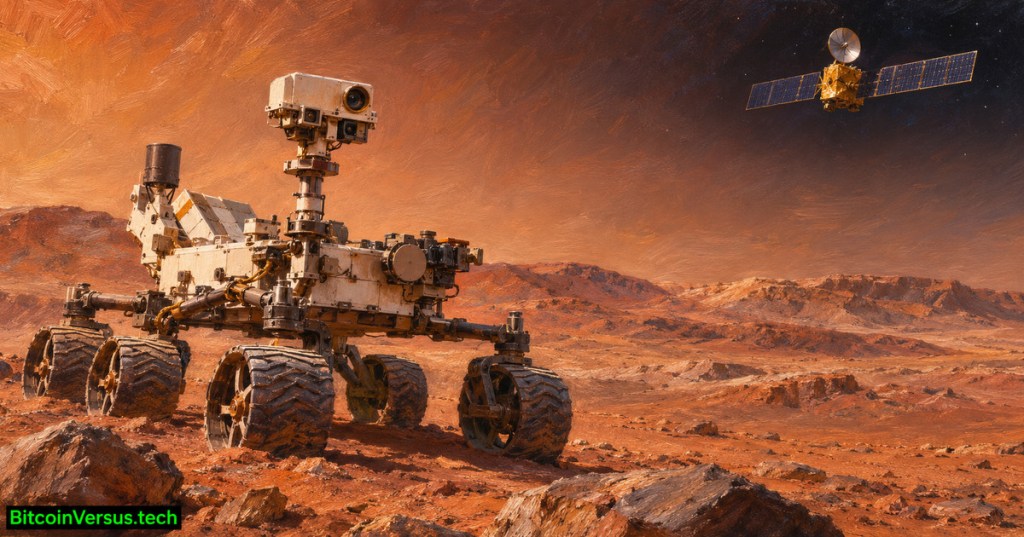
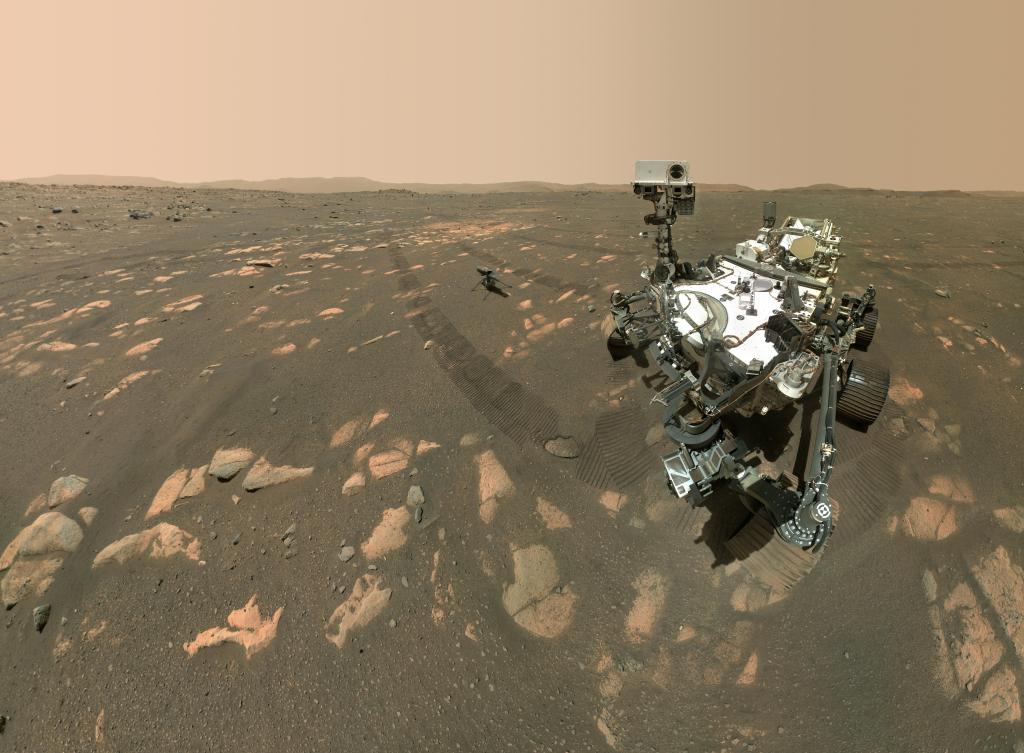
Two NASA Mars missions have temporarily stopped science operations following separate hardware problems. In a November 19, 2026 update, the agency said its Perseverance rover is stable and communicating with Earth, while the veteran Mars Odyssey orbiter is undergoing reaction-wheel tests. Neither problem has been traced to the other, and NASA has not declared either mission lost.
NASA Jet Propulsion Laboratory, “Two Rovers, Billions of Years of Martian History,” April 27, 2026. Official mission overview recorded before the current interruption. Original NASA video.
Perseverance loses its high-volume radio relay
On October 30, the rover’s primary ultrahigh-frequency (UHF) downlink radio stopped sending routine heartbeat signals to its onboard computer. After 25 missed pings, approximately 100 seconds, fault-protection software shut down the radio, activated a redundant unit and entered safe mode. The automatic switch was an intended protective response, not evidence that the rover’s computer had failed.
Engineers subsequently found that the backup UHF transmitter was operating at roughly half its expected output power. Both UHF units are now inactive pending investigation. Unlike the rover’s earlier geological investigation of water in Jezero Crater, ongoing science would normally generate substantial instrument and imaging data requiring efficient transmission through Mars orbiters.
Perseverance instead communicates directly with NASA’s Deep Space Network through an X-band high-gain antenna. NASA says the connection provides significantly less data capacity than its usual orbital relay, so engineers are prioritizing diagnostics over new images and measurements. The distinction resembles broader radio-antenna engineering challenges: maintaining a link is not equivalent to maintaining full throughput.
Odyssey’s attitude-control hardware faces a different problem
Mars Odyssey entered safe mode between November 4 and 6 after a reaction wheel stopped turning. Reaction wheels change spacecraft orientation by exchanging angular momentum with the vehicle, allowing precise pointing without constantly consuming propellant. Odyssey has four wheels, but one failed in 2013; the newly affected unit leaves fewer than the three wheels needed for normal orientation control.
NASA Jet Propulsion Laboratory, November 28, 2023: an official look at the 2001 Mars Odyssey orbiter and its atmospheric observations. Archival footage, not a recording of the 2026 hardware issue. Original NASA video.
Thrusters can substitute for the missing wheel control, but Odyssey’s remaining hydrazine is limited. NASA estimates the spacecraft could maintain orientation without reaction wheels for only one to two months; the figure is a preliminary fuel assessment, not a scheduled mission-ending date. One test did move the stalled wheel after a command, although repeatable recovery has not been established.
Odyssey has left safe mode but remains off science duty. Its relay and surface-mapping history matters to the wider Mars fleet: communications and navigation links are shared infrastructure. A comparable engineering tradeoff appears in small-satellite propulsion experiments, where pointing, fuel and power budgets constrain operations even when instruments remain intact.
What happens next?
NASA hopes Perseverance can resume science before November ends and is targeting the final week of November for Odyssey’s science and relay recovery, subject to test results. Both dates are objectives rather than confirmed restoration schedules. Meanwhile, newer missions, including the Mars-bound ESCAPADE probes, underline the importance of designing for redundancy and communication constraints well before a spacecraft leaves Earth.
The immediate lesson is not that Mars exploration has stopped. It is that a healthy flight computer, a functioning backup radio and an orbiting spacecraft can still be insufficient for routine science when bandwidth, attitude control or remaining fuel falls below operational requirements.
Primary source: NASA Mars Exploration Program, November 19, 2026. Engineering details, operational status and recovery targets come from the agency update. Official JPL videos provide historical context, not live fault diagnostics.
Editor’s Note: Reporting distinguishes NASA-confirmed failures from provisional recovery dates. The featured oil painting is editorial artwork and does not depict an observed scene. NASA archival media are dated in the captions. Embed playback and exact device rendering require independent browser verification.
We volunteer daily to ensure the credibility of the information on this platform is Verifiably True. If you would like to support to help further secure the integrity of our research initiatives, please scan the QR code below

Disclaimer: Reporting is provided for general technical and educational purposes. NASA mission conditions and recovery targets can change as testing progresses. Bitcoin donations are optional and generally irreversible.


Leave a Reply