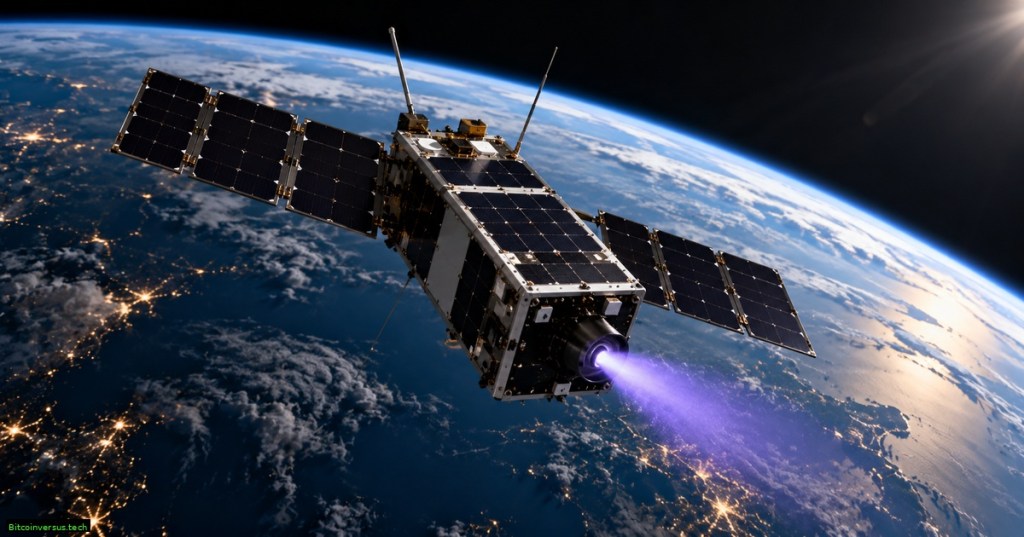
ESA and Danish satellite builder GomSpace launched GOMX-5 on October 1, 2026 aboard a SpaceX Transporter-18 mission. The 8U CubeSat is testing an iodine-based electric-propulsion system, automated spacecraft commissioning, new communications hardware, and maritime sensing in low Earth orbit.
The most important early test is unusually simple to describe: can a small satellite become ready to perform a collision-avoidance maneuver within 48 hours of launch? ESA says conventional commissioning can take at least a week. GOMX-5 is designed to compress that process through automation so its propulsion system can be available much sooner if another object threatens its orbit.
The 48-Hour Target Is Still a Test, Not a Confirmed Success
ESA confirmed that GOMX-5 reached orbit successfully and began its launch-and-early-operations phase. However, as of October 6, ESA and GomSpace have not publicly confirmed that the spacecraft actually completed propulsion commissioning inside the 48-hour target. Independent reporting published October 6 likewise describes the capability as a mission objective rather than a completed demonstration.
That distinction matters because the value of the mission is not just carrying a thruster. GOMX-5 is trying to prove that the complete spacecraft—power, attitude control, communications, software, navigation, and propulsion—can move from deployment to a collision-ready state far faster than traditional commissioning workflows.
Why Use Iodine for Electric Propulsion?
Electric propulsion accelerates charged particles to produce small but efficient thrust over long periods. Iodine is attractive for compact spacecraft because it can be stored densely as a solid instead of requiring a high-pressure xenon tank, which can simplify storage on volume-constrained satellites.
The tradeoff is materials and systems engineering. Iodine is chemically aggressive compared with noble gases, so the feed system, valves, cathode, seals, thermal design, and nearby materials all have to tolerate it. A compact thruster only becomes useful when the entire propulsion chain works reliably on orbit.
GOMX-5 Is More Than a Thruster Test
ESA describes the spacecraft as an 8U CubeSat with three-axis pointing, reaction wheels, a star tracker, deployable steerable solar power, an X-band transmitter, and a software-defined-radio payload covering multiple radio-frequency bands. The spacecraft is also designed as an on-orbit software laboratory whose code can be updated after launch.
That makes GOMX-5 part propulsion demonstrator, part satellite-communications testbed, and part maritime-sensing platform. Its maritime payload is intended to detect radio signals from ships, including activity in remote regions where vessels may be difficult to monitor using conventional tracking alone.
Collision Avoidance Is Becoming a Hardware Requirement
Low Earth orbit is becoming more crowded as commercial constellations, government spacecraft, research satellites, and rideshare payloads multiply. A spacecraft that cannot maneuver soon after deployment may have to spend its first days effectively waiting while operators commission subsystems manually.
GOMX-5 connects propulsion readiness directly to ESA’s Zero Debris approach. The mission is intended not only to support collision avoidance during operations, but also to demonstrate propulsion relevant to responsible end-of-life disposal. That same orbital-sustainability problem is why BitcoinVersus has covered robotic inspection of dead satellites and other technologies aimed at managing aging spacecraft in orbit.
Automation Is the Other Important Experiment
The unusual part of the mission may be the commissioning software rather than the propulsion hardware itself. GomSpace developed a largely automated procedure intended to bring critical spacecraft subsystems online with less manual intervention from the ground team.
That matters for future constellations. Launching one satellite allows engineers to spend days checking each subsystem by hand. Launching dozens or hundreds at a time makes that model much harder to scale. Faster automated commissioning could reduce operator workload while making propulsion, communications, power, and attitude control available earlier in the mission.
Transporter-18 Put It Into a Crowded Rideshare Environment
GOMX-5 flew on SpaceX’s Transporter-18 rideshare with roughly 129 other payloads, according to ESA. That launch environment makes the mission’s collision-readiness goal especially relevant: rideshare missions can deploy large numbers of spacecraft into similar orbital regimes within a short period.
BitcoinVersus has tracked the accelerating shift toward smaller, smarter spacecraft, from Google putting AI processors in orbit to satellite edge-compute platforms. GOMX-5 attacks a different part of the same scaling problem: making small spacecraft safer, more autonomous, and easier to operate immediately after deployment.
What to Watch Next
The next meaningful update is confirmation from ESA or GomSpace on whether the automated commissioning sequence met the 48-hour target and whether the iodine propulsion system is fully ready for commanded maneuvers. After that, watch for actual propulsion firings, collision-avoidance demonstrations, maritime-radio payload results, X-band performance, and end-of-life deorbit testing.
If the mission works as intended, GOMX-5 will demonstrate something more useful than a single successful CubeSat: a reusable operating model in which future small satellites can launch, configure themselves rapidly, communicate, sense, maneuver, and eventually dispose of themselves with much less manual intervention.
Sources
- European Space Agency: GOMX-5 successfully launched, October 2, 2026
- GomSpace: GOMX-5 technology-demonstration mission
- Manufacturing Industry: October 6 reporting on the iodine-propulsion mission
BitcoinVersus.Tech
Advertisement
Editor’s Note
ESA has confirmed launch and orbital deployment, but no public ESA or GomSpace update located as of October 6 confirms that the 48-hour propulsion-commissioning target was achieved. This article therefore treats that milestone as an active mission objective rather than a completed result.
We volunteer daily to ensure the credibility of the information on this platform is Verifiably True. If you would like to support to help further secure the integrity of our research initiatives, please donate here: 3C9o19EH5HSiwEPyCTmEKzxhNCbo2X6TTb
BitcoinVersus.tech is not a financial advisor. This media platform reports on financial subjects purely for informational purposes.


Leave a Reply