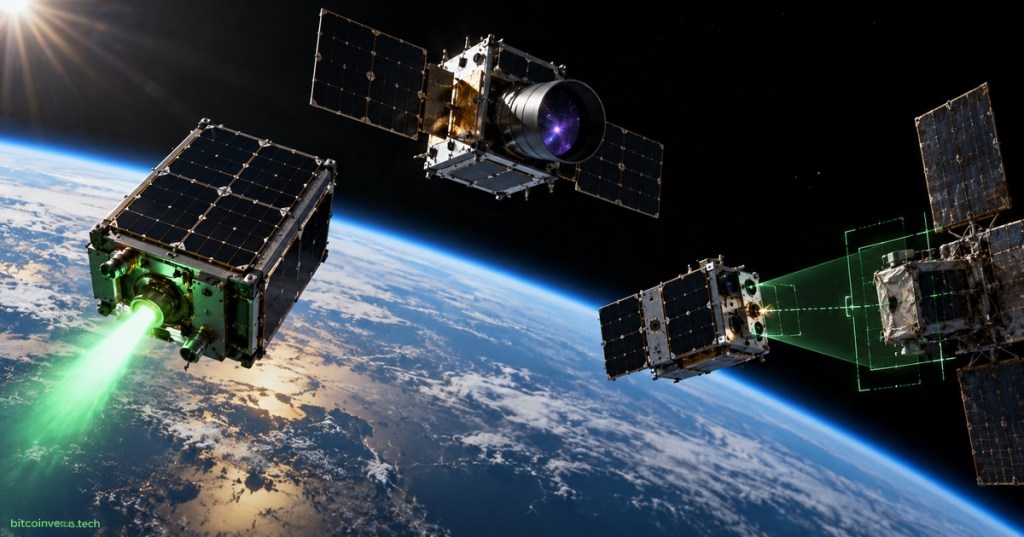
NASA launched three small spacecraft on SpaceX’s Transporter-18 mission on October 1, putting three different technologies into orbit at once: dual-mode propulsion, ultraviolet astrophysics, and autonomous inspection of inactive satellites. NASA’s mission update says the spacecraft launched from Vandenberg Space Force Base aboard a Falcon 9 headed for Sun-synchronous orbit.
The launch is a snapshot of where small-spacecraft engineering is heading. NASA is using compact spacecraft to test maneuvering systems, high-value science instruments and autonomous servicing capabilities that could later scale into larger missions.
One CubeSat Is Testing Two Propulsion Modes
The ASCENT Propulsion Dual Mode CubeSat combines a higher-power maneuvering system with four electrospray units for lower-power operations. Both modes share one onboard supply system, allowing NASA to test whether one compact spacecraft can handle both larger maneuvers and fine control without carrying separate architectures.
SPRITE Is a Shoebox-Sized UV Observatory
The second mission, SPRITE, is an astrophysics CubeSat built to observe ultraviolet wavelengths that cannot be measured from the ground. It will study star-forming regions and supernova remnants to track how gas, dust and high-energy radiation move through galaxies.
The spacecraft is about the size of a shoebox, but NASA says its detectors, mirror coatings and telescope design could deliver performance normally associated with much larger instruments.
SSPICY Is Practicing Autonomous Satellite Inspection
The third spacecraft may have the most immediate infrastructure implications. Starfish Space’s Otter 24C vehicle will support NASA’s SSPICY mission by approaching and inspecting up to four inactive U.S.-origin satellites in low Earth orbit. The spacecraft uses autonomous guidance, computer vision and a movable propulsion assembly to approach objects and collect information about their condition and geometry.
Space.com’s Transporter-18 coverage reports that the launch carried 130 payloads in total, including Starfish Space’s first Otter servicing spacecraft. NASA expects SSPICY’s inspection campaign to begin in 2027 and operate for roughly two years.
The mission fits a broader move toward orbital infrastructure rather than isolated spacecraft. BitcoinVersus.Tech recently covered NASA’s plan to bring 5G and Wi‑Fi 6 networking to the lunar surface, another example of space systems becoming interconnected rather than mission-specific.
Launch capacity is expanding at the same time. NASA recently added Blue Origin’s New Glenn 9×4 to its launch-services catalog, broadening the vehicles that can compete to carry future science and exploration payloads.
And farther from Earth, Dragonfly’s Titan mission is becoming real flight hardware. Together, these programs show the same engineering direction at different scales: more autonomy, more onboard capability and more infrastructure built to keep operating after launch.
Transporter-18 was a rideshare mission, but the NASA payloads were not minor passengers. They are testing three capabilities future spacecraft will increasingly need: maneuver efficiently, observe with compact instruments and inspect other objects without constant human control.
BitcoinVersus.Tech
Advertisement
Editor’s Note
We volunteer daily to ensure the credibility of the information on this platform is Verifiably True. If you would like to support to help further secure the integrity of our research initiatives, please donate here: 3C9o19EH5HSiwEPyCTmEKzxhNCbo2X6TTb
BitcoinVersus.tech is not a financial advisor. This media platform reports on financial subjects purely for informational purposes.


Leave a Reply