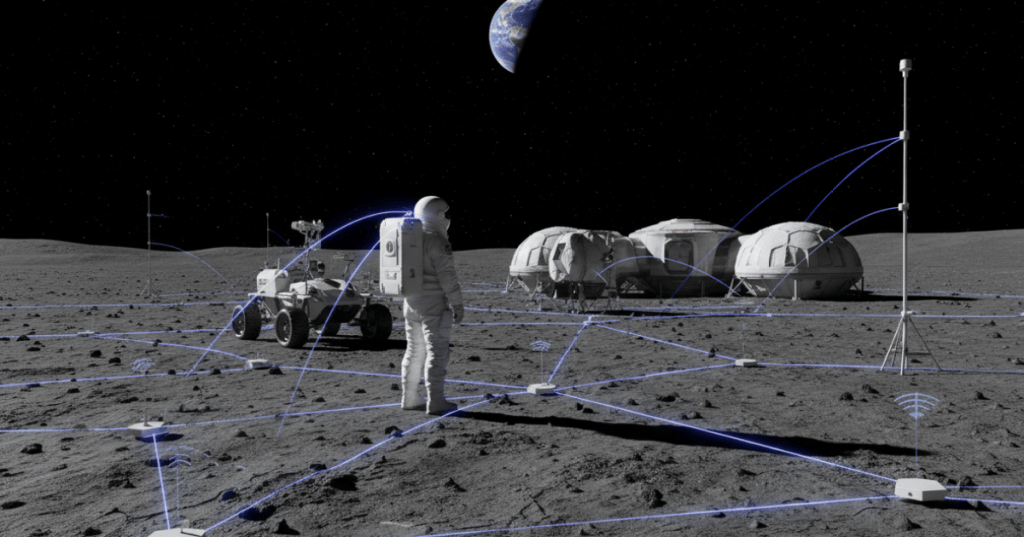
NASA is moving terrestrial wireless networking onto the lunar surface. The agency has awarded Modulate Space Corporation a contract to develop key elements of a 5G communications system with built-in Wi‑Fi 6 for future Moon Base operations. NASA’s September 30 contract release says the project will combine a 5G Network-in-a-Box with lunar radio-propagation testing and a later integrated surface-network demonstration.
The important engineering shift is that NASA is not treating lunar communications as a collection of one-off radios. The system is being designed as a scalable standards-based network that can connect astronauts, vehicles, instruments and surface infrastructure using technologies derived from 3GPP cellular networking and Wi‑Fi.
The earlier federal procurement notice on SAM.gov specified a minimum viable 5G New Radio user device and 5G Network-in-a-Box with integrated Wi‑Fi 6. It also identified Modulate Space as the intended development partner and framed the work as preparation for subsequent lunar missions rather than a simple terrestrial hardware transplant.
Why 5G on the Moon Is Harder Than 5G on Earth
Lunar networking has to operate without Earth’s dense tower grid, buried fiber backhaul or easy maintenance access. Terrain is also a major problem. Crater walls, ridges and the Moon’s south-pole topography can block radio links, while extreme thermal cycles and abrasive regolith put additional stress on antennas and electronics.
That makes radio-propagation measurements part of the core mission rather than an afterthought. Engineers need to understand how lunar terrain changes link budgets, where relay nodes should sit, how handoffs work around obstacles and which frequencies remain reliable when astronauts or rovers move behind local terrain.
The project also fits a larger NASA push toward modular communications infrastructure. BitcoinVersus.Tech recently covered NASA’s work on a new Mars telecommunications network, where future missions similarly need communications to scale beyond a single spacecraft talking directly to Earth.
A Lunar Base Needs a Local Network, Not Just a Deep-Space Link
Deep-space communications connect the Moon to Earth. A local 5G and Wi‑Fi network solves a different problem: moving data between people and machines already on the surface. A rover could stream telemetry to a habitat, an astronaut could send suit data to local systems, and instruments could share high-bandwidth measurements without each device requiring its own direct Earth link.
That local-network layer becomes more important as launch capability and surface activity expand. NASA recently added Blue Origin’s New Glenn 9×4 to its launch-services catalog, broadening the heavy-lift vehicles that may compete for future exploration missions.
The same infrastructure logic appears farther from Earth. BitcoinVersus.Tech also covered NASA’s Dragonfly mission to Titan, where mobility, communications, power and autonomous operation all have to function together in an environment where real-time human intervention is impossible.
For the Moon, 5G and Wi‑Fi 6 are not consumer conveniences. They are an attempt to turn a collection of future landers, rovers, suits and instruments into a networked surface system. If the demonstrations work, lunar exploration starts looking less like isolated expeditions and more like infrastructure.
BitcoinVersus.Tech
Advertisement
Editor’s Note
We volunteer daily to ensure the credibility of the information on this platform is Verifiably True. If you would like to support to help further secure the integrity of our research initiatives, please donate here: 3C9o19EH5HSiwEPyCTmEKzxhNCbo2X6TTb
BitcoinVersus.tech is not a financial advisor. This media platform reports on financial subjects purely for informational purposes.


Leave a Reply