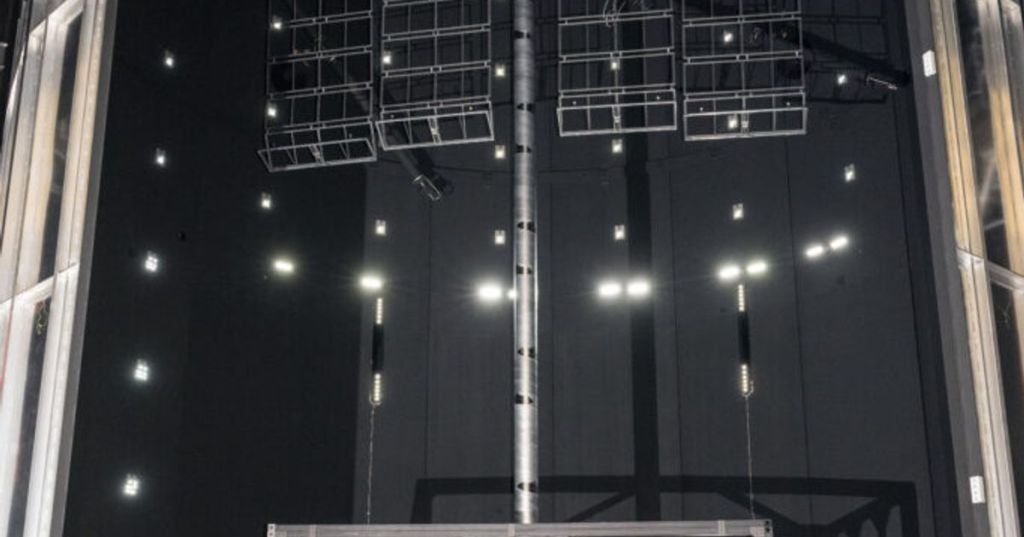
Blue Origin is treating lunar power less like a spacecraft subsystem and more like a utility. Its Power Tower is a vertically deployed solar-array system designed to rise about 20 meters above the Moon and deliver more than 10 kilowatts of electrical power for operations near the lunar south pole.
The idea is straightforward but important: instead of laying solar panels close to rough lunar terrain, raise them high enough to reach long-duration sunlight near the poles, then distribute that electricity beyond the lander to rovers, instruments, habitats and other surface equipment. Blue Origin says the architecture is modular and intended to support larger lunar power networks over time.
The company’s current Blue Moon Mark 1 documentation says the cargo lander will deploy Power Towers on the lunar surface, harvesting near-continuous sunlight from rare high points near the poles and supplying more than 10 kW of power.
Why put a solar array on a tower?
The Moon’s south pole is attractive because sunlight behaves differently there than it does near the equator. The Moon’s axis is tilted only slightly, so the Sun stays low on the horizon near the poles. Some elevated locations can receive sunlight for unusually long periods, while nearby craters remain in permanent shadow.
That creates both an opportunity and a problem. Long-duration sunlight can support solar power, but the low Sun angle means local ridges, crater walls and equipment can easily cast long shadows. Raising photovoltaic panels tens of meters above the ground improves their line of sight to the Sun and reduces the amount of time the array is blocked by terrain.
This is the same region NASA is targeting for sustained exploration because permanently shadowed areas may contain water ice. BitcoinVersus recently covered NASA’s Moon Base experiments aimed at ice and surface hazards and NASA’s work on 5G and Wi-Fi 6 for lunar communications. Power is the other half of that infrastructure problem: radios, rovers, science instruments and habitats are only useful if energy is available continuously enough to keep them operating.
The technology has already been tested on Earth
The Power Tower is not just a rendering. Blue Origin has released footage of a real deployment test performed on Earth, and the architecture builds on years of vertical-array work at Honeybee Robotics, the Blue Origin subsidiary that specializes in planetary mechanisms and exploration systems.
Honeybee’s earlier Lunar Array Mast and Power System, or LAMPS, completed thermal-vacuum testing inside Chamber A at NASA’s Johnson Space Center. That system also stood about 20 meters tall, used sail-style solar arrays, and was rated for up to 10 kW. Honeybee said the prototype reached Technology Readiness Level 6 after the test campaign.
LAMPS used a retractable mast based on Honeybee’s deployable interlocking actuator-band technology and included dust-tolerant connectors so rovers or habitats could connect to the power source. In its stowed configuration, Honeybee described the system as shrinking to roughly refrigerator scale for transport.
Ten kilowatts is small on Earth—but meaningful on the Moon
A 10 kW power system would be modest for an Earth-based commercial building. On the Moon, every kilogram of generation hardware, cable, battery and thermal-management equipment has to survive launch, transit, landing and the lunar environment. A continuously useful 10 kW-class source can therefore support a surprisingly large set of surface tasks.
Power demand could include rover charging, communications relays, navigation beacons, heaters, cryogenic systems, scientific instruments and eventually habitat systems. Blue Origin’s emphasis on distributing electricity beyond the lander is what makes the Power Tower more interesting than a normal spacecraft solar panel—it is being presented as shared infrastructure.
Blue Moon Mark 1 is the delivery truck
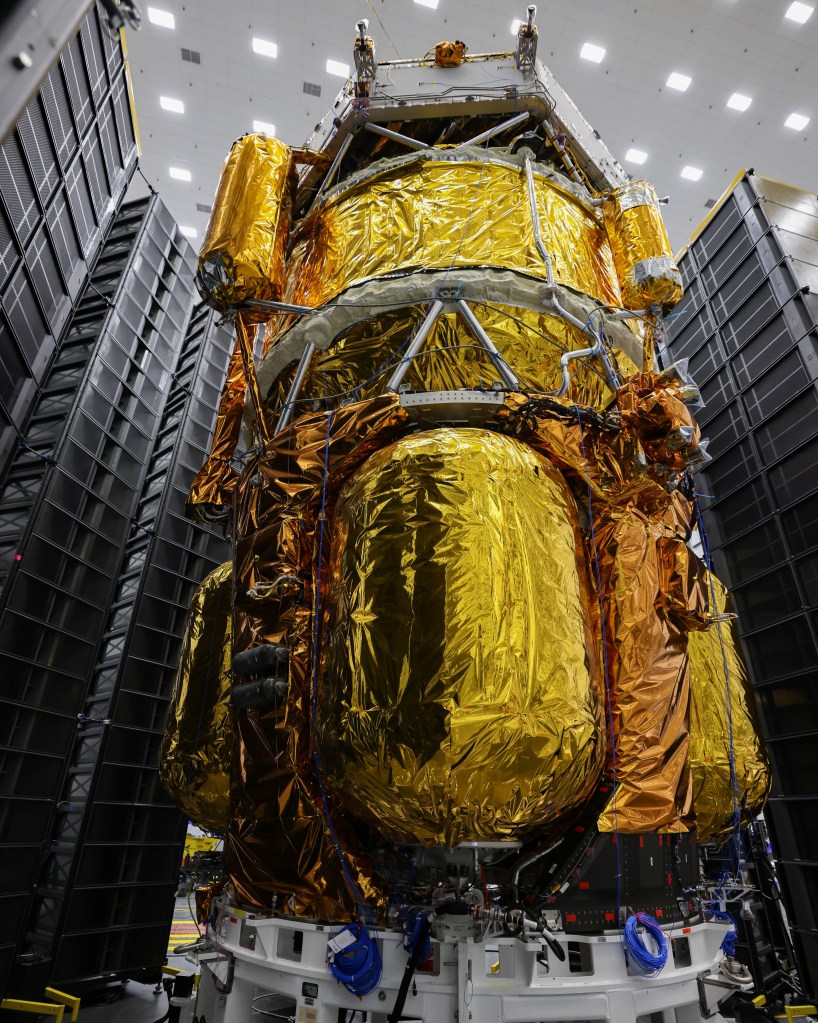
Blue Origin’s Blue Moon Mark 1 is a single-launch cargo lander designed to move heavy payloads to the lunar surface. The company says its initial cargo capability is up to 3 metric tons on New Glenn’s 7×2 configuration, with greater capacity planned for the larger 9×4 vehicle.
Mark 1 uses the hydrogen-and-oxygen BE-7 engine and is intended to support a sequence of increasingly infrastructure-heavy missions. Blue Origin says one MK1 will carry NASA’s VIPER rover to the lunar south pole, while later landers are planned to deliver Lunar Terrain Vehicles for early Moon Base development.
That puts the Power Tower in the same broader shift BitcoinVersus covered in NASA’s evolving Artemis and Blue Moon planning: the next phase of lunar exploration is less about a single landing and more about assembling repeatable transportation, communications, mobility and energy systems.
There is one public-number wrinkle
Blue Origin’s recent public description calls the Power Tower a 20-meter-tall system. An earlier company post from June described the arrays extending to 26 meters total height when mounted on the Blue Moon Mark 1 top deck. The company has not publicly explained whether those numbers represent a design revision or simply different measurement points, so the safest interpretation is that the deployed structure is roughly 20-plus meters tall.
Solar power will not be the Moon’s only energy source
Vertical solar arrays solve only part of the lunar-energy problem. Long shadows, eclipses, terrain and extended low-light periods still create gaps. Batteries, regenerative fuel cells and eventually nuclear fission systems are all candidates for maintaining reliable power when sunlight is unavailable.
The likely lunar grid will therefore look more like a microgrid than a single giant power plant: multiple generation sources, storage systems, local loads and power links spread across a small surface network. In that sense, a modular Power Tower could become a lunar equivalent of a pole-mounted utility asset rather than a one-off spacecraft component.
The bigger story is infrastructure, not the tower
For most of the space age, power systems were designed around individual missions. Every spacecraft carried its own solar panels or batteries, used them for a limited operational lifetime, and eventually became inactive.
Blue Origin’s Power Tower points toward a different model: land energy hardware once, connect multiple customers to it, and expand the network as more hardware arrives. That is what makes the concept interesting. A sustained lunar presence needs more than rockets and landers. It needs utilities.
On Earth, electrical infrastructure is so common that it disappears into the background. On the Moon, the first reliable shared power network would be one of the clearest signs that exploration is becoming settlement infrastructure.
Editor’s note: Blue Origin’s published height figures have varied between 20 meters and 26 meters total deployed height. This article distinguishes those public descriptions rather than treating them as interchangeable.
Disclaimer: BitcoinVersus.Tech publishes technology and space-industry news for informational and educational purposes.


Leave a Reply