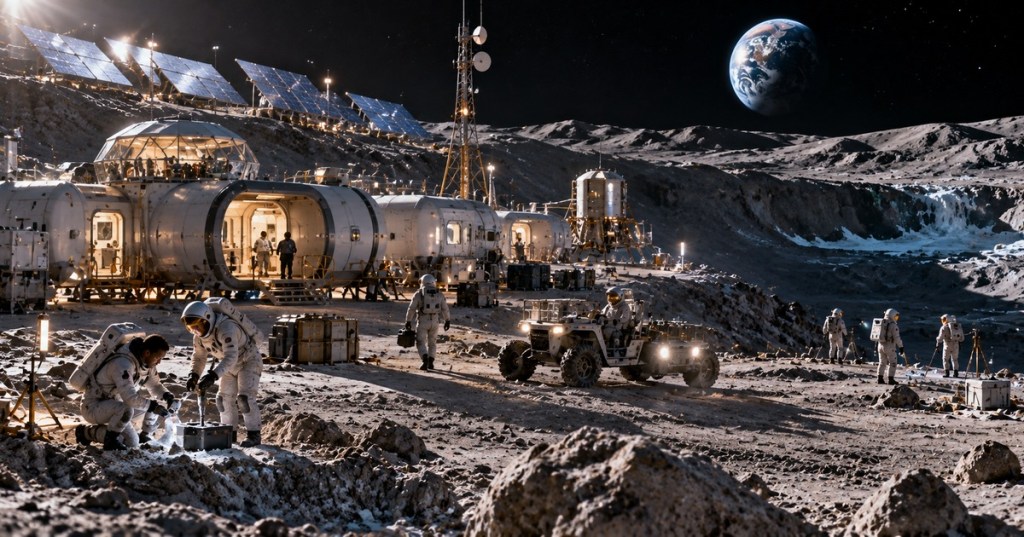
BitcoinVersus.Tech estimates that one prime, habitable-ready acre near the Moon’s South Pole could carry an economic use value of roughly $100 million to more than $1 billion during the first generation of permanent lunar settlement, with a central estimate around $500 million per acre. That is not a legal sale price. There is currently no broadly recognized system of private fee-simple land title on the Moon, so the value today is better understood as the value of access, infrastructure and location.
The Short Answer
- Raw lunar dirt with no recognized title: no defensible conventional real-estate price today.
- Surveyed operating site with power, communications and transport access: potentially tens to hundreds of millions of dollars per acre.
- Prime habitable-ready South Pole acre near persistent sunlight and accessible water ice: roughly $100 million to $1 billion+ in speculative use value.
- BitcoinVersus.Tech central estimate: about $500 million for one highly strategic serviced acre in an early lunar economy.
This is a follow-up to BitcoinVersus.Tech’s 2025 story, Mars Real Estate: The Astronomical Valuation of Martian Land, which explored speculative Martian acreage values in the hundreds of millions of dollars. The Moon requires a different model because it is far closer to Earth, but the most useful lunar sites may also be much more geographically concentrated.
You Cannot Price the Moon Like Nevada
The first problem is legal. Article II of the Outer Space Treaty says outer space, including the Moon, is not subject to national appropriation by sovereignty, use, occupation or other means. That means there is no conventional sovereign land registry handing out recognized one-acre lunar deeds.
The Artemis Accords take a different approach to resources. Signatories support extracting and using lunar resources in compliance with the Outer Space Treaty and coordinating operations through deconfliction or “safety” zones. Those operating arrangements could eventually create something economically similar to location rights, leases or concessions without turning the Moon into ordinary national territory.
What Makes an Acre “Habitable”?
For this estimate, “habitable” does not mean an acre enclosed under one giant dome. It means a surface site that can realistically support human operations because the expensive enabling systems are already nearby or connected.
- Stable, traversable terrain.
- Reliable electric power or connection to a lunar microgrid.
- Communications and navigation coverage.
- Access to landing, cargo and rover routes.
- A radiation and micrometeoroid shielding plan, likely involving regolith.
- Reasonable proximity to water, oxygen-producing resources or other in-situ materials.
- A location that does not create dangerous interference with neighboring operations.
NASA is now planning its Moon Base around the lunar South Pole because some locations can receive extended sunlight while nearby permanently shadowed regions may preserve water ice and other frozen materials. NASA also notes that lighting, terrain, Earth communications and access to resources all affect site selection.
Why $500 Million Is a Reasonable Central Estimate
The number comes from an infrastructure-replacement model rather than a fictional land deed. Recent NASA contracts show how expensive it still is to place useful capability on the lunar surface.
- NASA awarded Intuitive Machines $180.4 million in March 2026 for one CLPS delivery carrying seven science and technology payloads to the Moon.
- NASA awarded Astrolab $219 million and Lunar Outpost $220 million for the first phase of crewed lunar terrain vehicles and surface delivery.
- NASA’s potential human-landing-system contract values have reached roughly $4.3 billion for SpaceX and $3.1 billion for Blue Origin.
- NASA’s lunar relay services contract has a maximum potential value of $4.82 billion across its ordering period.
None of those contracts prices lunar land. They establish the scale of the logistics, mobility and communications systems required before land becomes economically useful. A South Pole acre that already sits beside dependable power, communications, cargo access, prepared terrain and extractable resources could avoid or share infrastructure that costs hundreds of millions to create.
That is why a central use-value estimate near $500 million per acre is plausible for a premium early settlement site. At one acre—about 4,047 square meters—that works out to roughly $124,000 per square meter. Again, that is an economic thought experiment about a serviced location, not a present-day property appraisal.
Water Could Be the Biggest Location Premium
Water is useful for drinking, life support, oxygen production and potentially rocket propellant after being split into hydrogen and oxygen. A site that can access water locally could avoid transporting some of that mass from Earth, which is why the lunar poles repeatedly appear in government and commercial planning.
BitcoinVersus.Tech recently covered Blue Origin’s 20-meter lunar power tower concept. Power infrastructure like that is exactly the sort of service that could turn otherwise worthless regolith into an economically valuable operating site.
Scarcity Matters More Than Total Lunar Area
The Moon has billions of acres of surface area, so lunar dirt itself is not scarce. The scarce commodity is the combination of favorable terrain, sunlight, communications, safe access and nearby resources.
NASA’s current Artemis III planning focuses on nine candidate regions near the South Pole. Those regions were selected because of mission accessibility, terrain, lighting, communications and scientific value. A small number of unusually favorable ridges or plateaus could therefore be far more valuable than vast amounts of remote terrain.
Moon vs. Mars Real Estate
The earlier Mars estimate landed in a similar hundreds-of-millions-to-billion-dollar range, but for different reasons. Mars is vastly farther away and harder to resupply, which raises the cost of making any acre habitable. The Moon is much closer, but the first highly useful sites may be concentrated around a relatively small number of power- and resource-friendly South Pole locations.
That makes lunar real estate potentially more like scarce industrial waterfront than suburban land: most of the surface may be inexpensive in economic terms, while a few strategic locations could carry enormous premiums.
BitcoinVersus.Tech has also covered NASA experiments hunting lunar ice, lava tubes and surface hazards. Those measurements could eventually affect which parts of the Moon are safest and most useful for long-duration operations—and therefore which locations would command the highest economic value.
Our Estimate
If a transferable, internationally recognized long-duration operating right eventually existed, BitcoinVersus.Tech would place a prime serviced lunar South Pole acre at roughly $500 million in the early settlement era, with a broad speculative range of $100 million to more than $1 billion.
A remote acre with no power, water, communications, landing access or legal operating framework could be economically close to worthless. The value comes from turning hostile terrain into usable infrastructure.
Editor’s Note: This article is a speculative economic model, not a claim that lunar land can currently be bought, sold or privately titled in the same way as terrestrial real estate. The $100 million-to-$1 billion range and $500 million central estimate are BitcoinVersus.Tech editorial estimates based on current lunar infrastructure costs, location scarcity, resource access and expected early-settlement economics. They are not NASA valuations or recognized market prices.
Support independent reporting: BitcoinVersus.Tech volunteers daily to help keep its research verifiably true. Bitcoin donation address: 3C9o19EH5HSiWEPyCTmEKzxhNCbo2X6TTb.
BitcoinVersus.Tech is not a financial advisor. This media platform reports on technology and financial subjects for informational and educational purposes.


Leave a Reply