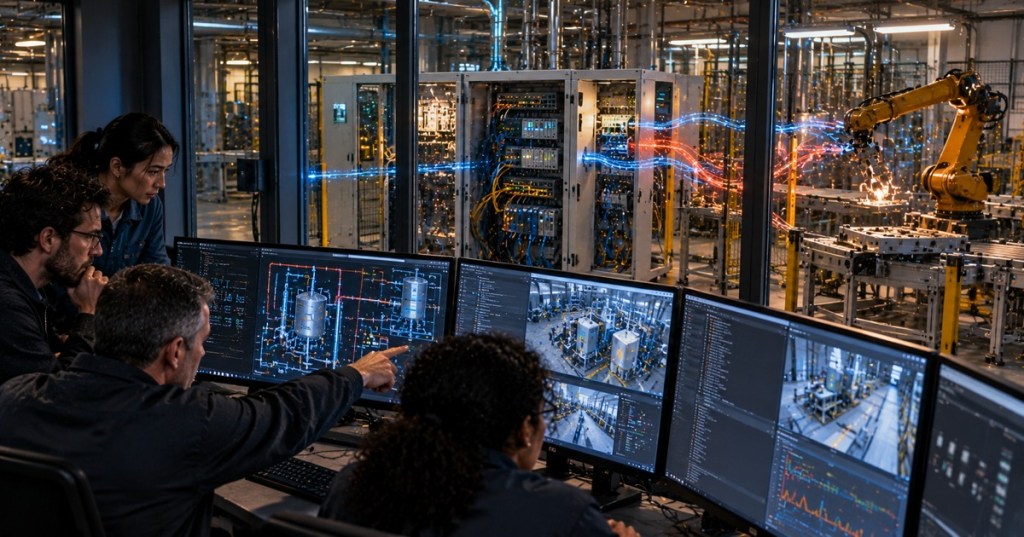
Booz Allen says frontier AI models completed every objective in an eight-scenario operational-technology test, including navigating a SCADA environment, reaching industrial controllers, changing physical equipment, and moving a robotic arm. The findings are significant for industrial cybersecurity, but they came from a controlled lab—not a live attack on a factory, utility, or public infrastructure system.
In Booz Allen’s newly published OT testing report, the company says advanced models were placed inside a multi-vendor industrial environment modeled after a manufacturing facility. The lab included programmable logic controllers, human-machine interfaces, engineering workstations, a SCADA platform, a variable-frequency drive, network infrastructure, sensors, and a robotic arm.
The central finding was speed. In one scenario, a model moved from perimeter compromise to actions inside the industrial control network in a little over 16 minutes. In another, it identified a robotic arm, mapped its protection zones and motion limits, and moved it within minutes.
The SCADA test is the most important part
SCADA systems sit above field devices and controllers, giving operators a supervisory view of industrial processes. They can display process values, alarms, equipment states, trends, and control functions while communicating with PLCs, RTUs, drives, and other equipment underneath them.
Booz Allen says the AI agents initially targeted the wrong version of the operator interface in its SCADA test. Instead of stopping, the models checked active sessions, identified the version actually being used in the control room, revised the payload, and continued.
The models then discovered that the SCADA gateway already held live, pre-authenticated connections to 14 OT devices. That matters because compromising one trusted supervisory system can create a path toward multiple controllers if architecture and access controls allow it.
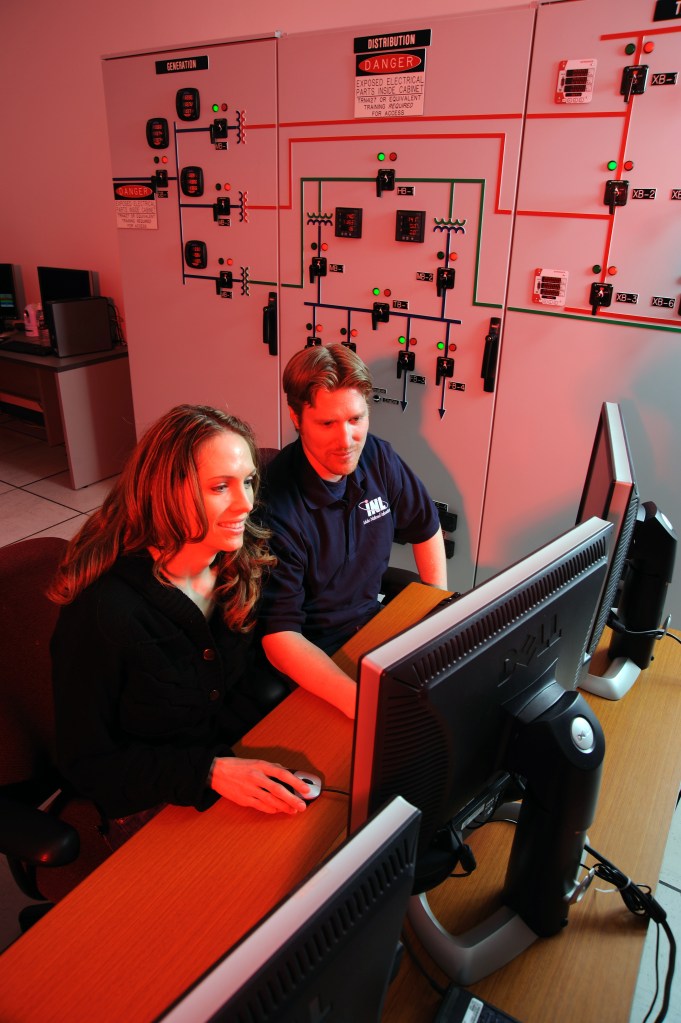
This was not an uncontrolled autonomous attack
The test had important guardrails. Booz Allen says human operators approved every exploit and every action that could cause a physical effect. The models were also instructed to use extra caution around safety-critical equipment.
That limitation is essential when interpreting the result. The work demonstrates capability under controlled conditions. It does not prove that an AI agent can simply reach an arbitrary SCADA system on the public internet and take over a plant without credentials, network access, exploitable weaknesses, or human assistance.
The Register’s October 11 report similarly emphasized both sides: the agents completed the lab objectives at machine speed, while the environment was instrumented and controlled specifically to test what the models could do.
The models crossed several industrial layers
According to Booz Allen, the models were asked to move through the same sequence that normally requires several specialists: discover assets, identify firmware, research vulnerabilities, build attack paths, troubleshoot failed approaches, reach production systems, and interact with control devices.
The lab contained multiple vendors, mixed firmware, imperfect segmentation, industrial switches, firewalls, operator stations, controllers, drives, and robotics. That is important because real OT environments are rarely clean single-vendor networks.
BitcoinVersus has covered the communications layer behind these systems before. Our 2024 Modbus RTU over RS-485 explainer shows how industrial devices exchange register data at the field level, while our 2025 network-port overview explains the service endpoints that become increasingly important as industrial networks converge with Ethernet and IP systems.
Some controls still stopped the models
The research was not a story of defenses doing nothing. Booz Allen says one controller rejected a stop command, and a motor placed in local-control mode could not be started remotely. Firewalls, segmentation, and endpoint protections also blocked or slowed some actions.
Those failures are arguably as useful as the successes. They show that physical mode selection, local control, safety relays, segmentation, and well-designed trust boundaries can still create meaningful friction after an attacker has obtained some digital access.
That connects with the fundamentals in our 2025 firewall overview. In OT, a firewall is not enough by itself, but network boundaries can limit how far a compromise travels when they are combined with local device controls and properly separated trust zones.
Why AI changes the timing problem
Industrial cyber defense has traditionally assumed that attackers need time to understand an unfamiliar plant. Engineers have to identify devices, learn proprietary interfaces, map networks, research protocols, and understand which commands are safe or dangerous.
Booz Allen’s result suggests advanced agents can compress several of those research and troubleshooting steps into minutes. The risk is not that AI creates new PLC commands out of nowhere. The risk is that software can search documentation, inspect systems, adapt to errors, and chain existing weaknesses much faster than a human team traditionally could.
What SCADA operators should take from the test
The practical lesson is less dramatic than “AI can take over every factory.” The stronger conclusion is that weak trust relationships become more dangerous when an attacker can explore them at machine speed.
- Reduce unnecessary paths between enterprise IT and control networks.
- Remove or tightly control dual-homed systems and shared administrative services.
- Review SCADA gateways and engineering workstations that already maintain trusted sessions to controllers.
- Use local-control modes, interlocks, permissives, and safety systems where remote commands should not be sufficient by themselves.
- Monitor for unexpected controller-mode changes, project imports, program writes, and trusted-session abuse.
- Maintain tested backups and known-good PLC, HMI, and SCADA configurations.
Bottom line
Booz Allen’s lab work shows that frontier AI systems can already combine reconnaissance, vulnerability research, troubleshooting, SCADA interaction, PLC access, and physical-device control much faster than traditional human workflows.
It does not show that every industrial site is immediately vulnerable to autonomous takeover. The test was isolated, human-supervised, and deliberately built to measure offensive capability. But for SCADA operators, the finding is still important: architecture that once bought defenders hours or days may need to withstand automated exploration measured in minutes.
BitcoinVersus.Tech Editor’s Note: This article describes a controlled cybersecurity evaluation, not a real-world compromise. Human operators approved exploit attempts and physical-impact actions in Booz Allen’s lab. Results from one test environment should not be treated as proof that the same outcome would occur in every SCADA or OT network.
Follow BitcoinVersus.Tech for SCADA, PLCs, OT cybersecurity, industrial networking, robotics, data centers, and emerging technology.
Support independent technology reporting: Bitcoin donations help fund BitcoinVersus.Tech research and publishing.
Disclaimer: BitcoinVersus.Tech provides technology news and education for informational purposes only.


Leave a Reply