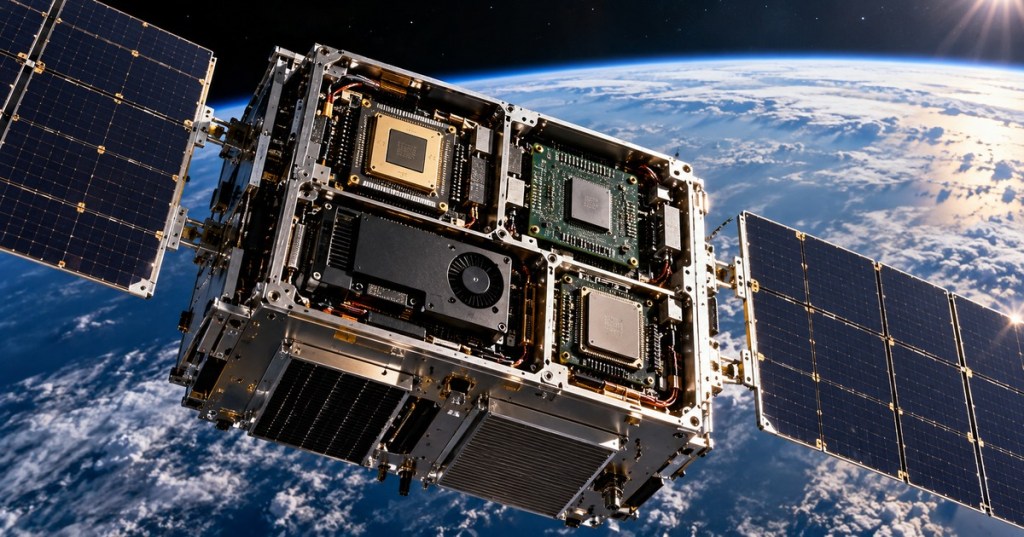
Before asking whether a Bitcoin mining ASIC can work in orbit, it helps to ask a simpler question: what kinds of computer chips have already survived launch and operated in space?
The answer is broader than it might seem. Radiation-hardened CPUs, commercial smartphone processors, FPGAs, AI vision processors, Intel Xeon server CPUs, NVIDIA Tesla GPUs and even an NVIDIA H100 data-center GPU have already flown. What has not yet been independently confirmed is a SHA-256 Bitcoin mining ASIC actually hashing in orbit.
This is a follow-up to BitcoinVersus’ earlier coverage of whether Bitcoin mining could move to space and Starcloud’s plan to fly Bitcoin mining ASICs.
RAD750: The Classic Radiation-Hardened Space CPU
One of the clearest examples is the BAE Systems RAD750, a radiation-hardened version of IBM’s PowerPC 750 architecture. BAE says the first RAD750 flight units launched in 2005 aboard Deep Impact, XSS-11 and Mars Reconnaissance Orbiter. Variants have since powered missions including Curiosity, Juno, WISE, InSight and GPS spacecraft.
The RAD750 is deliberately conservative by terrestrial standards: roughly 200 MHz-class operation and hundreds of MIPS rather than modern server-level throughput. Its advantage is reliability. It was designed to tolerate radiation that can flip bits, corrupt memory or permanently damage ordinary silicon.
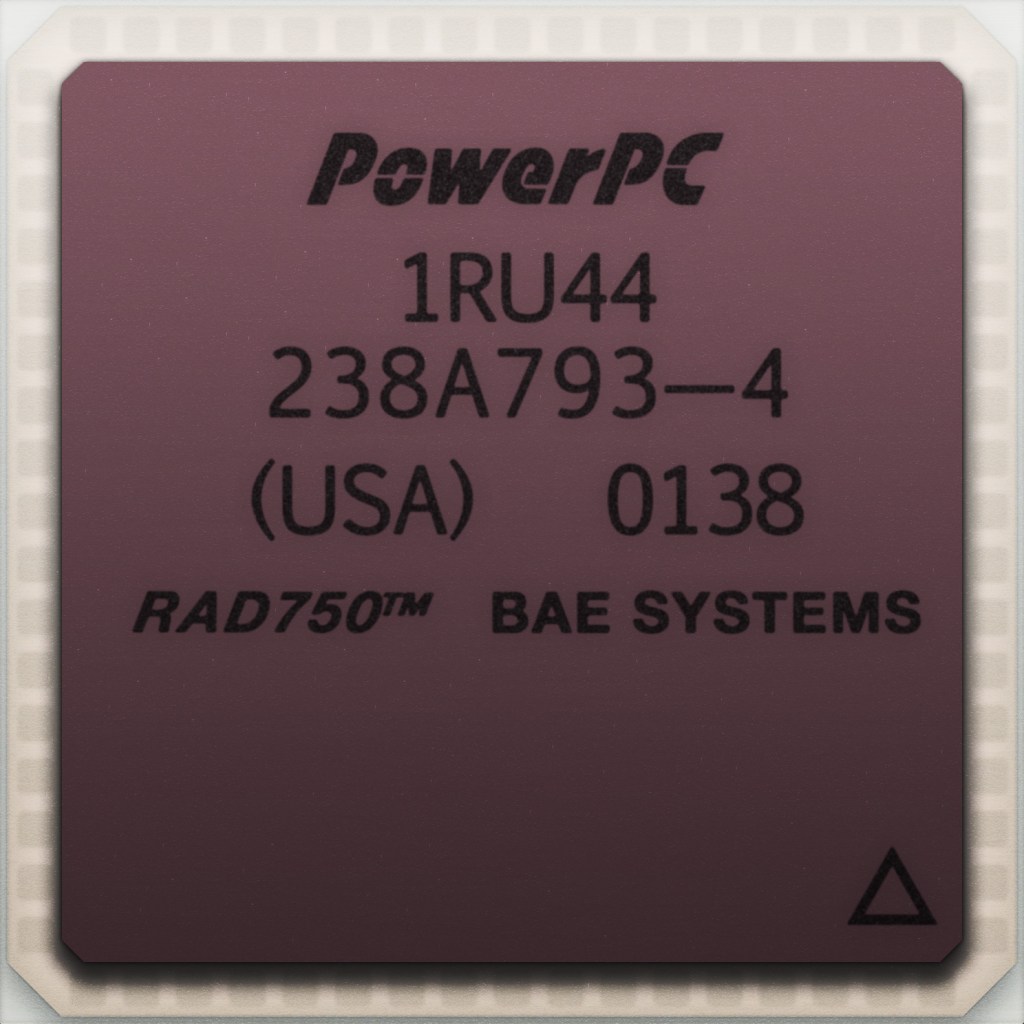
For Bitcoin mining, the lesson is not that a RAD750 could mine competitively. It could not. The lesson is that radiation tolerance, error correction and mission reliability matter as much as raw compute once hardware leaves Earth.
Xilinx Virtex FPGAs Have Flown for Years
NASA’s SpaceCube program pushed much more parallel processing into orbit using Xilinx FPGAs. SpaceCube 1.0 flew on the 2009 Hubble servicing mission using Virtex-4 devices. SpaceCube 2.0 later used Virtex-5 FPGAs and operated on the International Space Station.
NASA describes SpaceCube as a hybrid CPU/FPGA/DSP platform designed to deliver roughly 10× to 100× more onboard processing than traditional radiation-hardened processors. That makes FPGAs especially relevant to Bitcoin’s history because Bitcoin mining itself passed through an FPGA era before dedicated SHA-256 ASICs took over.
Microchip’s RTG4 is another radiation-tolerant FPGA with flight heritage. Microchip lists Mission Extension Vehicle 1 and 2 and CAS-500 among missions that have carried RTG4 devices.
A Smartphone Chip Flew on Mars
NASA’s Ingenuity Mars helicopter used a commercial Qualcomm Snapdragon 801 system-on-chip for high-level computing and visual navigation. JPL’s own technical work says the Snapdragon 801 combines ARM CPU cores with GPU, DSP, neural-processing and image-processing subsystems.
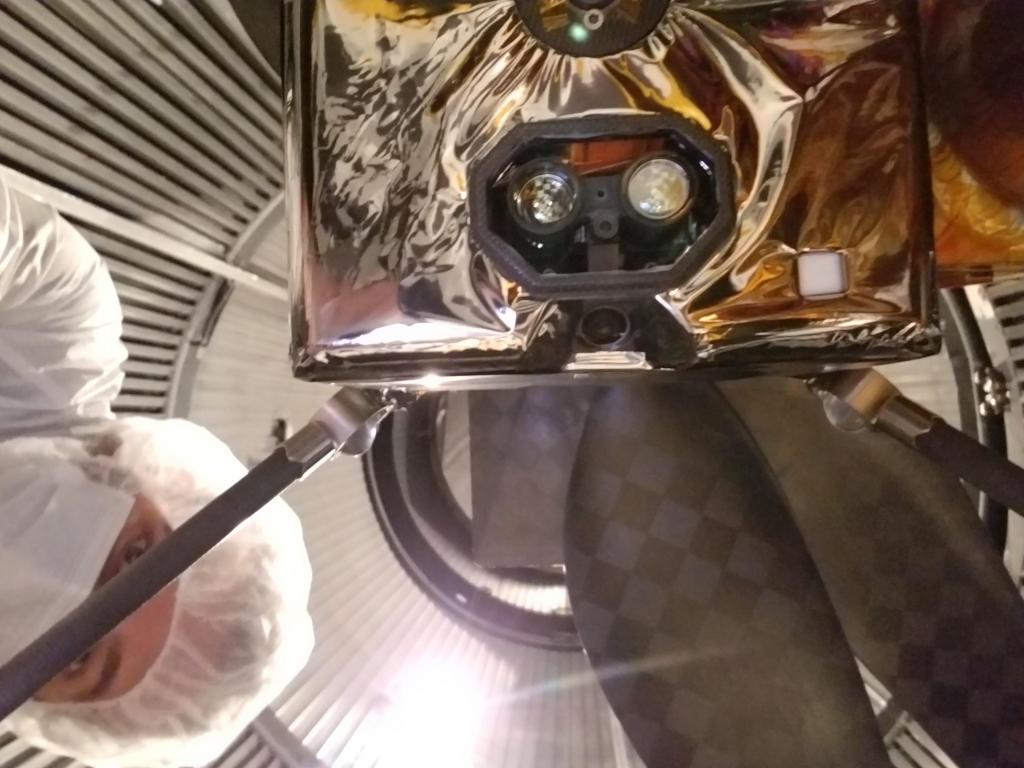
Qualcomm’s official Snapdragon video explains how its commercial computing platform was used aboard NASA’s Ingenuity Mars helicopter.
That is important because Ingenuity was not built around only traditional aerospace silicon. It demonstrated that carefully engineered commercial hardware can perform demanding autonomous computation far from Earth.
Intel Movidius AI Chips Have Flown Too
The European Space Agency’s Φ-sat-1 mission launched in 2020 with an AI processor built around Intel’s Movidius Myriad 2 integrated circuit. The chip processed Earth-observation imagery onboard, including filtering cloud-covered images before data had to be sent to the ground.
NASA later tested newer Intel Myriad X processors on the International Space Station alongside Qualcomm Snapdragon 855 development hardware. These are commercial AI-oriented chips rather than classic rad-hard spacecraft CPUs.
Intel Xeon CPUs and NVIDIA Tesla GPUs Reached the ISS
Hewlett Packard Enterprise’s Spaceborne Computer-2 pushed ordinary data-center hardware much further. JPL documentation describes the ISS system as commercial off-the-shelf Linux hardware using Intel Xeon Gold 5215 processors and four NVIDIA Tesla T4 GPUs per configuration.
The point of Spaceborne Computer-2 was not to make every chip physically radiation-hardened. NASA and HPE instead tested software-based fault detection, mitigation and recovery while operating commercial high-performance hardware in orbit.
HPE explains how Spaceborne Computer-2 brought commercial high-performance and AI computing onto the International Space Station.
NVIDIA H100: A Data-Center GPU Is Already in Orbit
The closest precedent to the power density of modern mining hardware may be Starcloud-1. Starcloud says its first satellite launched in November 2025 carrying an NVIDIA H100 GPU—the first H100 in orbit—and later ran and trained AI models onboard.
NVIDIA had described the mission as the first flight of a state-of-the-art data-center-class GPU in space. An H100 SXM can be configured up to roughly 700 watts, far above the tiny embedded processors historically associated with satellites.
Y Combinator’s Starcloud feature shows the company’s first orbital data-center demonstrator and the H100 mission that preceded its planned Bitcoin-mining experiment.
BitcoinVersus has also followed Starcloud beyond Earth orbit: Firefly and Starcloud plan an AI-compute experiment around the Moon.
NVIDIA Orin NX Has Now Joined the List
Another recent example is India’s MOI-1A orbital-computing satellite. Reuters reported that the spacecraft carries NVIDIA Orin NX edge-computing processors. SpaceX confirms the Transporter-18 rideshare mission launched successfully to low-Earth orbit on October 1, 2026.
That confirms the launch vehicle and mission reached orbit; commissioning and long-term operation of each individual hosted payload should still be treated separately from launch success.
What About ASICs?
Application-specific integrated circuits are not new to spacecraft. Space systems have long used custom ASICs for communications, signal processing, control and payload functions. What would be new is sending a modern SHA-256 Bitcoin mining ASIC whose main job is continuous hashing for the Bitcoin network.
As of October 11, 2026, BitcoinVersus has not found independently verified evidence of a Bitcoin mining ASIC already producing valid mining work from orbit. Starcloud has said it intends to include Bitcoin mining ASICs on Starcloud-2, but its current public mission page places the spacecraft’s full operation in sun-synchronous orbit in 2027 and does not disclose the miner model, chip generation, hashrate or power budget.
NASA’s continuing radiation-monitoring work is a reminder of the environment orbital electronics must survive. High-energy particles are a hardware problem, not just a human-spaceflight problem.
Why a Bitcoin ASIC Is Harder Than It Sounds
A modern Bitcoin miner concentrates several kilowatts into a small chassis and is designed around continuous heat removal. In a vacuum there is no ordinary convective air cooling. Heat has to move through conduction into spacecraft structures and then leave through radiators as infrared radiation.
Radiation creates another problem. A mining ASIC does not need the general-purpose flexibility of a CPU, but it still depends on control logic, memory, networking, voltage regulation and firmware. Single-event upsets or latch-up in any of those support systems could stop hashing even if the SHA-256 cores themselves survive.
Launch vibration, thermal cycling, solar-array sizing, radiator mass, communications availability and the impossibility of sending a technician to swap a failed hashboard all change the economics.
The Chip History Makes Space Mining More Plausible—Not Proven
The hardware record is more encouraging than the phrase “Bitcoin mining in space” initially sounds. Spacecraft have already carried very old rad-hard CPUs, modern commercial smartphone SoCs, reconfigurable FPGAs, AI accelerators, server CPUs, GPU accelerators and an H100.
That means the question is no longer whether advanced silicon can physically operate away from Earth. It can. The harder question is whether a multi-kilowatt Bitcoin ASIC can be powered, cooled, protected from radiation and kept connected cheaply enough to justify launching it.
Chips With Confirmed Spaceflight Heritage
- BAE RAD750: radiation-hardened PowerPC CPU; first flights in 2005; used across Mars, planetary, telescope and navigation missions.
- Xilinx Virtex-4 / Virtex-5: FPGA families flown through NASA SpaceCube systems, including Shuttle and ISS experiments.
- Microchip RTG4: radiation-tolerant FPGA with flight heritage on MEV-1, MEV-2 and CAS-500.
- Qualcomm Snapdragon 801: commercial smartphone-class SoC used by NASA’s Ingenuity Mars helicopter.
- Intel Movidius Myriad 2: AI vision processor flown on ESA’s Φ-sat-1.
- Intel Xeon Gold 5215 + NVIDIA Tesla T4: commercial server CPU/GPU hardware used in HPE Spaceborne Computer-2 aboard the ISS.
- Qualcomm Snapdragon 855 + Intel Myriad X: commercial processors tested aboard the ISS.
- NVIDIA H100: data-center-class GPU launched aboard Starcloud-1 in November 2025.
- NVIDIA Orin NX: reported aboard MOI-1A on SpaceX Transporter-18, launched October 1, 2026.
- Bitcoin SHA-256 mining ASIC: planned by Starcloud, but not yet independently confirmed hashing in orbit.
The progression is clear: space computing has moved from slow, heavily radiation-hardened processors toward a mix of specialized aerospace silicon and increasingly powerful commercial hardware. A Bitcoin ASIC would be another step along that curve—but one with unusually high continuous power and thermal demands.
BitcoinVersus.Tech
Editor’s Note: “Launched,” “operated,” and “commissioned” are different milestones. This article distinguishes chips with documented flight heritage from planned hardware. No orbital Bitcoin hashrate is treated as confirmed without evidence of a launched miner successfully producing mining work.
We volunteer daily to improve the credibility of the information on this platform. If you would like to support the research, please donate here: 3C9o19EH5HSiwEPyCTmEKzxhNCbo2X6TTb
BitcoinVersus.tech is not a financial advisor. This media platform reports on technical and financial subjects purely for informational purposes.


Leave a Reply