
NASA asked commercial space companies on October 29, 2026, how they might lift the aging Hubble Space Telescope to a safer orbit, repair it, or guide its eventual disposal. The agency’s October 30 announcement describes a request for information, not a funded mission or contract award. Companies have until November 30 at 3 p.m. Eastern to respond.
The NASA Goddard notice, 80GSFC27RFIHSTS, asks about capturing Hubble and boosting it to at least 600 kilometers, servicing aging equipment, or performing a controlled reentry. Any boost or repair would need to avoid damaging the telescope. NASA anticipates that a possible mission would need to occur by 2032; it has not chosen a provider, spacecraft or price.
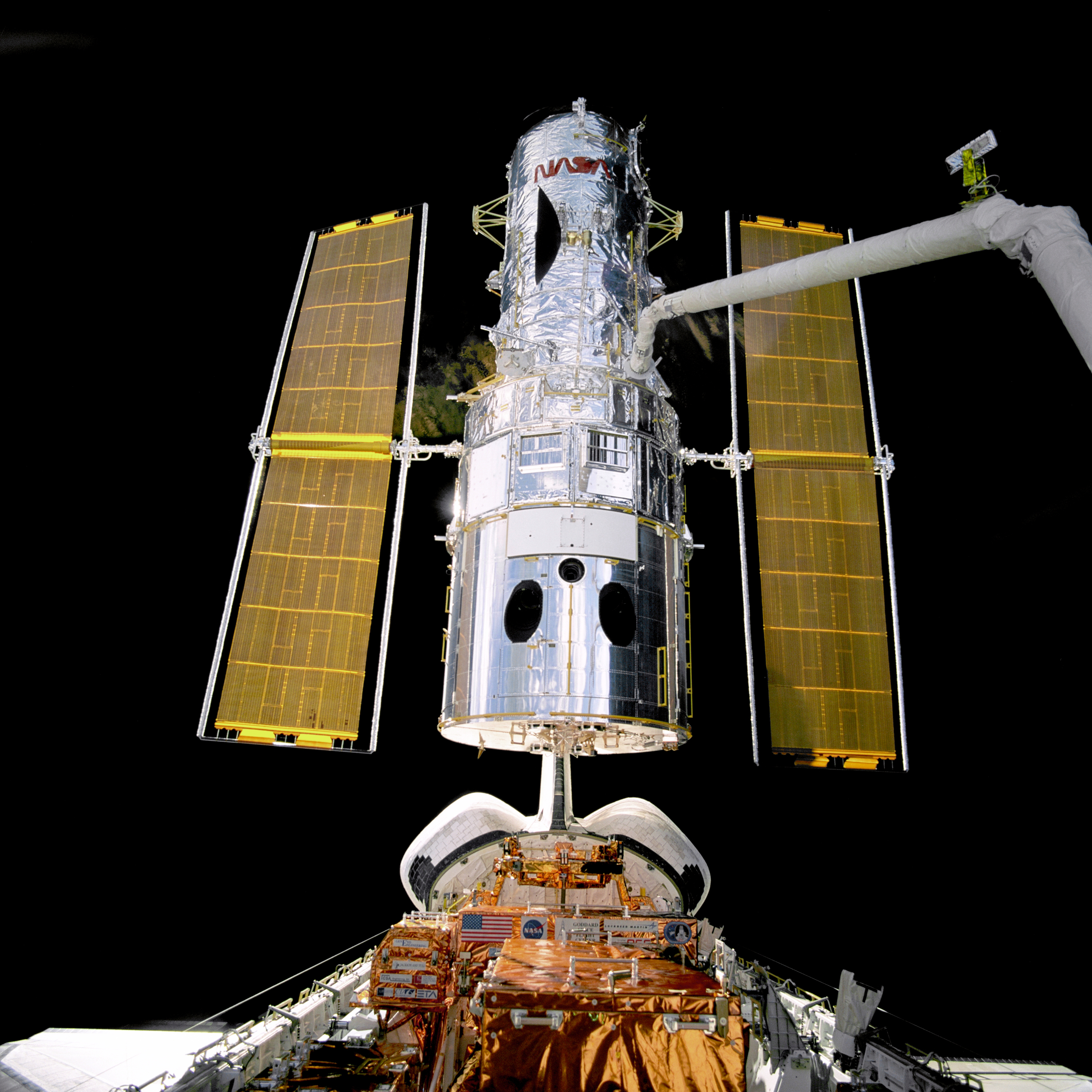
What NASA is asking industry to do
Hubble has no onboard propulsion to maintain its altitude. Thin atmospheric drag slowly lowers its orbit, unlike a navigation satellite executing planned burns such as India’s NVS-03. NASA’s current analysis places likely natural reentry in 2033–2034 without intervention. Higher altitude could buy scientific time but would introduce rendezvous, capture and orbital-debris risks.
NASA Goddard — “Hubble’s Servicing Mission 4 Celebrates Its 15th Anniversary” (2024). Official historical footage about the last shuttle servicing mission in 2009, not a video of NASA’s 2026 request.
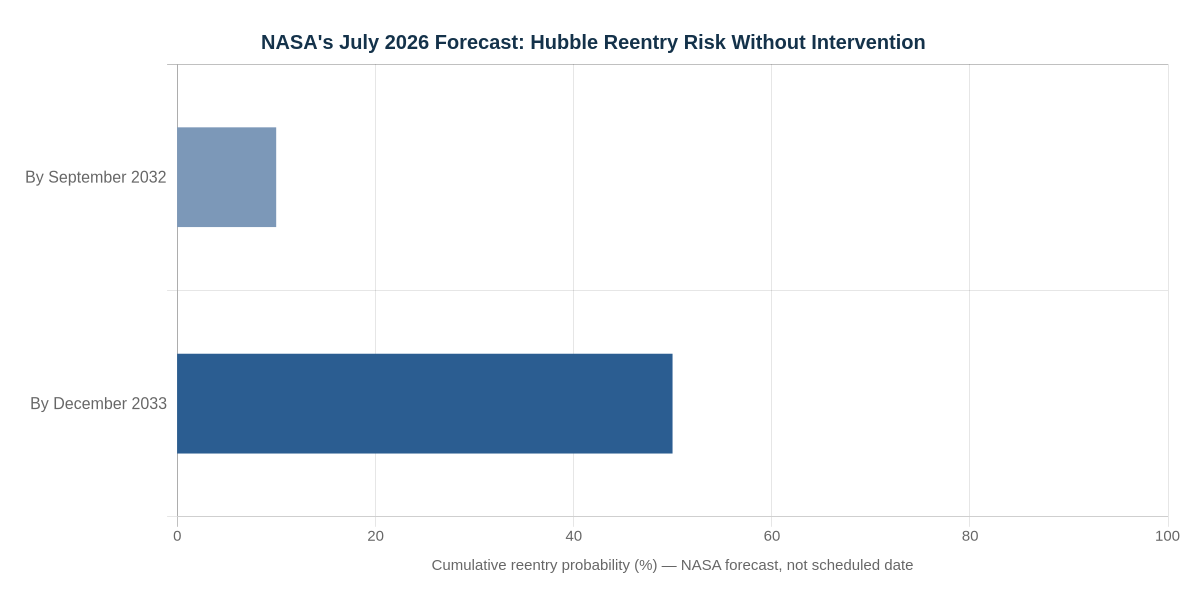
The agency’s July 2026 lifetime assessment estimated a 10% cumulative probability of reentry by September 2032 and 50% by December 2033. These probabilities are forecasts—not scheduled impact dates, nor a promise that Hubble will operate until then. Atmospheric density changes with solar activity, so the timeline remains uncertain. A boost could alter those probabilities, but no approved mission exists.
Historic repairs—and today’s engineering limits
Hubble was launched in 1990 and upgraded during five shuttle servicing missions, last in 2009. Astronaut Story Musgrave helped repair its optics in 1993, after the telescope’s flawed primary mirror blurred early imagery. The original deployment era also included astronaut Kathryn Sullivan. Future servicing would use very different hardware now that the shuttle fleet is retired.
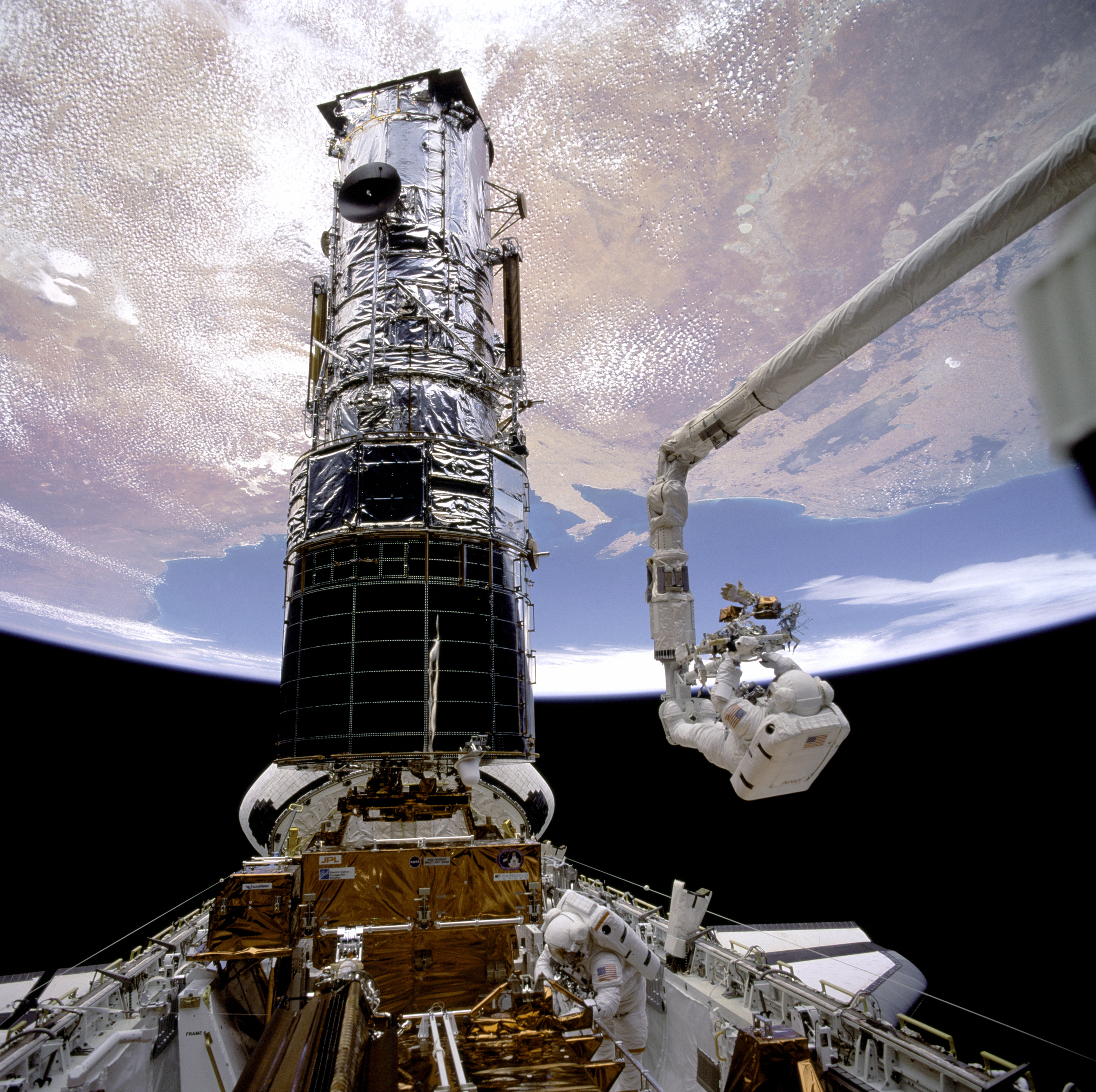
A commercial vehicle would need precise navigation, safe grapple points, reliable attitude control and careful operations around an irreplaceable observatory. That engineering challenge resembles broader questions about long-lived space electronics. NASA previously explored commercial Hubble-reboost possibilities in 2022, but those discussions did not produce an approved rescue mission.
NASA Goddard — “Hubble’s Servicing Mission 1” (2020). The agency explains its 1993 orbital optics correction and astronaut repairs. Video relates to the historical engineering context, not an approved 2026 servicing flight.
NASA and ESA continue using Hubble for astronomy, complementing newer telescopes operating at different wavelengths. The next milestone is industry feedback, which may help NASA decide whether to issue an actual solicitation. As with commercial space-station procurement, requesting information is not the same as buying a flight. Until a mission is selected, Hubble’s scientific future still depends on its aging systems and decaying orbit.
Editor’s Note: We volunteer daily to ensure the credibility of the information on this platform is Verifiably True. If you would like to support our work and help further secure the integrity of our research initiatives, please scan the QR code below to donate 5,000 sats.

For mobile scanning, open this report on a laptop or larger screen and scan the original QR code with your Bitcoin wallet. Confirm the receiving address 3C9o19EH5HSiwEPyCTmEKzxhNCbo2X6TTb before sending 5,000 sats.
BitcoinVersus.tech is not a financial advisor. This media platform reports on financial subjects purely for informational purposes.


Leave a Reply