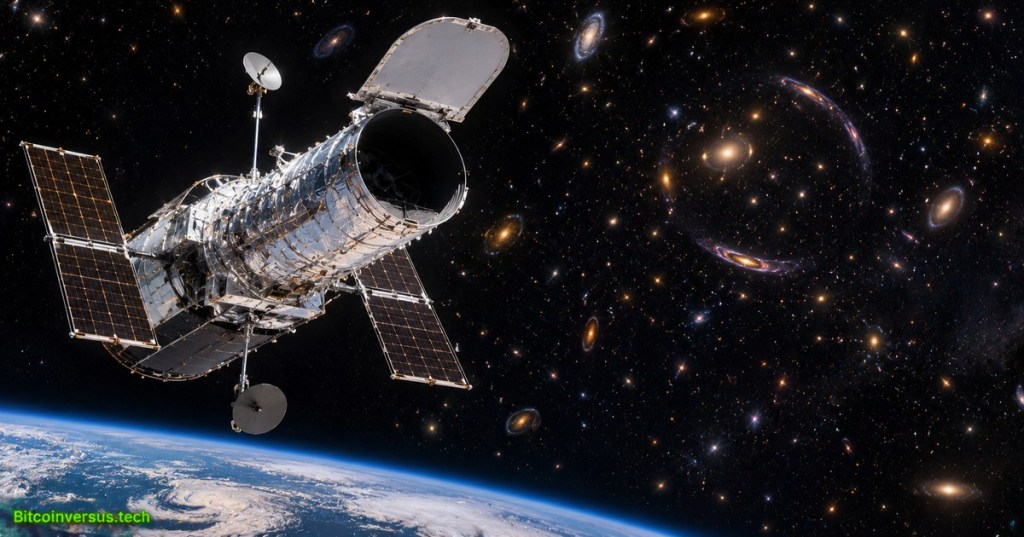
NASA released a nine-image Hubble Space Telescope gallery on November 12, 2026, showing distant galaxies warped into arcs, rings and repeated images by the gravity of foreground galaxies. The observations are groundwork for the newly launched Nancy Grace Roman Space Telescope, whose wider infrared survey could reveal many more gravitational lenses. Astronomers hope the combined measurements will constrain the distribution of dark matter—including hypothetical clumps far smaller than a galaxy—but the new gallery is not a detection of those clumps.
Why gravity produces rings instead of ordinary images
Einstein’s general relativity predicts that mass curves spacetime, bending the paths of light rays. When a massive foreground galaxy lines up closely with a more distant galaxy, an observer can see distorted light along multiple paths. Depending on the alignment and mass distribution, the background source appears as a long arc, paired arcs, a nearly complete Einstein ring or several copies of the same galaxy.
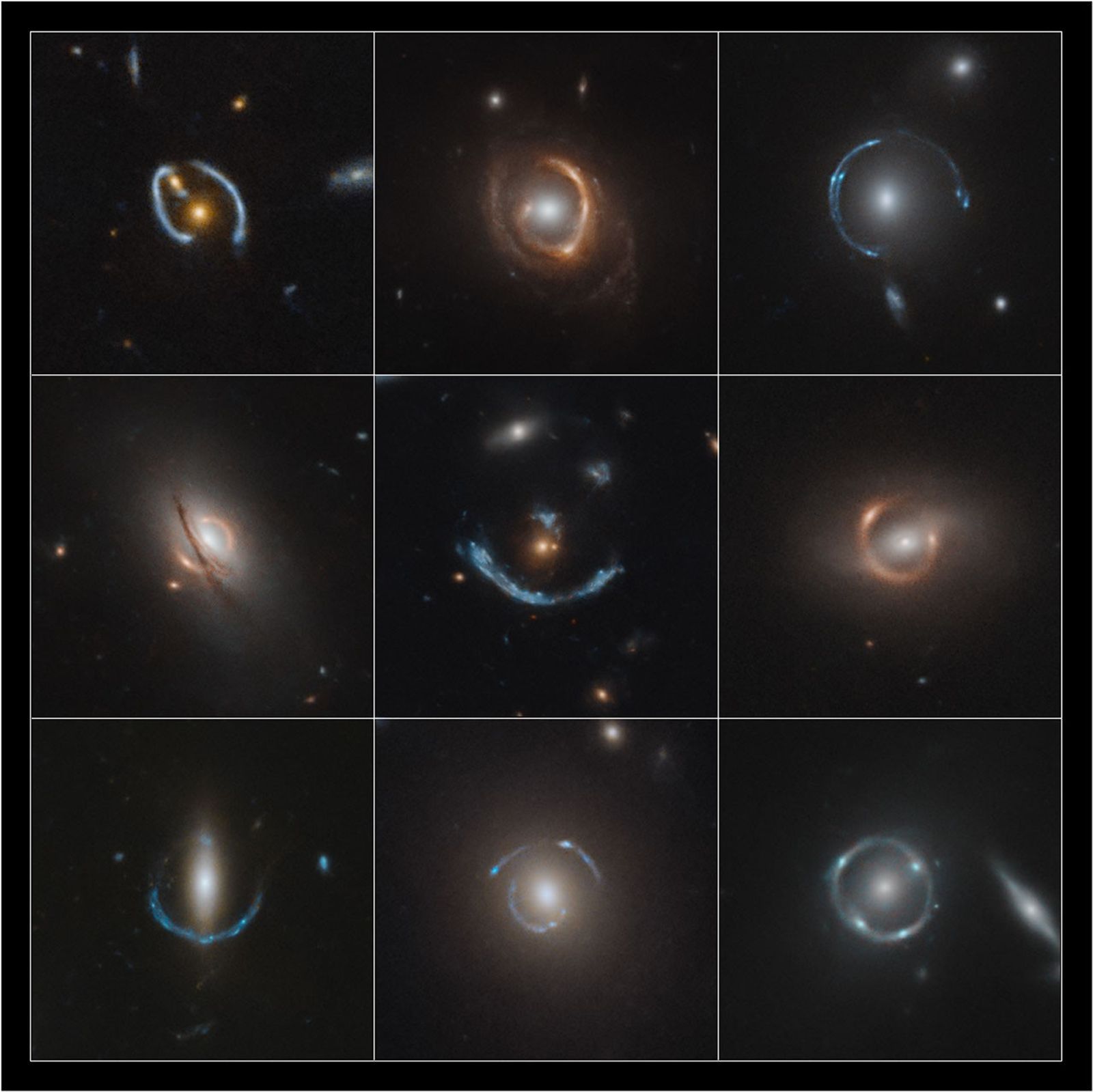
The nine examples were initially identified using the Dark Energy Spectroscopic Instrument at Kitt Peak, NASA says. Hubble then supplied detailed images for modeling. The selection includes an almost complete ring in panel F, four apparent images of one source in panels C and I, and a dust-lane foreground galaxy in panel D. Those visible differences make the sample useful for testing how analysis software handles diverse lenses.
Roman’s larger sky survey meets Hubble’s precision
Hubble specializes in sharp images of individual targets at visible, ultraviolet and selected infrared wavelengths. Roman observes mainly infrared light over a much larger field, allowing it to search broad regions of the sky for subtle structures. Roman launched in August 2026; planned follow-up science should not be confused with observations already completed. BitcoinVersus.Tech previously reported on Roman telescope instrument alignment as its instruments entered commissioning.
Roman could spot new candidates in panoramic images, while Hubble can study promising objects at higher apparent detail. Such complementary measurements matter because lens reconstruction depends on foreground mass, source geometry, dust and observational uncertainties. A nearby visible arc is not itself a direct photograph of invisible dark matter.
Testing small dark-matter structures
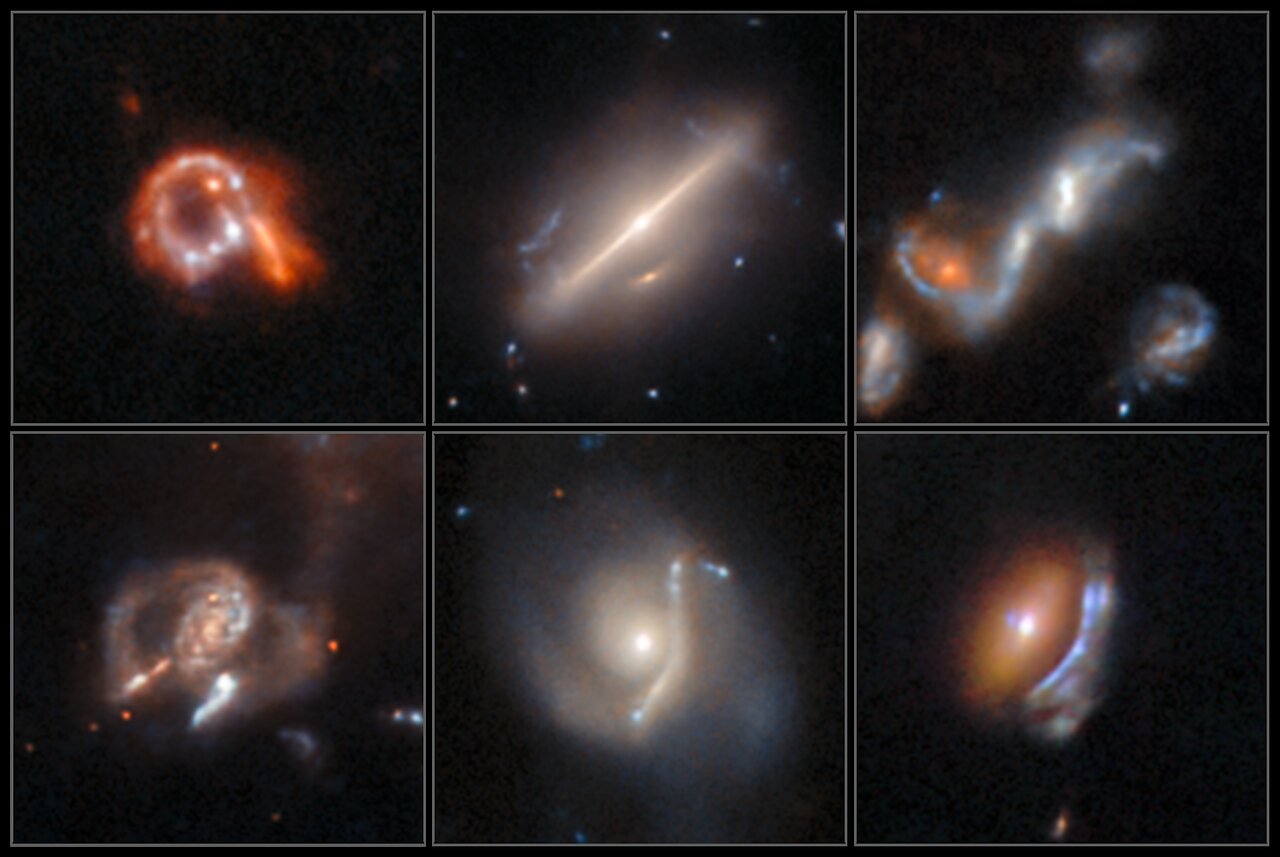
Models of cold dark matter predict numerous clumps with masses around one million to one billion times the Sun. NASA says tiny imperfections in otherwise smooth lensed arcs may provide evidence for such structures. The approach requires precise image modeling and careful exclusion of ordinary features in lensing galaxies. An apparent anomaly alone would not establish a new particle, prove a cosmological model or rule out competing explanations.
The research team also intends to use Hubble images to develop a machine-learning search tool for Roman imagery. Algorithmic candidate selection still requires astronomical confirmation, uncertainty analysis and independent review. Related observations will complement other instruments: BitcoinVersus.Tech has covered Webb exoplanet data analysis, Chandra’s X-ray binary investigation and the engineering questions surrounding Hubble’s possible orbital reboost.
What matters next is the number of robust new lenses Roman actually finds, their spectroscopic follow-up and the quality of mass-reconstruction results. The Hubble gallery supplies authentic training and calibration examples; dark-matter constraints remain a prospective scientific outcome, not an announced breakthrough measurement.
Primary sources
NASA — November 12, 2026 Hubble lens gallery; NASA — October 22 Hubble lens observations; NASA Roman mission documentation; ESA/Hubble official gravitational-lens gallery.
BitcoinVersus.Tech Editor’s Note: We volunteer daily to ensure the credibility of the information on this platform is Verifiably True. If you would like to support to help further secure the integrity of our research initiatives, please donate using the QR code provided.

For easier QR scanning, open the article on a desktop or larger screen and scan with a compatible phone wallet. On mobile, save the QR image and use the wallet’s scan-from-image feature where available. Verify payment details before sending; Bitcoin transactions generally cannot be reversed.
BitcoinVersus.Tech is a volunteer-run independent publication. Reporting is educational and informational, not investment, financial or purchasing advice.


Leave a Reply